
A dehumidifier measures how much moisture it removes from the air in 24 hours, which is its moisture removal capacity rated in pints or litres per day. It extracts between 10 to 70 pints of moisture depending on room conditions. Dehumidifier sizing depends on room square footage and humidity level, using charts for capacity guidance.
Dehumidifiers for room size vary, 20 to 30 pints suit small rooms, 30 to 50 pints work for medium rooms and 50 to 70 pints fit large rooms. You should adjust the dehumidifier size based on square footage to meet whole house needs, which range from 70 to 225 pints. Dehumidifier size depends on factors like square footage, humidity, ceiling height, air volume, climate and occupancy. It runs poorly if the wrong size is used, which causes constant cycling or uneven moisture and needs resizing or adjustments, such as improving sealing or placement.
Dehumidifier capacity for a basement ranges from 30 to 40 pints if slightly damp and 50 to 70 pints for high humidity. It requires higher capacity in humid climates or poor ventilation. A crawl space of 1,000 to 1,500 square feet needs 50 to 70 pints or 70 to 90 pints if heavily damp. It benefits from a larger unit to prevent mold and maintain dryness. A bathroom needs 20 to 30 pints, with larger sizes for poor ventilation or very high moisture. It stays comfortable and dry when the right capacity is used.
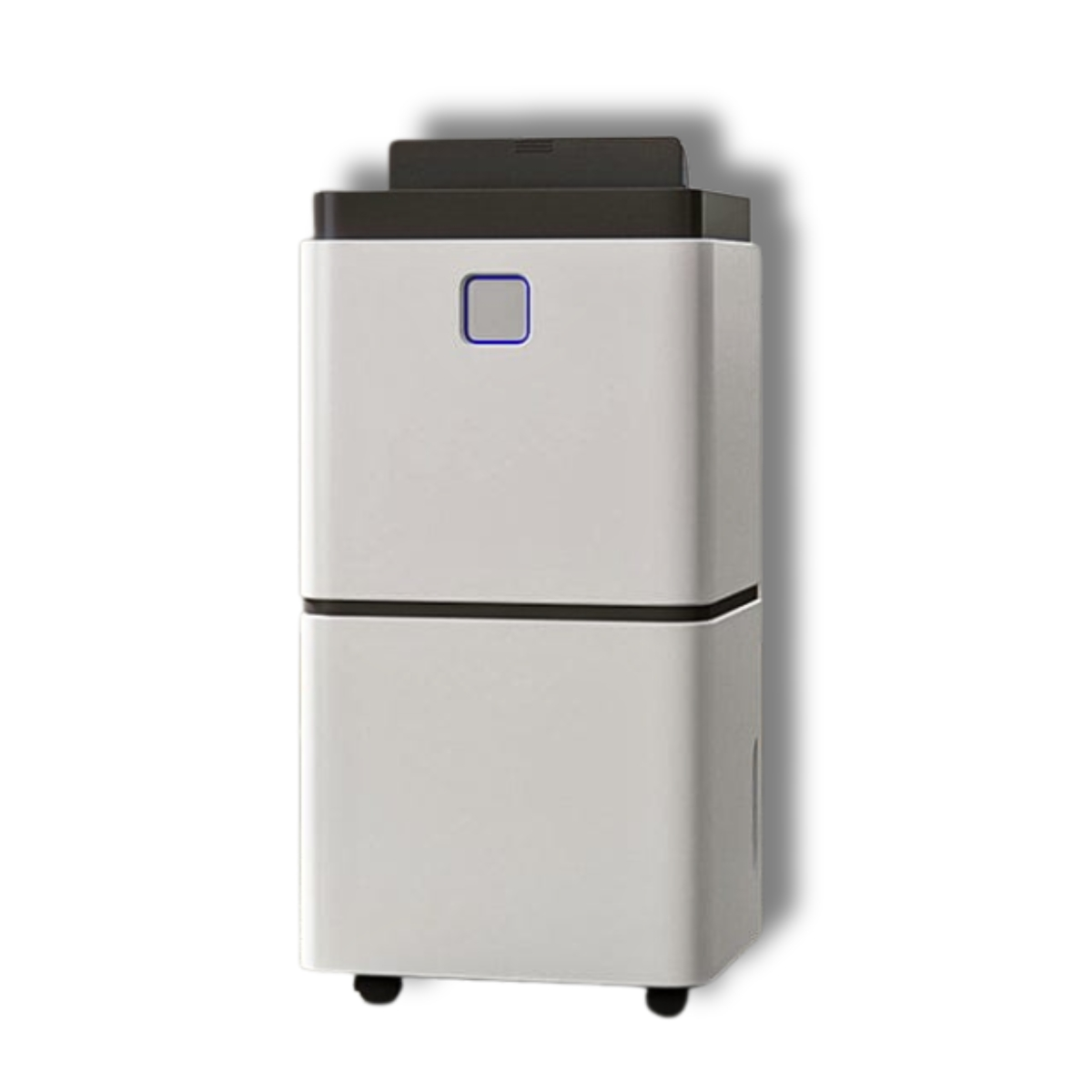
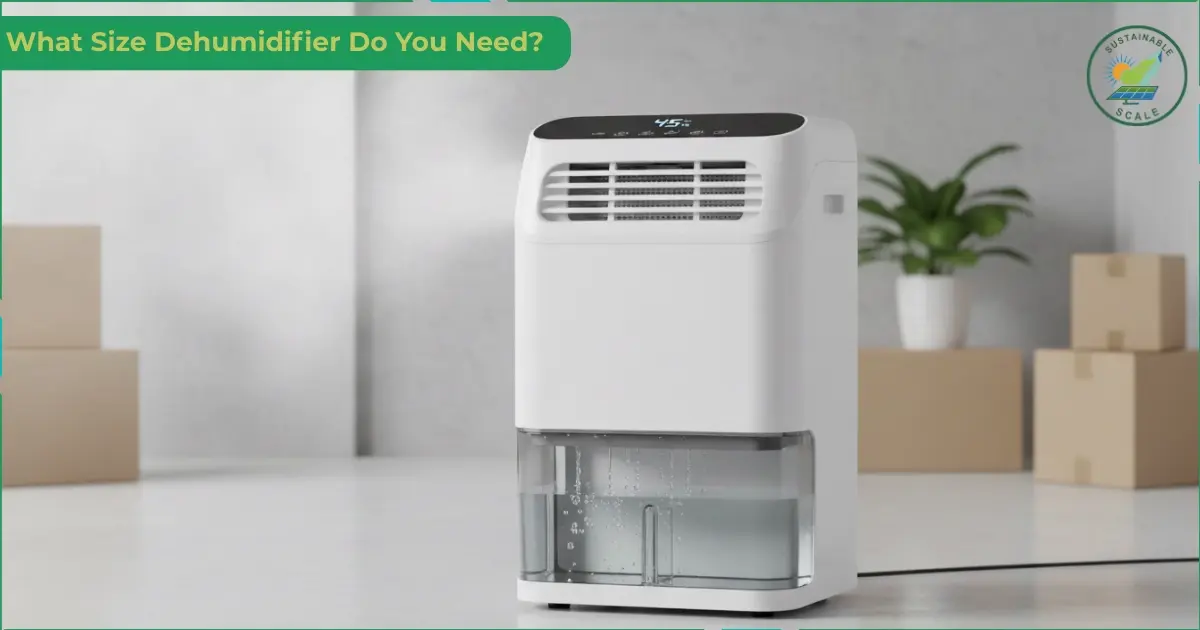
The size of a dehumidifier means the moisture removal capacity or physical dimensions of the dehumidifier used in a 24 hour period. It shows how much moisture the dehumidifier extracts, from 10 to 50 pints or 4.7 to 23.7 litres per day. A dehumidifier has a physical size, which affects how much space it takes and where it is placed. It includes a built-in tank and the tank size controls how long it runs before needing a manual empty. Dehumidifier capacity and tank size together decide how well the unit fits different room sizes and moisture levels.
The chart below specifies the recommended dehumidifier capacity in pints per day based on different room sizes and humidity conditions.
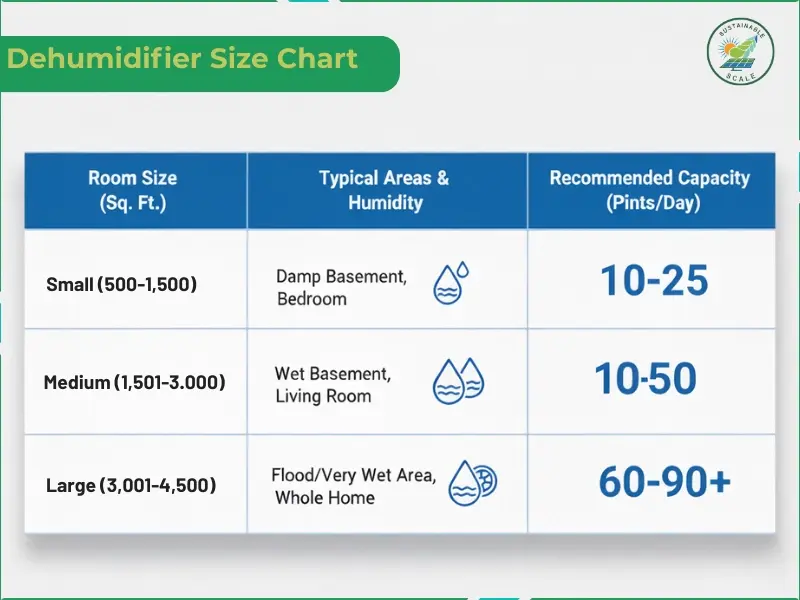
The pint capacity of a dehumidifier is the amount of moisture it removes from indoor air in 24 hours. It indicates how many pints of water the dehumidifier extracts under standardized test conditions defined by the US Department of Energy (DOE).
The U.S. Department of Energy (DOE) defines these test conditions as 65 degrees Fahrenheit temperature and 60% relative humidity. Residential dehumidifier capacity ranges from 20 to 70 pints per day, according to DOE data. These standards provide accurate moisture removal ratings, verify energy efficiency and help buyers select the correct dehumidifier capacity for their room size, humidity level and moisture removal needs.
To size a dehumidifier, measure the room’s length and width to get the square footage and check the humidity level. It requires checking the humidity level using a hygrometer to understand how much moisture the unit must remove. Dehumidifier capacity is selected using a sizing chart that matches room size and humidity with pints per day.
5 steps to size a dehumidifier are outlined below.
The sizing chart to choose the capacity is given in the table below.
Room size | Slightly damp | Moderately damp | Very damp | Wet |
Up to 500 square feet | 20 pint | 20 pint | 25 pint | 30 pint |
500 to 1,000 square feet | 30 pint | 30 pint | 35 pint | 40 pint |
1,000 to 1,500 square feet | 40 pint | 40 pint | 45 pint | 50 pint |
Over 1,500 square feet | 50 pint | 50 pint | 60 pint | 70 pint |
4. Adjust based on special conditions: Increase capacity if the room has extra moisture sources like laundry, a basement or poor ventilation.
5. Check tank size and placement: Choose a dehumidifier with a tank size that matches usage frequency preferences and verify the physical size fits the room space for easy placement and convenient water removal.
The infographic below outlines a three-step process for choosing the right dehumidifier size by measuring room square footage, assessing moisture levels, and matching them to the recommended pint-per-day capacity.
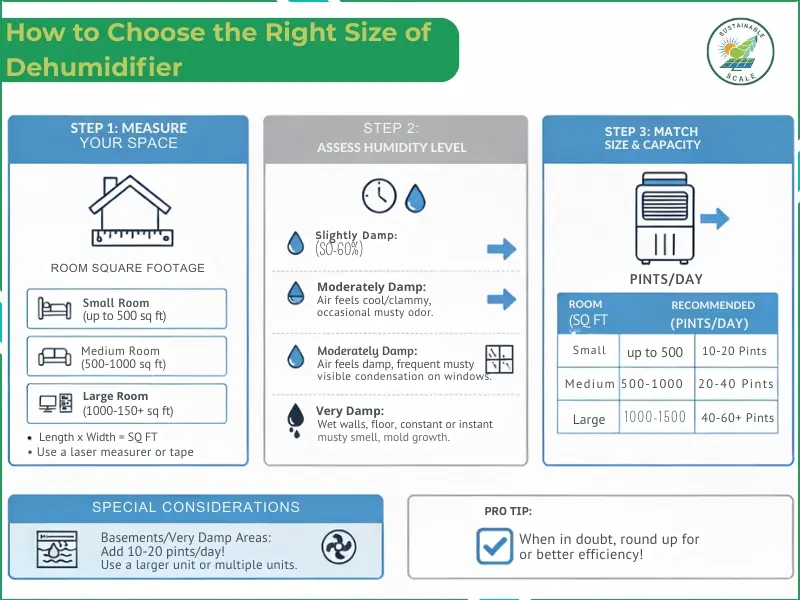
The best size dehumidifier for a small room up to 300 square feet ranges from 20 to 30 pints of capacity. It removes 30% more moisture in high humidity and handles light dampness with less energy use. Dehumidifier size depends on room humidity, temperature, air circulation and overall moisture level. It performs better when slightly larger than needed, which reduces cycles and increases efficiency over time.
The best size dehumidifier for a medium room of 400 to 800 square feet ranges from 30 to 50 pints per day. A dehumidifier with 30 pint capacity works for moderate humidity and removes daily moisture within 24 hours. A dehumidifier of 40 to 50 pint capacity works better at higher humidity levels to provide faster drying and steady moisture control. Dehumidifier selection changes when a medium sized room contains multiple windows or doors, a washer and dryer, or several people. These conditions raise moisture levels and require a stronger dehumidifier to maintain comfort and dryness.
The best size dehumidifier for a large room over 1,000 to 1,200 square feet ranges from 50 to 70 pints per day. A dehumidifier of 50 pints removes moisture within 24 hours at moderate humidity. A dehumidifier with 60 to 70 pint capacity works better at higher humidity levels to provide faster drying and steady moisture control. It adjusts to exact square footage, humidity level, humid climates and multiple windows that influence the required size.
The best size dehumidifier for the whole house ranges from 70 to 80 pints for smaller spaces and 155 to 225 pints for larger areas. It depends on the home’s total square footage and how well it is sealed. Homes with loosely sealed windows require a higher capacity dehumidifier than those with moderately or tightly sealed ones. Proper dehumidifier sizing helps in moisture control and consistent comfort throughout the home.
The best size dehumidifiers for the whole house by square footage are given in the table below.
Building condition | 70 to 80 pints | 75 to 100 pints | 100 to 155 pints | 155 to 225 pints |
Loosely sealed | Up to 1,800 square feet | Up to 2,200 square feet | Up to 3,600 square feet | Up to 4,000 square feet |
Moderately sealed | Up to 2,200 square feet | Up to 2,600 square feet | Up to 3,200 square feet | Up to 4,000 square feet |
Tightly sealed | Up to 2,600 square feet | Up to 3,000 square feet | Up to 4,400 square feet | Up to 5,000 square feet |
This table reflects whole house needs based on home size and sealing quality. Larger or less sealed homes require higher capacity units for efficient moisture control.
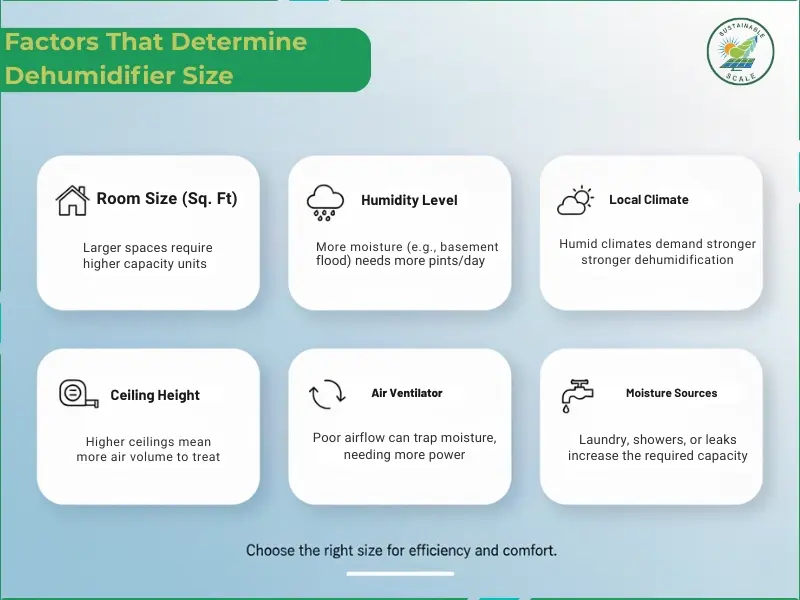
Factors that influence dehumidifier size are square footage, humidity level and ceiling height. Climate conditions, occupancy levels and airflow patterns determine the right pint capacity for moisture removal in a 24 hour period.
The factors that influence dehumidifier size are given below.
The infographic below details six key factors that determine the appropriate size for a dehumidifier, including room square footage, humidity levels, and moisture sources.
If your dehumidifier is the wrong size, you need to check your purchase agreement to verify if the unit matches the room requirements. Dehumidifier undersizing reduces moisture removal and leaves the humidity high and you should return or exchange an undersized unit for a larger model. Dehumidifier oversizing causes frequent cycling and wastes energy, but you solve this by returning or exchanging it for a smaller unit. You should always measure the room size and humidity levels before choosing to avoid wrong sizing issues.
It is better to oversize a dehumidifier because an undersized unit runs constantly without lowering humidity, which leaves the space damp and uncomfortable. An oversized unit removes moisture faster, reduces run time and maintains a more consistent humidity level, which improves comfort and prevents mold growth.
Yes, you can oversize your dehumidifier, but it has pros and cons. An oversized dehumidifier removes moisture faster and shortens running time, which saves energy if it has a humidistat to control humidity levels. A dehumidifier without a humidistat cycle on and off wastes energy and causes excess dryness.
4 signs to tell if your dehumidifier is too small are given below.
If you use a small humidifier in a large room, it takes a long time to reduce humidity and runs for extended periods. This uses more energy, reduces efficiency, causes poor results and leaves the space damp.
A 70 pint dehumidifier covers about 2,000 to 4,000 square feet, based on manufacturer data from Honeywell and AprilAire. Honeywell rates certain models for 4,000 square feet and AprilAire lists around 2,200 square feet. This size is used in a basement with multiple connected rooms, large family rooms, living rooms and crawl spaces.
You need a basement dehumidifier with a capacity of about 30 to 40 pints per day for a basement that is not excessively damp. A basement with high humidity or dampness requires a larger unit with a capacity of 50 to 70 pints or more to remove moisture. The size depends on the basement’s area, humidity, insulation, ventilation and moisture level. Adjusting for these factors ensures proper moisture control and comfort.
You need a dehumidifier for a crawl space around 1,000 to 1,500 square feet with a capacity of about 50 to 70 pints per day. A crawl space with high humidity requires a larger unit, around 70 to 90 pints. It is better to oversize a crawl space dehumidifier to ensure thorough moisture control and prevent mold growth.
A bathroom requires a dehumidifier with a capacity of 20 to 30 pints per day, which depends on the bathroom’s size, dampness, and humidity levels. Dehumidifier capacity changes with the number of windows and the ventilation available. It affects the effectiveness when using a dehumidifier in the bathroom for moisture control.