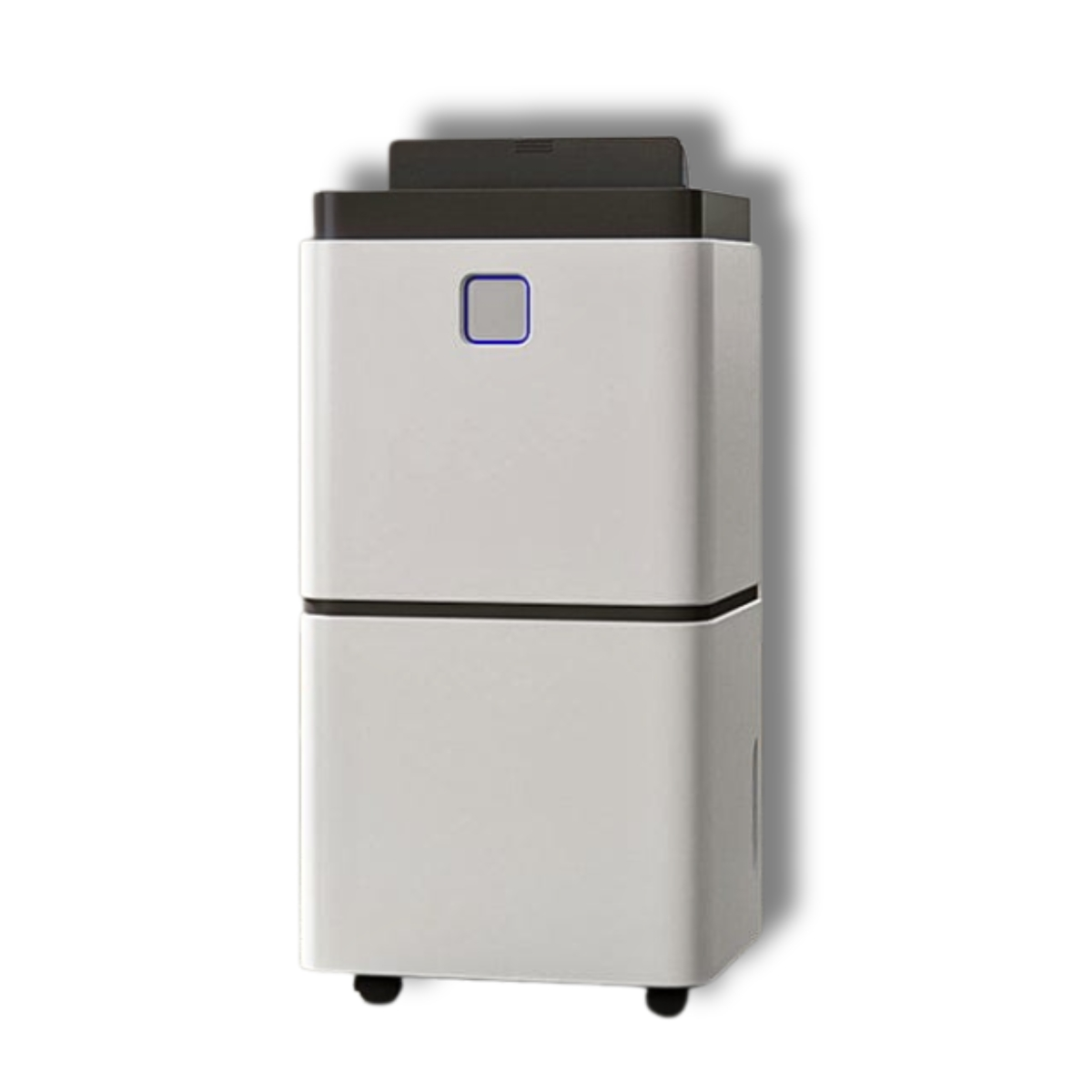
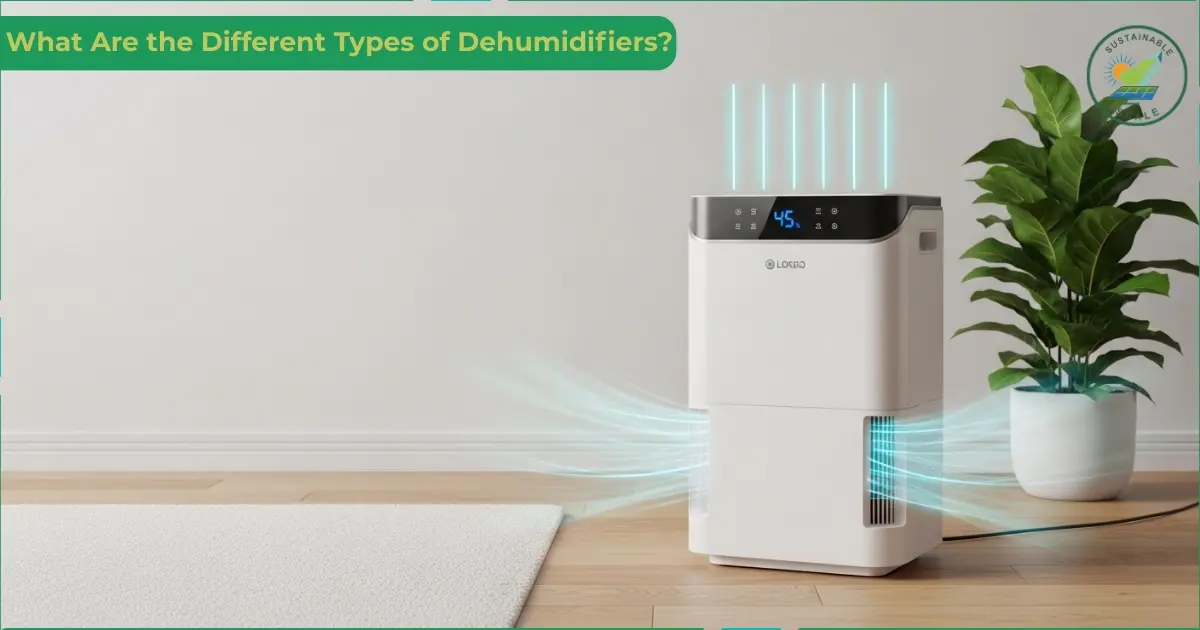

A dehumidifier draws in air, removes excess moisture and returns drier air to the room, which prevents discomfort and property damage caused by dampness. It keeps indoor humidity between 30% and 50% relative humidity, which protects against condensation, mold, mildew, allergens and pests while improving comfort, air quality and respiratory health.
Dehumidifiers are categorized into 3 main types such as refrigerant, desiccant and thermoelectric models, each suited to specific environmental conditions. Refrigerant dehumidifiers use a refrigeration cycle to condense moisture and work best in warm, humid environments above 15 °C. This makes them effective in homes, basements and offices with high extraction rates and energy efficiency. Desiccant dehumidifiers absorb moisture using materials like silica gel, which delivers consistent performance in cold or unheated spaces such as garages, storage rooms and industrial sites where coils freeze. Thermoelectric dehumidifiers use the Peltier effect to condense water on a cool surface. This offers quiet, compact solutions for small enclosed areas like wardrobes, bathrooms or RVs, though with lower capacity.
Dehumidifier model selection involves measuring room size, assessing dampness level, selecting the suitable type, matching capacity to needs and considering ease of maintenance, warranty and features. Dehumidifiers prevent damp related damage, maintain healthy air quality, reduce energy costs and improve comfort, which makes them essential for indoor climate control and long term property protection.
A dehumidifier provides air dehumidification by removing excess moisture from indoor air and helping control humidity levels. It draws moist air into the unit through a fan and passes it over cold coils or moisture absorbing materials. It collects extracted water in a tank or drains it through a connected hose. A dehumidifier then releases drier air back into the room. It helps reduce dampness, limit conditions that support mold and mildew and protect moisture sensitive belongings. It also supports more consistent indoor humidity control.
The types of dehumidifiers are refrigerant, desiccant and thermoelectric (Peltier) dehumidifiers, which remove moisture through different methods. Dehumidifiers condense water vapor, absorb moisture with a desiccant or use the Peltier effect for moisture removal. Refrigerant dehumidifiers use cooling coils to condense water vapor from humid air and collect the extracted moisture. Desiccant dehumidifiers use moisture absorbing materials to remove water vapor and perform effectively in cooler environments. Thermoelectric dehumidifiers use the Peltier effect to condense moisture on a cold surface and provide quiet, compact moisture control.
3 types of dehumidifiers are listed below.
Refrigerant dehumidifiers are electrical appliances that use a refrigeration based cooling system to condense water vapor from moist air. The primary purpose of refrigerant dehumidifiers is to create comfortable living conditions by controlling humidity levels in residential and commercial spaces. They work by drawing humid air through a fan system and passing it over cold evaporator coils within the refrigeration based cooling system.
Refrigerant dehumidifiers’ features include robust moisture extraction rates, user friendly digital controls and adjustable humidistats for automated humidity regulation. Their additional features are air filtration, timer settings, compact designs and low noise performance. Refrigerant dehumidifiers are ideally used in bedrooms, basements, laundry areas and warm, humid climates. Tankless dehumidifier models provide continuous drainage, which prevents water overflow in persistently damp spaces such as basements or laundry rooms. Refrigerant dehumidifiers extract 10 to 50 liters per day, which is sufficient capacity and efficiency for most domestic needs and small commercial settings. Refrigerant dehumidifier models that are Energy Star rated deliver efficient performance for high humidity, large homes and continuous operation.
Desiccant dehumidifiers are moisture control devices that use specialized moisture absorbing desiccant materials like silica gel to extract water vapor from the air instead of relying on refrigeration. Their main purpose is to remove excess moisture in cold environments where other dehumidifier types struggle, which helps to prevent mold, mildew and damp related property damage. They work by drawing in humid air and passing it through a slowly rotating desiccant wheel. The wheel’s material adsorbs moisture and a heated airstream regenerates it, which releases the trapped water as vapor. This process guarantees no risk of coil freezing and allows continuous operation.
Desiccant dehumidifiers’ features include their effectiveness at low temperatures (even below 0°C). They reduce humidity down to 30% RH, are compact, lightweight, quiet and offer various dehumidifier draining options such as tanks or ducted exhaust. Desiccant dehumidifiers are used for cold or unheated basements, garages, storage areas, attics, industrial or commercial spaces and specialized applications requiring very low humidity. Their capacity and efficiency range from 6 to 10 L per day in home models, while industrial units exceed 100 L per day. They maintain constant performance regardless of temperature but use more energy in warm conditions.
Thermoelectric (Peltier) dehumidifiers are compact devices that use the thermoelectric Peltier effect to remove minor excess humidity from the air. Their primary purpose is to provide quiet, low maintenance humidity control for small spaces like closets, bathrooms, RVs or offices. This dehumidifier technology works with no compressor or moving mechanical parts, which makes it ultra quiet, durable and low maintenance, designed for small, enclosed spaces.
Thermoelectric dehumidifiers help prevent mold, mildew and musty odors while providing an energy efficient solution. The process involves passing an electric current through a Peltier module, which creates a temperature difference. One side becomes cold to condense moisture from incoming air, while the other side releases heat. The collected water is stored in a small tank or directed through a drainage option and the dehumidified air is recirculated.
Thermoelectric dehumidifiers’ key features include lightweight portable designs, simple draining options and automatic shut-off when the tank is full. Thermoelectric dehumidifiers are ideal for targeted moisture control in bedrooms, closets, cabinets, bathrooms, RVs or offices with light humidity issues, with a capacity of about 200 to 600 ml per day.
The types of dehumidifiers by application are outlined below.
The types of dehumidifiers by installation are outlined below.
To choose the right dehumidifier, evaluate your space’s needs according to room size, dampness level, dehumidifier technology, moisture removal capacity, ease of maintenance and warranty coverage.
6 steps to choose the right dehumidifier are outlined below.
The benefits of using dehumidifiers are moisture removal, air quality improvement, comfort enhancement, energy cost reduction, respiratory health support and pest control.
The benefits of using dehumidifiers are outlined below.
No, a dehumidifier can not remove mold because it does not kill or eliminate mold that already exists on surfaces. A dehumidifier helps by reducing indoor humidity and lowering the moisture content in the air, which prevents further mold growth but does not remove existing mold patches or spores.
No, a dehumidifier does not cool air because it does not directly cool the air or lower the actual room temperature. A dehumidifier makes a room feel cooler and more comfortable by removing excess moisture from the air. This helps reduce humidity and helps sweat evaporate more efficiently from the body.
It costs $10 to $18 per month to run a smaller dehumidifier like a 30 pint unit in the USA for about 8 hours a day. This translates to roughly $1 to $2 per day, potentially increasing a homeowner’s electricity bill each month by this amount. A dehumidifier’s cost is influenced by factors like dehumidifier size, energy efficiency, usage time, local electricity rates and room humidity levels.
Yes, there are some drawbacks of using a dehumidifier because it increases electricity bills, produces noticeable operating noise and requires regular maintenance. A dehumidifier also requires emptying water tanks and cleaning filters regularly, while excessive operation lowers indoor humidity too much and creates dry conditions.
Whole house dehumidification systems are integrated units installed within the ductwork of an HVAC system to control humidity throughout an entire home. They work by drawing humid air from the return ducts, which passes it over cold coils to condense and remove moisture. Then circulates dry air back into all living spaces via the ductwork. This maintains balanced humidity and prevents mold, mildew and mustiness.
Whole house dehumidifier installation costs range from $1,300 to $2,800 in the United States, which includes the unit and professional installation. It depends on capacity, brand, installation complexity such as ductwork changes or tight spaces and features like smart controls or built-in pumps.
The desiccant dehumidifier is best for industrial use because it works efficiently at low temperatures and achieves very low humidity. Desiccant dehumidifiers are the best industrial dehumidifiers because they maintain performance regardless of temperature. This makes them ideal for demanding industrial settings that require stable humidity control and high moisture extraction rates.
The Midea Cube 50 Pint model is the best commercial dehumidifier for basements because it provides high capacity, smart features, energy efficiency and flexible drainage options. The Midea Cube 50-Pint model also supports continuous moisture removal, which makes it suitable for demanding basement environments with persistent humidity.
A portable refrigerant dehumidifier is the best type for home use because it is affordable, easy to move between rooms and suitable for common household humidity levels. It also provides adjustable humidistats for convenient and consistent humidity control in different areas of the home.
No, you can not use a dehumidifier outdoors because most units are intended for indoor use only. It can be damaged by rain, moisture, dust and extreme temperatures. A dehumidifier works best in an enclosed space where environmental conditions remain suitable for safe and consistent operation.
Yes, there are non-electric dehumidifiers because some models use moisture absorbing materials instead of electricity. These dehumidifiers use calcium chloride, which absorbs water vapor from the surrounding air. Non-electric dehumidifiers work without power and suit small enclosed spaces such as closets, cabinets and storage areas.
The key difference between humidification and dehumidification lies in their effect on air moisture. Humidification adds moisture to the air, which increases humidity levels for comfort or health in dry environments. Dehumidification removes moisture from the air, which lowers humidity to prevent mold, mildew and discomfort. This is essential in damp or high humidity conditions for property protection and air quality.
The difference between a dehumidifier and an air conditioner is that a dehumidifier removes excess moisture from indoor air to control humidity and prevent mold growth. An air conditioner primarily cools the air to provide temperature reduction and comfort. A dehumidifier focuses on moisture control, whereas an air conditioner focuses mainly on cooling while also removing some moisture.