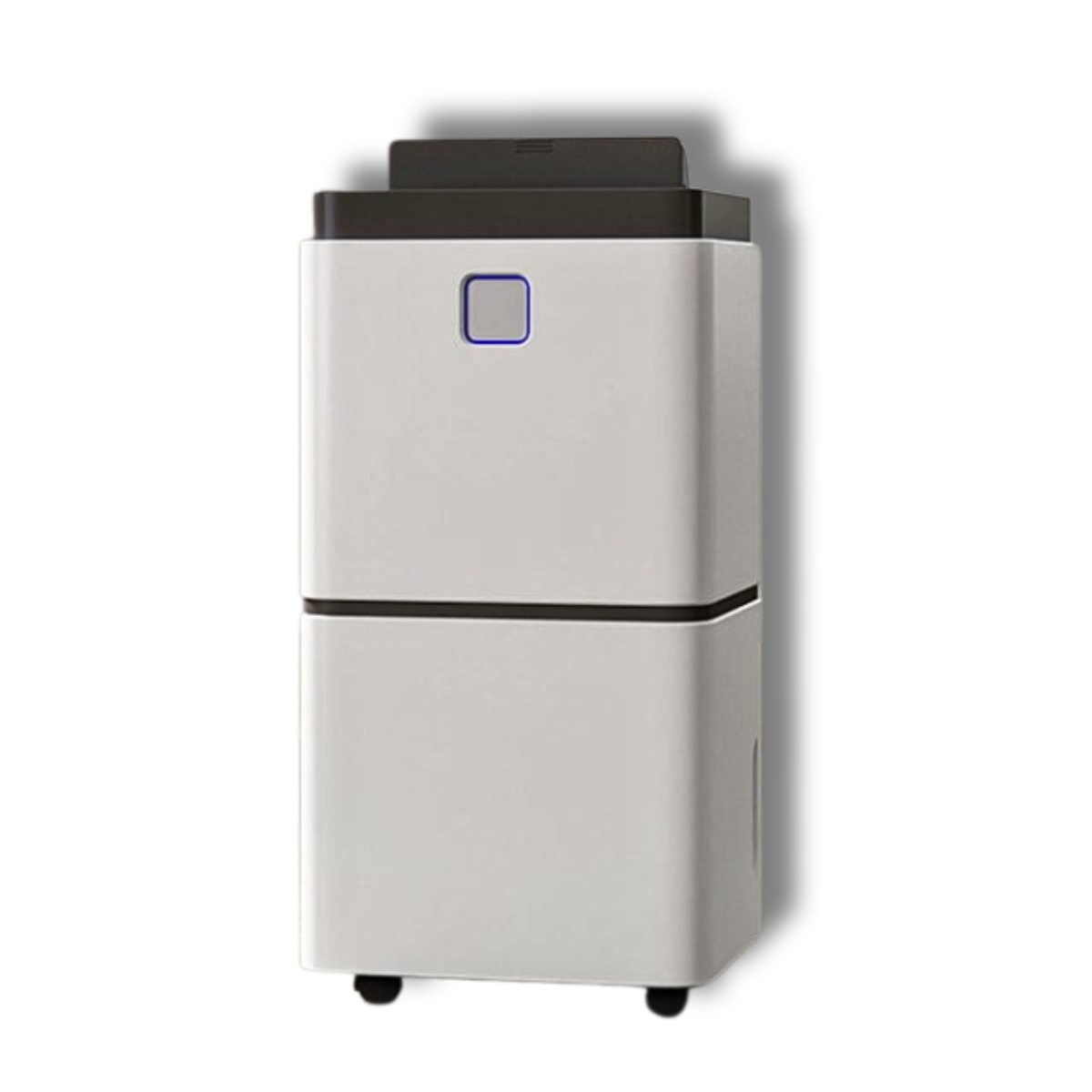
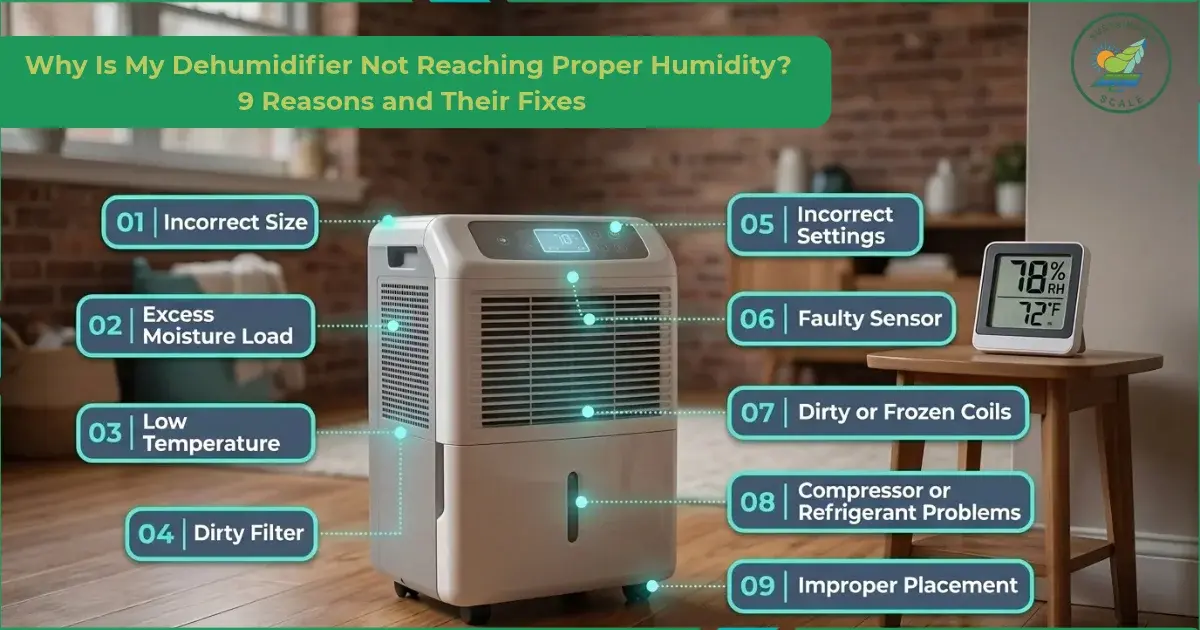

Dehumidifier not reaching proper humidity due to incorrect dehumidifier size, an excess moisture load, low room temperature, a dirty air filter and incorrect humidity settings. An incorrect dehumidifier size occurs when a small dehumidifier sits below the room’s moisture load, so it runs long cycles yet leaves humidity above target. Excess moisture load arises from leaks and household activities that keep feeding vapour faster than the unit extracts, so the room stays damp.
Low room temperature slows coil performance and reduces condensation on the coils, so the dehumidifier removes less moisture during each operating cycle. A dirty air filter clogged with airborne particles restricts airflow through the cabinet and starves the coils, so the unit removes less moisture overall. Incorrect humidity settings stop the compressor early and block the room from reaching its target range, so humidity never settles inside the comfort band.
A faulty humidity sensor sends wrong readings to the control board, so compressor operation no longer matches actual room humidity and drying stalls. Dirty or frozen coils block condensation on the coil surfaces, so moist air passes across the fins without releasing enough water into the tank. Compressor or refrigerant problems prevent the system from circulating refrigerant at rated pressure, so coils stay too warm to condense moisture effectively.
9 reasons why your dehumidifier is not reaching proper humidity are listed below.
- Incorrect dehumidifier size
- Excess moisture load
- Low room temperature
- Dirty air filter
- Incorrect humidity settings
- Faulty humidity sensor
- Dirty or frozen coils
- Compressor or refrigerant problems
- Improper placement
1. Incorrect dehumidifier size
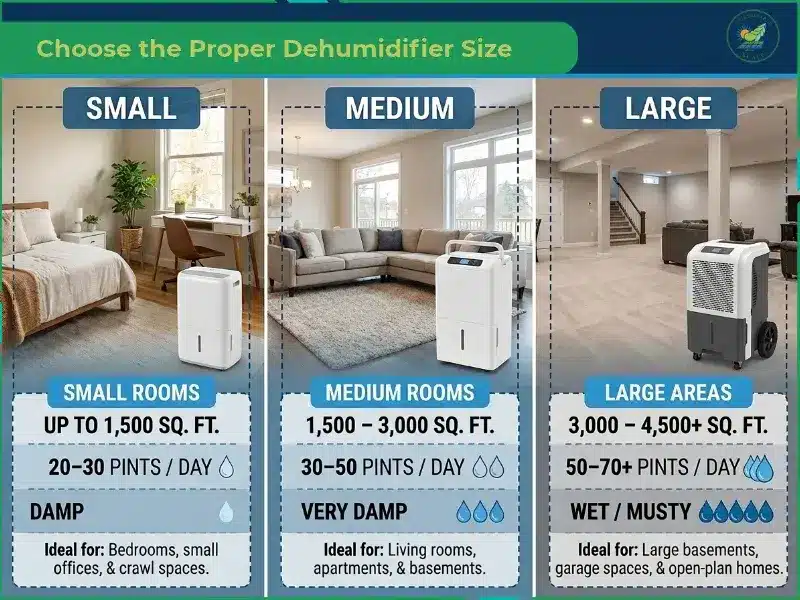
An incorrect dehumidifier size occurs when the moisture removal capacity falls below the room’s moisture load, so relative humidity remains elevated. A small dehumidifier struggles to remove enough moisture in a 1500 square foot basement due to insufficient capacity against the space demand. It keeps humidity near 65% because extraction per cycle remains slower than the incoming moisture load.
An incorrect dehumidifier shows clear signs, which include continuous operation, slow tank filling and damp surfaces that persist after 48 hours. A dehumidifier compressor runs without cycling while humidity fails to decline, confirming incorrect sizing for the environment. It reaches target humidity within 12 hours after replacement with a correctly sized unit rated near 30 pints for moderate dampness.
The infographic below shows the steps to choose proper dehumidifier size.
2. Excess moisture load
A dehumidifier excess moisture load occurs when water vapour enters faster than extraction, so high humidity levels stay above target. It arises from household activities such as showering, cooking and drying laundry indoors that increase indoor moisture sources. It also builds through ventilation issues, which plumbs leaks and open sump pits that continuously feed vapour into the room.
A dehumidifier’s readings stay elevated because excess moisture load replaces extracted vapour instead of allowing humidity to decline. It appears as window condensation, musty odour and a water tank filling within 6 hours under sustained generation. A dehumidifier drops within two days after plumbing leaks are sealed, bathrooms vent outdoors and crawl spaces receive a vapour barrier.
3. Low room temperature
A dehumidifier’s low room temperature occurs when the air falls below 65°F, so humidity stays above target and surfaces remain damp. A dehumidifier’s effective operating range defines the minimum temperature where coils stay clear and it keeps extraction stable against indoor moisture. It slows performance because cold air holds less vapour, reaches evaporator coils at a reduced dew point and forms initial frost.
A dehumidifier’s performance drops in standard refrigerant models once coil surfaces freeze and ice buildup reduces airflow across the cabinet. It shows visible frost on coils, cold discharge air and frequent defrost cycles during normal operation. It is fixed by heating the space above 65°F or installing a desiccant unit rated for 34°F room conditions to keep removing moisture efficiently.
4. Dirty air filter
A dirty air filter occurs when its mesh screen becomes clogged with dust and airborne particles, so humidity stays above target. A dehumidifier gets loaded as the fan pulls room air across the filter each cycle and restricts airflow through the unit during operation. It then removes less moisture per hour because reduced airflow lowers contact between warm air and the cold coils.
A dehumidifier’s performance shows dirt loading through weaker outlet airflow, a grey mat visible on the mesh and rising energy use. It is cleaned by rinsing the mesh under warm water every two weeks, which dries completely and reinstalls it in the cabinet. It returns to clean condition and restores rated airflow within a single cycle, which allows humidity to fall toward the target range.
5. Incorrect humidity settings
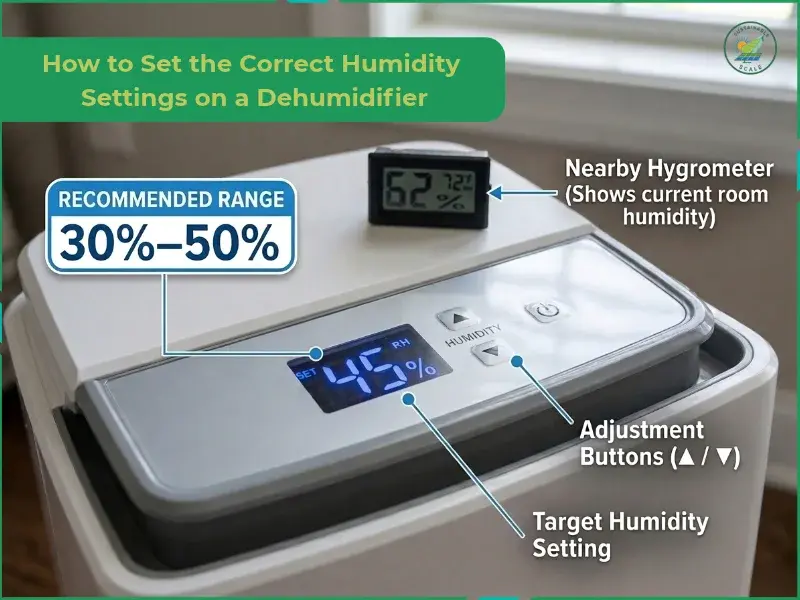
Incorrect humidity settings in a dehumidifier occur when its humidistat values sit outside the 30%–50% RH comfort band, so the room misses proper drying. A dehumidifier shuts off before removing enough moisture when the target humidity level is set too high, which leaves damp air and short compressor cycles. It runs longer than necessary when the setting is too low, so the unit operates constantly without reaching a stable indoor humidity level.
A dehumidifier shows incorrect humidity settings through a room that stays damp, short compressor operation, and a warm room where the tank collects nothing. It is corrected by choosing a target humidity level of 45% and checking readings against a separate hygrometer placed across the room. It then maintains comfort because 30% to 50% RH stays within the recommended range for occupied living space.
The infographic below shows the steps to set the correct humidity setting on a dehumidifier.
6. Faulty humidity sensor
A faulty humidity sensor occurs when its humidistat component measures the room’s relative humidity incorrectly after dust exposure or electrical drift. A dehumidifier sends inaccurate readings to the control board, so the compressor stops or continues at the wrong moment and humidity never reaches the target. A dehumidifier that is not lowering room humidity despite steady runtime points to sensor drift rather than a failed compressor.
A dehumidifier shows a faulty humidity sensor through continuous operation at an empty tank, which reads frozen at one value and erratic display jumps. It is tested when owners compare the displayed humidity against a calibrated hygrometer for 3 hours to confirm deviation. A dehumidifier requires cleaning of the sensor housing or control board replacement once readings differ more than 5 percentage points from the reference.
7. Dirty or frozen coils
Dirty or frozen coils occur in a dehumidifier when the evaporator coil surfaces carry a dust film or ice that blocks condensation, so humidity stays high. A dehumidifier freezes when restricted airflow, a failing fan motor, or low refrigerant levels drop coil temperature below freezing and limit contact. It then cuts extraction sharply within one cycle because blocked coil surfaces reduce the dehumidifier’s ability to condense vapour.
A dehumidifier shows dirty or frozen coils through visible ice on the fins, a rattling fan, and water collection stopping after 30 minutes. It is fixed by unplugging the unit, thawing ice for 2 hours, and brushing the fins with a soft brush to restore airflow. It requires a certified technician when frozen evaporator coils return within 24 hours, indicating a low refrigerant charge that prevents stable humidity control.
8. Compressor or refrigerant problems
Compressor or refrigerant problems occur when the sealed system cannot circulate refrigerant at rated pressure, so coils stay warm and cause poor humidity reduction. A dehumidifier develops compressor or refrigerant problems from refrigerant leaks at brazed joints, worn compressor windings and a faulty compressor start relay. It then prevents the system from cooling enough to condense moisture from the air. A dehumidifier leaves the room damp because warm coils fail to pull water out of circulating air even though the unit runs.
A dehumidifier shows compressor or refrigerant problems through an outlet that does not produce heat, loud humming and a dry tank during operation. It is fixed by a licensed technician because sealed system service with refrigerant leaks requires recovery equipment and EPA certification. It favours replacement over repair when compressor or refrigerant problems appear in a unit older than six years, since worn components rarely restore control.
9. Improper placement
Improper placement of a dehumidifier occurs when the unit sits against a wall, in a corner or behind furniture that blocks the intake, so restricted airflow develops. A dehumidifier limits moisture circulation between the room and the intake grille, which leaves humidity pockets that stay damp away from the unit. It shows through uneven humidity across the room, warm exhaust recirculating into the intake and slow tank filling over repeated cycles.
A dehumidifier best practice for placement is clearance around the unit of at least 12 inches on all sides for unobstructed intake and exhaust. It reaches proper humidity faster when positioned near the center of the room or beside the largest moisture source to capture vapour. A dehumidifier maintains even drying because central placement allows processed air to mix with humid air instead of trapping it against walls or furniture.
How can your dehumidifier reach the desired humidity faster?
Your dehumidifier can reach the desired humidity faster when you close doors and windows, set a realistic humidity level and place the dehumidifier correctly. These operating adjustments reduce incoming moisture and raise extraction efficiency, so indoor relative humidity stays within the 30% to 50% comfort band.
The best practices for your dehumidifier to reach the desired humidity faster are outlined below.
- Close doors and windows: Seal openings to prevent humid outdoor air from entering the room, so the dehumidifier processes a fixed moisture volume and dries the space faster.
- Set a realistic humidity level: Target between 30% and 50% to align compressor run time with comfort, so the unit extracts steadily instead of cycling off early.
- Place the dehumidifier correctly: Position the unit in an open area with adequate clearance to support unrestricted airflow across intake and outlet grilles and promote even drying.
- Clean the air filter: Rinse the mesh under warm water every two weeks to restore full airflow, so the dehumidifier captures more vapour during each operating cycle.
- Empty the water bucket or use continuous drainage: Attach a gravity drain hose to prevent automatic shutoff at a full tank, so the unit runs overnight and clears trapped humidity.
- Eliminate moisture sources: Seal plumbing leaks, close an open sump pit and vent the dryer outdoors to stop new moisture entering the room and opposing extraction.
- Use the correct dehumidifier size: Match pint capacity to room area so the unit finishes pull‑down faster and maintains stable humidity once the space reaches the target range.
- Perform regular maintenance: Check coils, fan blades and the drain hose monthly to catch airflow losses early, so the dehumidifier avoids stalls and keeps humidity downward.
What factors help your dehumidifier reach the desired humidity faster?
The factors that help your dehumidifier reach the desired humidity faster are outlined below.
- Initial humidity level: Rooms starting at 60% RH need less moisture to remove than rooms starting at 80%.
- Ambient room temperature: Compressor units extract fastest between 70°F and 90°F, because warmer air releases water vapour readily.
- Internal air circulation: Ceiling fans moving air across the room deliver damp air to the intake within minutes.
- Room insulation: Insulated walls limit temperature changes, so coil surfaces hold a stable condensation rate.
- External air leakage: Wall air leaks around windows and outlets admit outdoor moisture that offsets extraction.
- Outdoor humidity: Dry outdoor air below 50% RH helps lower indoor humidity through natural exchange at doorways.
- Daily room occupancy: Each occupant releases roughly 2 pints of moisture daily through breathing and skin evaporation.
- Seasonal conditions: Summer months carry outdoor dew points above 65°F, which extends every dehumidification cycle.
Should you run the dehumidifier continuously?
Yes, you should run the dehumidifier continuously when indoor humidity remains high above 60% RH, so extraction stays steady instead of letting dampness rebuild. The dehumidifier running during damp conditions removes moisture consistently between cycles and it idles naturally once the room reaches its target range.
How often should you clean a dehumidifier?
You should clean a dehumidifier every two weeks during continuous seasonal use, so its parts stay clear and airflow remains stable. A dehumidifier needs rinsed filters and wiped coils to prevent dust from restricting intake. It also needs you to clean the water tank with diluted vinegar to limit bacteria buildup and odour.
Does regular dehumidifier maintenance improve moisture removal?
Yes, regular dehumidifier maintenance improves moisture removal because cleaning the filter, coils, and drainage components improves airflow and heat exchange. Better airflow helps the unit extract moisture more effectively, while routine inspections prevent performance problems caused by blockages, dirt or drainage issues, allowing the dehumidifier to operate consistently.
What signs indicate your dehumidifier is losing efficiency?
Signs that indicate your dehumidifier is losing efficiency include slower moisture removal and less water collecting in the tank, so room humidity stays high longer. Dehumidifier performance issues also show longer operating times and rising energy consumption. Its collection of under 1 pint daily in a damp room signals coil inspection or component replacement.
How long does it take a dehumidifier to lower humidity?
A dehumidifier lowers humidity to your target range within 4 to 12 hours in a sealed room, so moisture load drops steadily across each cycle. A dehumidifier’s total runtime depends on room size, which starts with humidity and active moisture sources in the space. Its first run takes the longest in saturated basements holding multiple gallons of water vapour.
Why is my dehumidifier running but the humidity is not going down?
Your dehumidifier is running, but the humidity is not going down because the unit may be undersized for the room’s moisture load. This sizing issue means it cannot overcome continuous dampness. Dehumidifier performance also suffers when an incorrect humidity setting above 60% combines with continuous moisture sources and poor airflow, which keeps readings unchanged.
Why is my dehumidifier not collecting water?
Your dehumidifier is not collecting water because low humidity below 40% RH leaves little vapour available for condensation. This condition means the coils remove almost nothing per cycle. A dehumidifier with an incorrect humidity setting, restricted airflow from a blocked filter or a faulty humidity sensor shows the same empty tank despite operation.
Can a dehumidifier make humidity worse?
Yes, a dehumidifier can make humidity worse when a malfunctioning unit may release moisture back into the room instead of storing it. A dehumidifier leaks collected water onto the floor due to a drainage problem, such as a cracked tank. Its improper operation with a 70% humidistat setting raises the room’s moisture load and holds relative humidity above target.
Solar Panel
Air Purifier