

Solar panels have a lifespan of 25 to 30 years and generate electricity efficiently before their output decreases gradually. Many photovoltaic (PV) systems continue to function beyond 30 years, although their efficiency diminishes over time.
The annual degradation rate of solar panels ranges from 0.5% to 1% per year according to the U.S. National Renewable Energy Laboratory (NREL) analytical review. The solar panels lifespan is influenced by the quality of materials, installation standards, climate conditions, maintenance frequency, exposure to wind, snow and UV radiations.
Monocrystalline solar panels offer the longest lifespan for 30 years compared to polycrystalline and thin-film panels. Regular cleaning, timely inspections, proper mounting, and continuous system monitoring extend solar panel life by detecting and fixing issues early. Solar panels do not require replacement after 25 to 30 years, unless there is severe physical damage or the system becomes inefficient relative to newer technologies.
Commercial solar panels last 25 to 30 years or more because they use better-quality components and receive more consistent maintenance, both of which help them operate reliably in large-scale applications.
Portable solar panels, on the other hand, have a shorter lifespan of 5 to 15 years due to frequent handling, transport and environmental exposure. Such conditions accelerate wear, reducing the lifespan of photovoltaic panels compared to fixed installations.
The lifespan of solar panels is about 25 to 30 years which is recognized as the industry standard for both residential and commercial photovoltaic (PV) systems. This period represents the average life of solar panels, with consistent energy production for most of their operational years. The National Renewable Energy Laboratory (NREL) has conducted research that shows that after 25 years of use, most solar panels still produce 80 to 90% of their original output. This gradual decline means that the power output of solar panels degrades over time.
Solar Panels generate electricity after 30 years but at reduced efficiency, which makes replacement practical for homeowners. This reduced performance near the end of the solar panel lifespan upgrades to newer and more efficient models.
Solar photovoltaic (PV) systems are designed with durable components like tempered glass covers, aluminum frames, silicon solar cells, EVA encapsulation layers, weather-resistant backsheets and corrosion-resistant mounting systems. They work together for extended performance of PV panels in various environmental conditions like rain or clouds.
Solar panels’ lifespan positions them as a highly reliable energy source as compared to other household technologies like HVAC systems or water heaters. Household appliances, such as water heaters last 6 to 12 years and air conditioning units last 7 to 15 years, and have shorter lifespans than solar panels.
A line graph comparing four solar brands like LG, REC, Qcells, and Silfab is shown below demonstrating their remaining power output after 25 years, with REC leading at 92%.
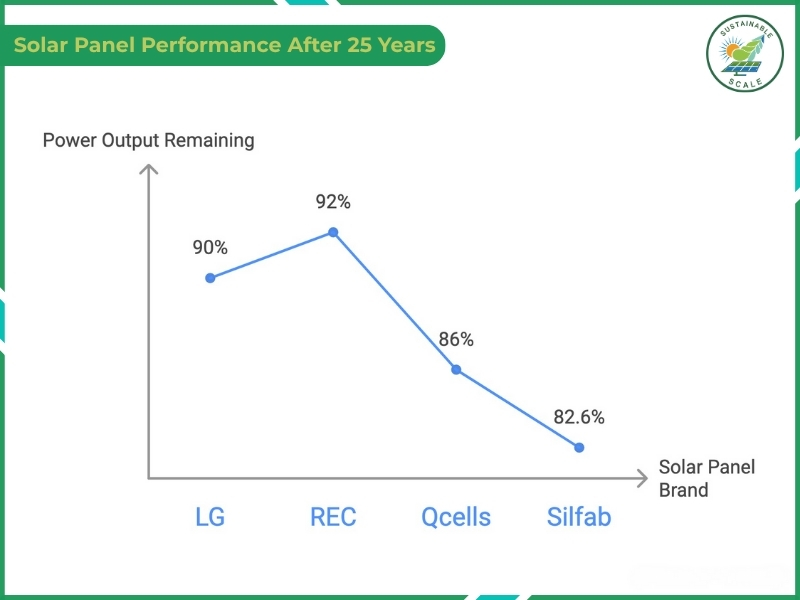
The degradation rate of solar panels refers to the annual percentage loss in a panel’s ability to convert sunlight into electricity. Modern solar panels degrade at a rate of 0.25% to 0.8% per year, with most high-quality panels falling around 0.4% to 0.5% per year, as per EnergySage data.
This degradation leads to a gradual decline in power output over time, caused by environmental exposure, material fatigue and operational stresses. Solar panels produce 80 to 87% of their initial power output after 25 years. Premium panels maintain up to 93% of their original output in some cases.
The factors that affect the lifespan of solar panels include quality of materials and manufacturing, installation quality, environmental and climatic conditions, maintenance practices, panel orientation and location, and exposure to stressors.
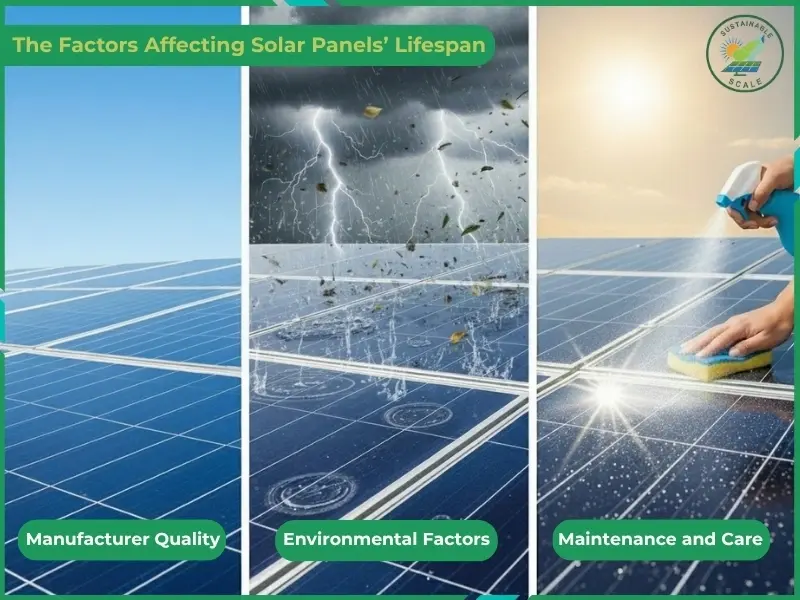
The factors that affect the solar panel lifespan are given below.
The infographic below is divided into three panels illustrating that manufacturer quality, environmental factors like storms, and regular maintenance and care determine a solar panel’s lifespan.
Monocrystalline solar panels have the longest lifespan among all major solar panel types, which is 30 to 40 years, with many manufacturers offering performance warranties that guarantee at least 80 to 85% of their original output after 25 to 40 years. Their longevity is due to the high purity of the silicon used and their robust single-crystal structure, which makes them less susceptible to environmental degradation over time.
The table below provides a comparison of different solar panels in terms of lifespan and efficiency, along with relevant notes on degradation.
Solar panel type | Lifespan (years) | Efficiency (%) | Notes on degradation and performance |
|---|---|---|---|
Monocrystalline | 30 to 40 | 20 to 25 | Most efficient, longest-lasting and low degradation. |
Polycrystalline | 25 to 30 | 18 to 21 | Slightly less efficient, ceased production in 2023 |
Thin-film | 10 to 20 | 17 to 19 | Flexible, lightweight, lower efficiency, higher degradation. |
Transparent | 25 to 35 | ~1 | Low efficiency, window blending, niche use. |
Solar tiles | 25 to 30 | 10 to 20 | Aesthetic roof integration, similar lifespan to polycrystalline |
Perovskite | 25 to 35 | 24 to 27 | Emerging tech, very high efficiency, not widely commercial |
Monocrystalline panels are the industry standard for residential and commercial installations due to superior efficiency and durability, degrade slowly and maintain over 80% output after 25 years. Thin-film panels degrade faster and last shorter despite their flexibility and unique applications.
To extend the lifespan of your solar panels, clean them regularly, schedule annual professional inspections, monitor their energy output, remove shading and obstructions, check mounting structures for damage, and follow the manufacturer’s maintenance guidelines. Implementing these steps helps extend panel lifespan and maintains efficient energy production for decades.
Some tips to make your solar panels last longer are given below.
Warranty safeguards your solar investment by protecting against defects, performance degradation and installation problems. It ensures system reliability and long-term durability. Solar panel warranties fall into three categories, including product, performance and installation.
Solar panels come with 10 to 25 years of product warranty and performance guarantees, and give at least 80% output after 25 years. Microinverters have warranties up to 25 years, while string inverters have 10 to 15 years of coverage. Warranties encourage proper installation and maintenance, protecting investment and extending panel life with prompt repair or replacement if performance degrades prematurely.
Solar panels need to be replaced every 25 to 30 years, which aligns with their average lifespan before a noticeable drop in efficiency, as noted by EnergySage. Solar panels operate at 80% to 87% of their original efficiency with a 0.5% to 0.8% degradation rate after 25 years.
Solar panels can continue generating electricity beyond 30 years, but reduced output often makes replacement more cost-effective. Many homeowners choose to replace their panels as warranties expire or when newer, more efficient technology becomes available. Older panels are sometimes repurposed for low-demand or off-grid applications, where lower efficiency is still sufficient.
Commercial solar panels last 25 to 30 years on average, with some newer models lasting up to 40 to 50 years. They have a longer life than residential panels due to higher-quality materials, robust construction and strict maintenance. Factors that influence lifespan of commercial solar panels include material quality (grade A silicon), environmental conditions (heat, hail, dust) and installation quality.
Portable solar panels last 5 to 15 years on average, which depends on panel quality, environmental exposure, frequency of use and maintenance. Higher-quality portable panels with monocrystalline cells degrade more slowly and last longer. Frequent use of solar panels in harsh conditions shortens lifespan, while proper care, including cleaning and avoiding extreme conditions, extends their usability.
Yes, solar panels can work without direct sunlight and generate electricity using both direct and indirect (diffused) sunlight. Solar panels still produce power even on cloudy or overcast days, though at reduced efficiency and generate 10% to 60% of their normal output depending on cloud density.
Yes, some solar panels can last 50 years, especially high-quality monocrystalline panels in optimal conditions with regular maintenance. Recent studies show panels continue producing electricity beyond 30 years, at reduced efficiency. Warranties cover 25 to 30 years, and replacement is considered when efficiency falls below 80%. Panels continue functioning after 50 years, but with diminished output.
The reasons for solar panel degradation are environmental exposure, material aging and manufacturing factors that reduce efficiency over time. Key causes include ultraviolet (UV) exposure, thermal cycling, heavy rainfall, humidity freeze and damp heat, all of which cause mechanical stress, corrosion and material breakdown. These factors, with light-induced degradation, voltage issues, poor manufacturing and backsheet failure, collectively weaken the panels’ ability to convert sunlight into electricity.
Solar panels are reused or recycled to prevent environmental harm, at the end of their life. Recycling involves disassembling aluminum frames, separating glass and silicon, and applying thermal processing and chemical recycling to recover materials. These reclaimed components are reused in manufacturing new panels, promoting sustainability and reducing waste.
No, solar panels cannot be 100% recycled, but 90 to 95% of their materials, including glass, aluminum and silicon recovered. Recycling facilities extract these components to reduce waste and environmental impact. Solar panel recycling infrastructure is growing globally which aims to improve recovery rates and handle increasing panel disposal as installations age.
Solar batteries last between 5 and 15 years, depending on the battery type, usage patterns and environmental conditions. Lithium-ion batteries, the most common type, last 10 to 15 years, while lead-acid batteries last 3 to 7 years. Proper maintenance and optimal installation can extend the lifespan of solar batteries.
Solar inverters last between 10 and 15 years on average, depending on the type of inverter. Most inverters require replacement at least once during the solar panel system’s lifespan. The lifespan of a solar panel is influenced by product quality, installation, environmental conditions and maintenance for safe and efficient operation.