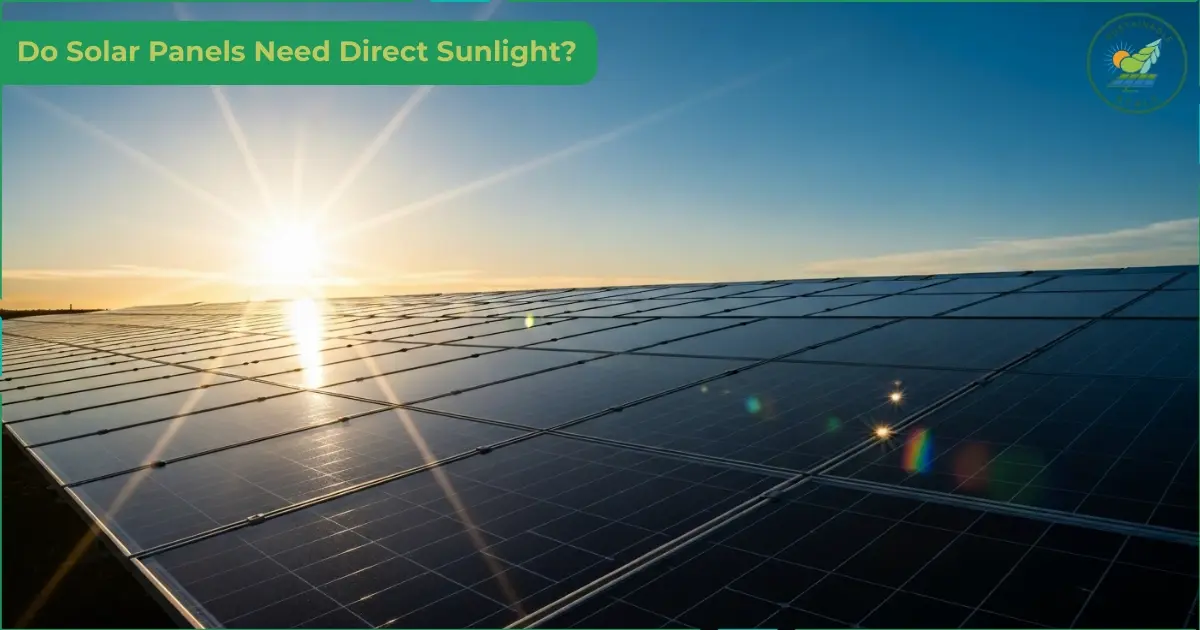

Solar panels do not require direct sunlight to generate electricity, but perform best when exposed to full sunlight due to stronger and direct light wavelengths. Energy output decreases in shaded environments, between 50% to 80% but modern systems equipped with bypass diodes, microinverters or optimizers help maintain partial performance. The efficiency in shaded conditions depends heavily on solar panel quality, with advanced designs like half-cut cells, PERC, N-type silicon and thin film technologies offering greater shade tolerance.
Panels continue producing energy on cloudy days by capturing diffuse light that penetrates cloud cover. Output ranges from 10% to 90% depending on cloud density, time of year and geographic location. Panel location plays a crucial role in maximizing exposure during shorter daylight hours or in regions with frequent overcast conditions. Rainy weather causes output to drop due to cloud coverage, not the rain itself. Rain naturally cleans the panels, removing debris and cooling the surface, which helps maintain stable performance over time.
A light dusting of snow in snowy conditions still allows some light to pass through, but heavy accumulation blocks sunlight entirely. Panels shed snow due to their tilted angle and slight warmth when sunlight returns. High quality panels are designed to withstand snow loads and harsh weather. The minimum effective sunlight for optimal performance is four peak sun hours per day, but systems still function at reduced output in less sunny areas. Efficient solar system design with proper panel location and strong solar panel quality guarantees consistent energy production throughout the year.
How do solar panels work in the shade?
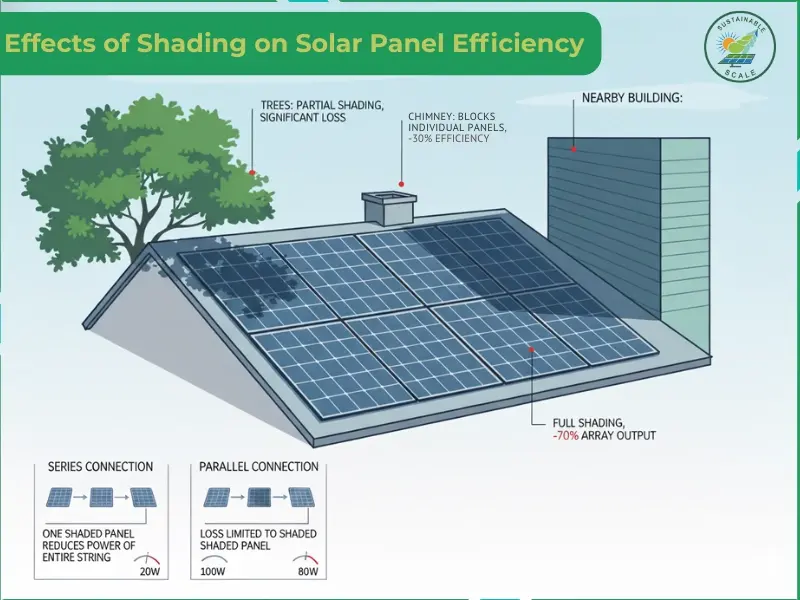
Solar panels function in shaded conditions, but their electricity output drops compared to full sunlight. According to SolarReviews and Renogy, shading from trees, buildings or other obstacles reduces energy production by 50% to 80%, depending on severity. Solar panels generate some electricity by capturing diffuse sunlight even in the shade, though efficiency is lower.
Modern solar panels include bypass diodes to reduce energy loss, which redirect current around shaded sections. This allows the unshaded portion to generate power and prevents issues like hotspots, which improves system reliability. Many systems use microinverters or optimizers that let each panel operate independently, which minimizes performance loss from partial shade.
Solar panels’ shade tolerance varies by panel type, such as thin-film panels that handle scattered shade better than monocrystalline or polycrystalline panels, which are sensitive. Newer technologies such as half cut cells, N-type silicon, PERC or anti shading layouts like ShadowFlux offer improved performance in shaded conditions and greater reliability than standard designs.
The image below illustrates the shading effects of nearby trees, chimneys and surrounding buildings on solar panels.
How do solar panels perform on cloudy days?
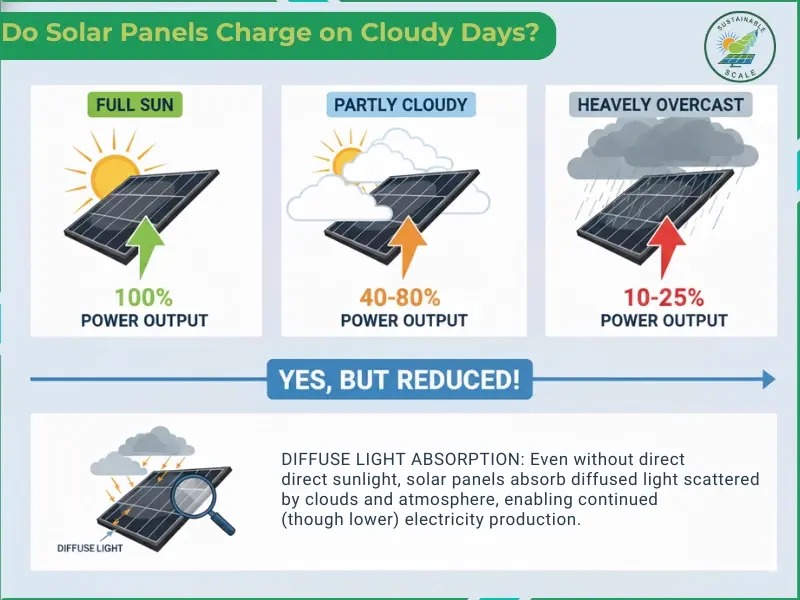
Solar panels continue to produce electricity on cloudy days, but their performance is reduced due to the impact of cloud cover and other weather related effects. Cloudy weather blocks a portion of direct sunlight, so solar panels rely more on indirect sunlight, diffusing light that penetrates through the clouds. The degree to which energy output drops depends on many factors, such as the thickness of the cloud cover, time of year, geographic location and local weather patterns. Thicker cloud cover leads to a greater reduction in sunlight reaching the panels, sometimes limiting output to just 10% to 33% of maximum capacity, while lighter clouds still allow panels to generate 75% to 90% of their output.
Solar output variability increases when cloud patterns and density change rapidly. Time affects production, like in winter, shorter daylight hours and a lower sun angle already reduce efficiency and cloudy conditions worsen this effect. Geographic location affects solar output; the Pacific Northwest loses more energy to overcast skies, while areas with intermittent clouds get brief boosts in output. Local weather patterns, such as persistent fog or frequent rain, also reduce the amount of energy solar panels generate on cloudy days. Despite these challenges, modern solar panels are designed to capture diffuse light as much as possible, which guarantees that at least some electricity is produced even in suboptimal weather conditions.
The image below shows an educational infographic illustrating that while solar panels continue to generate electricity on cloudy days by absorbing diffused light, their power output decreases from 100% in full sun to as low as 10 to 25% during heavily overcast weather.
How do solar panels function during rain?
Solar panels continue to operate during rain due to their waterproof design and strong weather resistance. They still generate electricity even when sunlight is limited by clouds and precipitation. Efficiency drops on rainy days because the available sunlight is weaker and mostly diffuse, which reduces energy output to about 10% to 30% what is possible on a clear day. This reduction is caused by cloud cover, not rain, as panels rely on diffuse light that passes through clouds and moisture.
Rain helps maintain solar panel performance by naturally cleaning the surface. It removes dust, pollen and debris, which helps restore efficiency once the sun returns. Rainwater also cools the panels, which improves their performance by lowering the risk of overheating and supporting consistent energy output. Rain supports local ecosystems and assists with rainwater harvesting.
Certain actions are recommended to keep solar panels efficient during rainy periods. Trim nearby trees and remove obstructions, such as satellite dishes or debris, to reduce shading. Adjusting panel angles improves light exposure and allows rain to wash off dirt effectively. You have to regularly check energy output, which has unexpected drops that indicate a buildup or technical problems.
Annual professional maintenance ensures that the waterproofing and structural integrity remain intact in areas with frequent storms. EnergySage recommends these methods to support steady performance, noting that routine rain provides adequate surface cleaning for most households. Despite reduced efficiency in cloudy weather, modern solar panels are designed for durability and stable energy output, which makes them a dependable energy source even on rainy days.
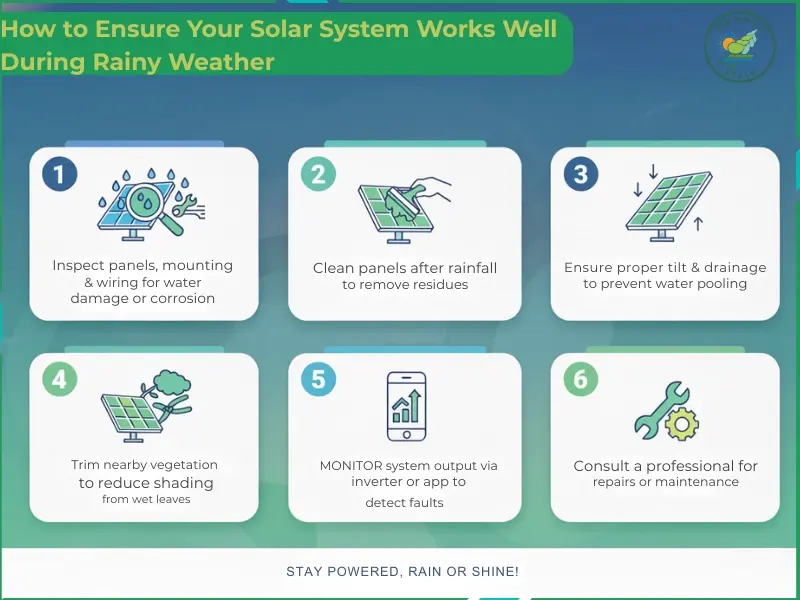
The image below shows an infographic outlining six key maintenance steps like inspecting, cleaning, draining, trimming, monitoring and consulting to ensure a solar system works well during rainy weather.
How do solar panels operate during snowfall?
During snowfall, solar panels continue to operate by using panel heat absorption and the reflective properties of snow. Their power output drops due to sunlight blockage when snow covers the surface. A thin layer of snow allows some light to pass through. Heavy or packed snow stops electricity production until it melts.
Panels help shed snow through their smooth, angled surfaces and the slight heat they produce when exposed to sunlight, a process known as natural cleaning. Most solar panels, such as SunPower, LG, Canadian Solar and Q CELLS, are designed with snow weight tolerance to withstand the extra load without damage. Regular maintenance supports performance in winter. This includes gently sweeping off loose snow with a soft tool to avoid surface damage and cleaning after major storms to restore light access. It is important to schedule system checks before and after the winter season.
Panel heaters melt snow slowly and snow guards reduce the risk of large sheets sliding off. These strategies, proper panel angle and regular inspection, help maximize sunlight exposure and keep solar panels safe and efficient in snowy climates.
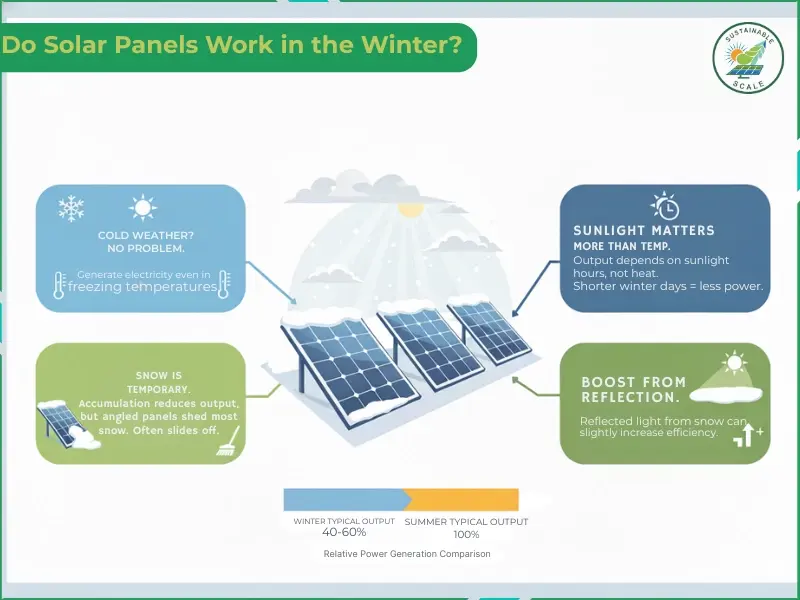
The image below shows the efficiency of solar panels during winter by highlighting key factors like cold weather, sunlight matters, temporary snow, reflection boost and relative power generation comparison.
What is the minimum sunlight needed for solar panels?
The minimum sunlight required for solar panels is measured in peak sun hours, which refers to an hour when the sunlight intensity averages 1,000 W/m². Most residential solar panels need at least four peak sun hours per day to be cost effective and generate enough electricity. This refers to the daily hours when solar panel efficiency is at its highest.
Solar panels do not require direct sunlight to function. They generate electricity on cloudy days or in indirect sunlight, though at reduced output. Under light cloud cover, panels produce 24% less electricity and under heavy clouds, efficiency drops by up to 67%. Most panels produce only 10% to 25% of their maximum output on overcast days, which shows the energy production variability caused by changing weather conditions. Minimum sunlight needs vary by location, such as southwestern states receive more daily sun exposure than northern regions.
Areas in the southwestern US, such as Arizona, California and Nevada, regularly receive more than six peak sun hours daily. This supports higher efficiency and greater energy production. Northern or cloudier states receive 2.5 to 4 peak sun hours per day, so installations there must compensate with higher efficiency panels. Viable solar energy systems are still installed in less sunny regions, though their energy output varies due to weather conditions.
Can a solar panel work without the sun?
No, a solar panel cannot work without the sun because it relies on natural light to generate electricity. When sunlight is absent, such as at night, energy production drops to zero, directly impacting solar system performance and day night energy use. Even with artificial light, the light intensity impact is too low for meaningful power even with artificial light, which highlights natural energy production variability.
Is morning sun better for solar panels?
No, morning sun is not better for solar panels because the lower perpendicular sunlight angle in the morning leads to increased atmospheric effects and light scattering. This weakens the light intensity reaching the panels and causes lower output compared to midday. This results in notable performance variation, with panels generating the most electricity when the sun is higher in the sky around noon.
What is the best sun exposure for solar panels?
The best sun exposure for solar panels is direct, unshaded sunlight from the south, which maximizes maximum sunlight capture and midday sun intensity. Panels south face at an angle of 30° to 40° to optimize energy throughout the year. East and west facing panels are viable and help balance production for varied energy use. Shading should be avoided and a professional solar assessment allows site specific optimization.
Do solar panels work at night?
No, solar panels do not work at night because energy production relies on sunlight. During the absence of sunlight, standard panels generate no electricity. Energy storage systems like batteries are used to store solar power at night. Most homes depend on grid connection for nighttime electricity needs without storage.
Can solar panels generate electricity from moonlight?
No, solar panels can not generate meaningful electricity from moonlight because moonlight is just reflected sunlight with extremely low light intensity. The electricity produced is negligible even under full moon conditions. It produces about 0.2% to 0.3% of what panels generate in direct sunlight, which is little for any practical use.
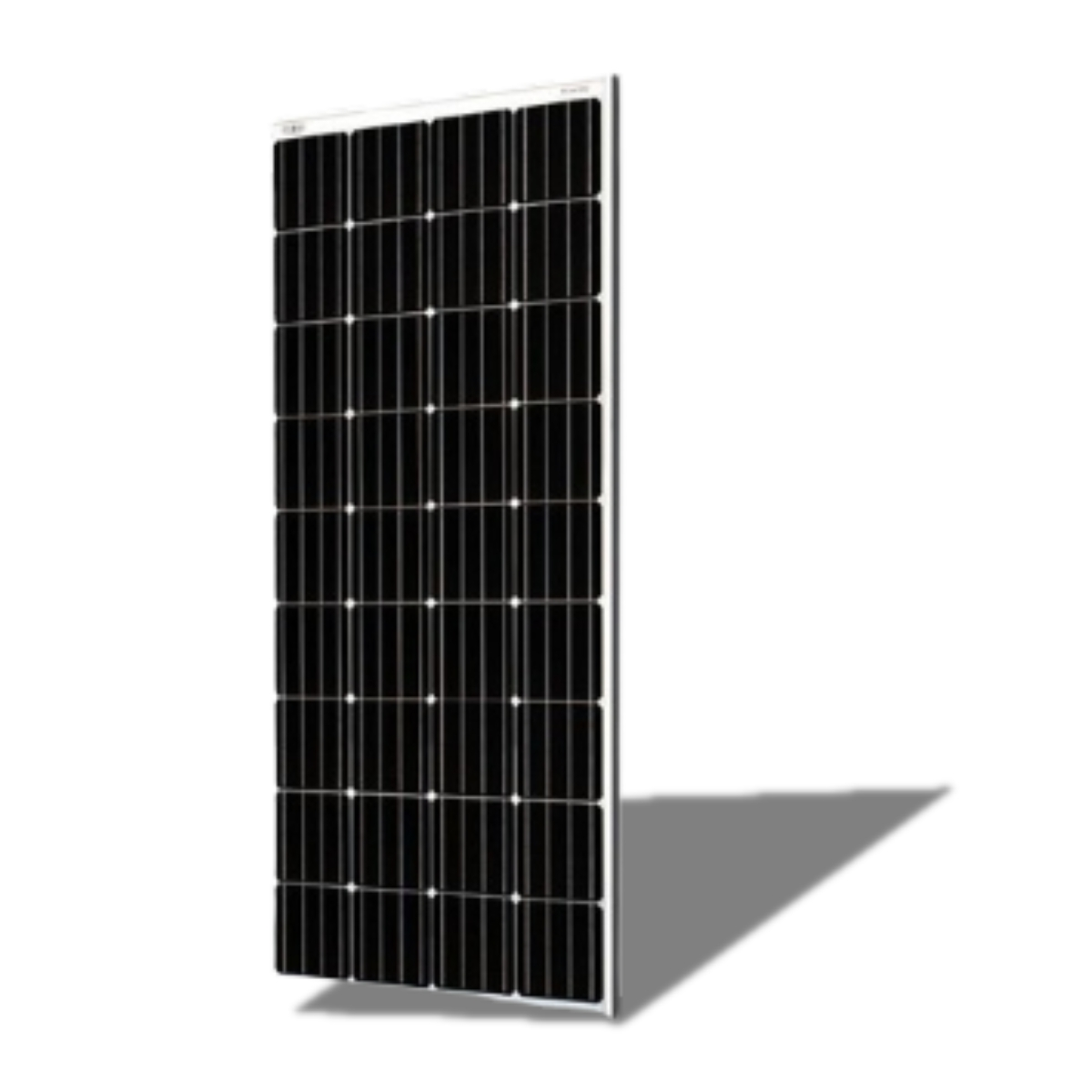
Solar Panel
Air Purifier