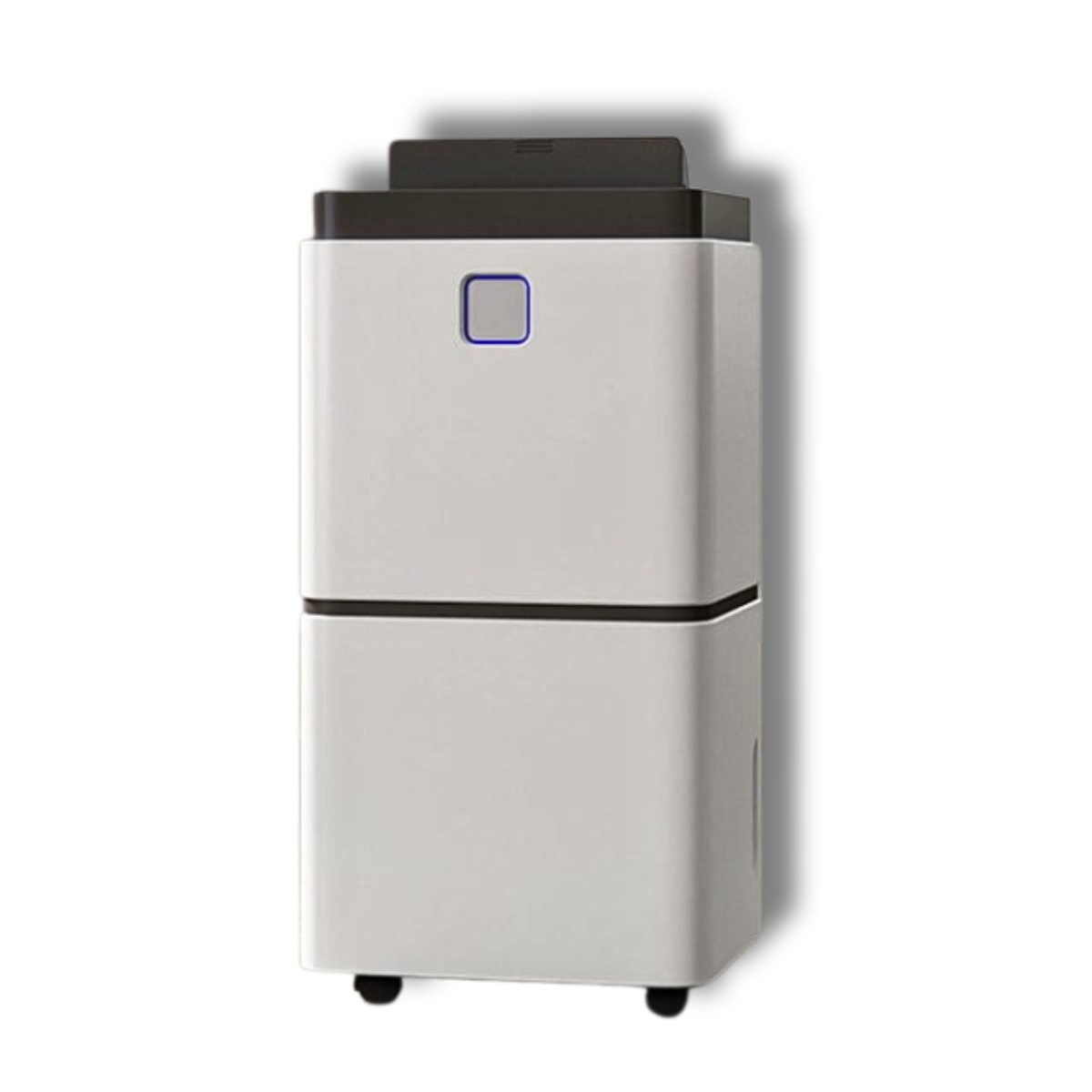
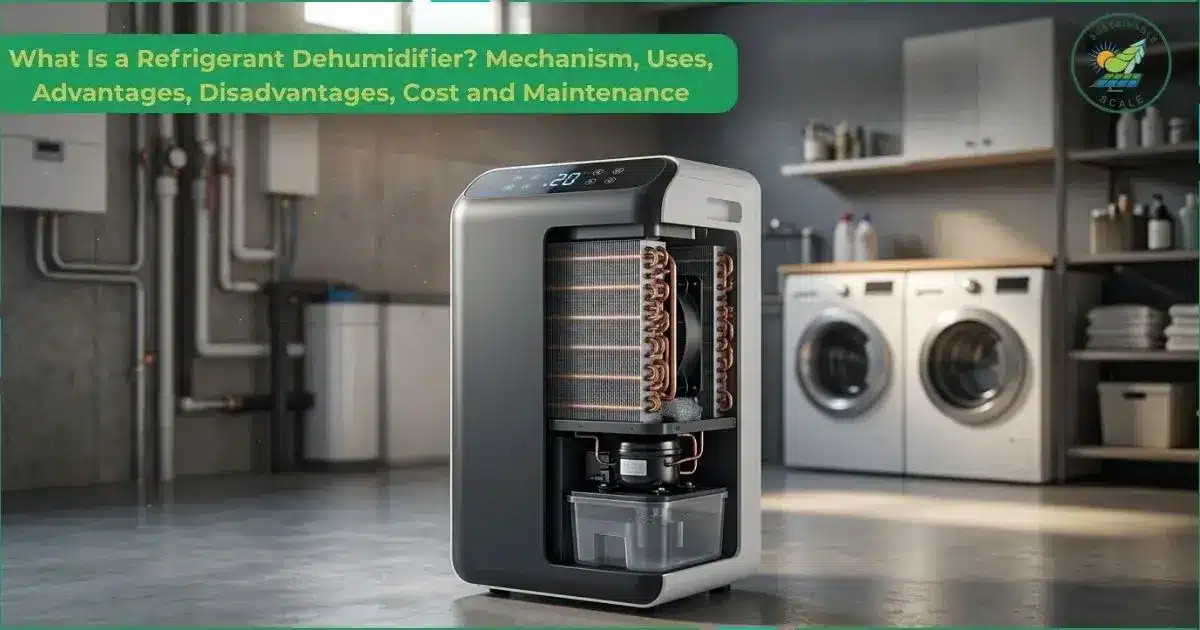

A refrigerant dehumidifier removes excess moisture from indoor air and keeps indoor humidity levels within a stable range in homes, commercial buildings and specialized environments. It draws humid air across cold evaporator coils, condenses water into a collection path and delivers reheated, drier air back into the room in a continuous loop. It appears as portable, whole house, crawl space, commercial, industrial and low grain units that match different room sizes, installation formats and moisture loads.
A refrigerant dehumidifier serves home humidity control, mold and mildew prevention, protection of electronics and appliances, warehouse and industrial storage, food and healthcare spaces, construction drying and archive preservation. It delivers energy efficient operation, fast moisture removal, a cost effective solution, easy maintenance, automatic humidity control and better air conditions. It brings weaker performance in cold conditions, added room heat, noise and limited impact on pollutants. Refrigerant dehumidifier’s popular choices iclude Midea Cube 50 pints, GoveeLife 50 pints, Frigidaire FFAD5033W1, TCL smart units, Honeywell TP70AWKN, GE, hOmeLabs and Amazon Basics models.
A refrigerant dehumidifier costs $200 to $3,500 that depends on the unit type, size and installation requirements. A refrigerant dehumidifier requires regular air filter, water tank, coil, and drain hose maintenance, proper placement, exterior cleaning, defrost monitoring and occasional operation during storage to maintain efficient performance and extend its lifespan.
What is a refrigerant dehumidifier?
A refrigerant dehumidifier is a humidity control appliance that removes excess moisture from indoor air by using a refrigeration cycle. It draws humid air over cold evaporator coils, where the temperature drops below the air’s dew point. This process causes moisture to condense into water, which collects in a reservoir or drains away.
A refrigerant dehumidifier lowers indoor humidity to create a drier, more comfortable environment while helping reduce dampness, condensation and musty odors. It works most effectively in warm, humid conditions and is commonly used in homes, basements, laundry rooms and other moisture prone spaces to improve indoor comfort and protect building materials.
How does a refrigerant dehumidifier work?
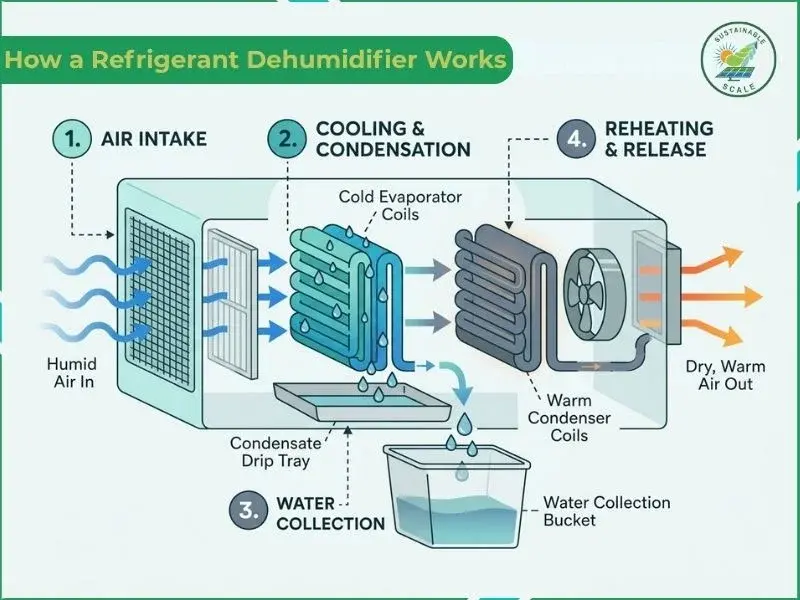
A refrigerant dehumidifier works through four key stages such as air intake, cooling and condensation, water collection and reheating or release to return drier air into the room. These processes run in a continuous sequence that removes moisture and stabilizes humidity within the enclosed area.
4 steps on how a refrigerant dehumidifier works are given below.
- Air intake: A refrigerant dehumidifier draws humid air through its intake grille and directs the airflow toward its internal processing section for the dehumidification cycle to begin.
- Cooling and condensation: A refrigerant dehumidifier moves the air across refrigerant filled evaporator coils that lower the air temperature and cause invisible water vapor to condense into water droplets.
- Water collection: A refrigerant dehumidifier channels the liquid into a collection tank or connected drain line that manages water removal and prevents accumulated moisture from remaining inside the treated space.
- Reheating and release: A refrigerant dehumidifier guides the cooled air across warmer components, raises its temperature and releases the drier air back into the room to maintain a stable humidity level.
What are the types of refrigerant dehumidifiers?
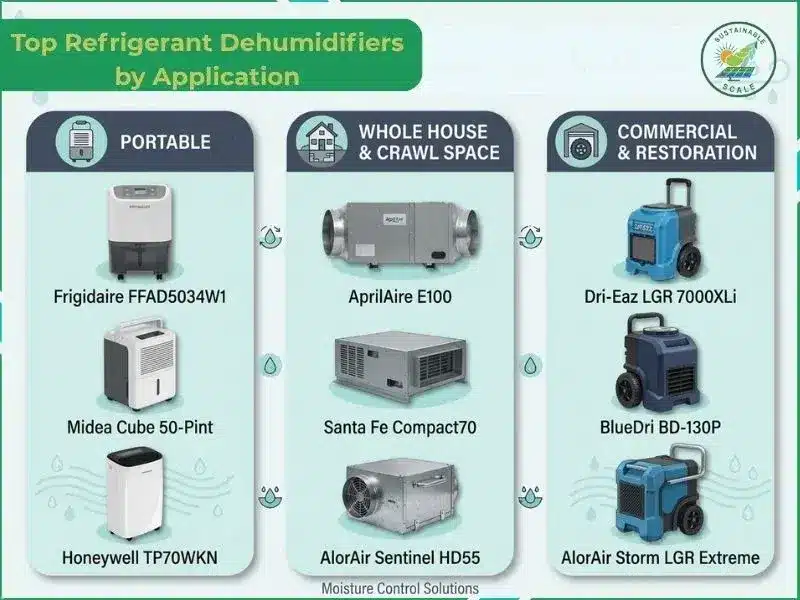
The types of refrigerant dehumidifiers are portable refrigerant dehumidifiers, whole house refrigerant dehumidifiers, crawl space refrigerant dehumidifiers, commercial refrigerant dehumidifiers and low grain refrigerant dehumidifiers used in different spaces and conditions. These refrigerant dehumidifiers remove excess moisture, maintain target humidity levels and support healthier air in residential, commercial and specialized environments.
6 types of refrigerant dehumidifiers based on applications are given below.
- Portable refrigerant dehumidifiers: Portable refrigerant dehumidifiers represent a common type for homes and manage room humidity where users place units in specific rooms and improve basic moisture control.
- Whole house refrigerant dehumidifiers: Whole house refrigerant dehumidifiers connect to a central HVAC system and treat supply or return air streams so buildings maintain consistent humidity across multiple rooms and conditioned zones.
- Crawl space refrigerant dehumidifiers: Crawl space refrigerant dehumidifiers serve underfloor or basement crawl areas and manage humidity that rises from soil or foundations to protect joists, subfloors and insulation from moisture exposure.
- Commercial refrigerant dehumidifiers: Commercial refrigerant dehumidifiers operate in offices, shops and public facilities and maintain humidity that protects furnishings, electronics, inventory and interior finishes from moisture driven risks.
- Industrial refrigerant dehumidifiers: Industrial refrigerant dehumidifiers work in warehouses, factories and processing areas and control humidity around equipment, raw materials and finished goods in large industrial storage environments.
- Low grain refrigerant (LGR) dehumidifiers: Low grain refrigerant (LGR) dehumidifiers support water damage restoration with rugged units on wheels and achieve lower grains per pound when saturated structures and contents need deep drying.
What are the uses of a refrigerant dehumidifier?
The uses of a refrigerant dehumidifier include home humidity control, mold and mildew prevention, protection of electronics and appliances, industrial and warehouse storage and libraries and archive preservation. It works to condense moisture from humid air, manage indoor humidity levels, reduce dampness and prevent microbial growth in sensitive or enclosed environments.
The uses of a refrigerant dehumidifier are given below.
- Home humidity control: A refrigerant dehumidifier lowers dampness in living spaces, protects building materials from moisture exposure and maintains indoor humidity levels that support stable conditions in occupied rooms.
- Mold and mildew prevention: A refrigerant dehumidifier limits on vulnerable surfaces, controls moisture on walls and furniture and prevents microbial growth in enclosed areas that face recurring humidity exposure.
- Protection of electronics and appliances: A refrigerant dehumidifier manages equipment, limits moisture on sensitive components and maintains indoor humidity levels that support consistent and safe operation of devices.
- Industrial and warehouse storage: A refrigerant dehumidifier manages in storage zones, controls moisture around stored goods and maintains indoor humidity levels that support protection from corrosion and material degradation.
- Food storage and processing areas: A refrigerant dehumidifier manages packaging and contact surfaces, controls moisture around products and maintains indoor humidity levels that support food quality and hygiene compliance.
- Healthcare and laboratory humidity control: A refrigerant dehumidifier manages dampness around instruments and work surfaces, controls air moisture in critical rooms and maintains indoor humidity levels that support accurate procedures and sample stability.
- Construction and renovation drying: A refrigerant dehumidifier pulls moisture from building materials, lowers dampness in newly finished spaces and maintains indoor humidity levels that support proper curing and structural integrity over time.
- Libraries and archive preservation: A refrigerant dehumidifier limits in storage stacks, protects books and documents from moisture exposure and maintains indoor humidity levels that support long term preservation of sensitive collections.
What are the advantages of a refrigerant dehumidifier?
The advantages of a refrigerant dehumidifier are energy efficient operation, fast moisture removal, cost effective solution, easy maintenance, and automatic humidity control. These support controlled indoor humidity levels, long term protection against moisture damage and improved indoor air quality in enclosed spaces.
The benefits of a refrigerant dehumidifier are given below.
- Energy efficient operation: A refrigerant dehumidifier runs with energy efficient operation by processing large air volumes, transferring heat within a closed loop and limiting electricity use during moisture control cycles.
- Effective in warm environments: A refrigerant dehumidifier performs effectively in warm environments by using higher air temperatures to improve cooling efficiency, stabilize evaporation and sustain reliable dehumidification output across the treated space.
- Fast moisture removal: A refrigerant dehumidifier delivers fast moisture removal by drawing high airflow through its coils to condense moisture from humid air and pushes drier air back into the room.
- Cost-effective solution: A refrigerant dehumidifier provides a cost effective solution by balancing purchase price, energy consumption and operational lifespan to reduce long term expenditure for moisture management in buildings.
- Easy maintenance: A refrigerant dehumidifier supports easy maintenance through accessible components, simple filter care and routine checks that reduce downtime and prevent the need for frequent deep cleaning work.
- Improves indoor air quality: A refrigerant dehumidifier improves indoor air quality by reducing dampness, limiting condensation on surfaces and supporting cleaner conditions that remove excess moisture from enclosed rooms.
- Widely available and versatile: A refrigerant dehumidifier remains widely available and versatile by appearing in multiple sizes, serving varied room types and adapting to different installation layouts without complex control requirements.
- Automatic humidity control: A refrigerant dehumidifier delivers automatic humidity control by using built-in sensors that respond to target settings and regulate moisture levels to prevent microbial growth in the surrounding environment.
What are the disadvantages of a refrigerant dehumidifier?
The disadvantages of a refrigerant dehumidifier are poor operation in cold conditions, a limited dryness range, added heat in the room, noise generation, maintenance needs and a narrow impact on air quality. These disadvantages show how a refrigerant dehumidifier affects comfort, energy use, maintenance effort and overall indoor air treatment.
The limitations of a refrigerant dehumidifier are given below.
- Poor low temperature performance: A refrigerant dehumidifier struggles below 10 to 15°C because the cooling process loses efficiency and the moisture removal rate decreases as coil temperature and room temperature converge.
- Limited dryness range: A refrigerant dehumidifier removes less water when the room air approaches low humidity levels and operation approaches the lower relative humidity capability of the system.
- Heat output: A refrigerant dehumidifier releases heat into the room as it condenses moisture and this added load increases cooling costs in warm climates during extended operation.
- Noise levels: A refrigerant dehumidifier uses a compressor and fan that produce an audible hum (20 to 50 dB) and this continuous sound affects indoor acoustic comfort for occupants.
- Regular maintenance required: A refrigerant dehumidifier needs cleaning of filters, coils and drainage paths because accumulated material restricts airflow and reduces performance over time.
- Limited air quality improvement: A refrigerant dehumidifier primarily targets moisture and leaves many airborne particles, gases and odors in circulation within the indoor environment.
What are the top refrigerant dehumidifiers?
The top refrigerant dehumidifiers are Midea Cube 50 Pint Dehumidifier, GoveeLife 50 Pint Smart Dehumidifier, Frigidaire FFAD5033W1, TCL 50 Pint Smart Dehumidifier, Honeywell TP70AWKN, GE ADEL50LZn and Amazon Basics AB50-01BW. They remove indoor moisture through a refrigerant based condensation process that draws humid air over cooled coils, collects liquid water in a tank and returns drier air into the room.
The top 10 popular refrigerant dehumidifiers are given below.
- Midea Cube 50 Pint Dehumidifier: Midea Cube 50 Pint Dehumidifier is rated 1 for basements and large rooms and features energy star certification, digital controls and continuous drain support for efficient humidity control.
- GoveeLife 50 Pint Smart Dehumidifier: GoveeLife 50 Pint Smart Dehumidifier supports continuous drain through a hose connection, pulls humid air across its evaporator section and keeps room humidity near the user selected target level.
- Frigidaire FFAD5033W1: Frigidaire FFAD5033W1 holds energy star certification, draws room air across an evaporator coil, directs condensed water into a tank or hose and returns processed air into the space.
- TCL 50 Pint Smart Dehumidifier: TCL 50 Pint Smart Dehumidifier uses digital controls for humidity and timer settings, moves air across cooled coils, guides water toward its outlet and discharges drier air into adjacent areas.
- Honeywell TP70AWKN: Honeywell TP70AWKN pulls moist air into the cabinet, passes it over an evaporator surface, channels liquid water toward a bucket or hose and maintains humidity near the selected level.
- Black+Decker BDT50WTB: Black+Decker BDT50WTB draws humid air through its intake, routes flow across a cold evaporator, moves water into an internal reservoir and sends conditioned air back into the room.
- Hisense DH5020K1W: Hisense DH5020K1W operates a refrigeration loop that exposes air to evaporator and condenser sections, gathers condensed water in its tank assembly and releases drier air toward surrounding zones.
- GE ADEL50LZ: GE ADEL50LZ pulls air through an evaporator passage, converts airborne moisture into liquid within the coil, directs water to a drain route and stabilizes humidity in treated spaces.
- hOmeLabs HME020031N: hOmeLabs HME020031N circulates indoor air along a cooling path, produces liquid water from moisture in the airflow, carries it through a drain connection and keeps readings near the chosen setting.
- Amazon Basics AB50-01BW: Amazon Basics AB50-01BW passes humid air over a refrigerant coil assembly, sends water into a tank or hose, supports general room dehumidification and returns drier air into occupied areas.
The image below shows the top refrigerant dehumidifiers by application.
How much does a refrigerant dehumidifier cost?
A refrigerant dehumidifier costs $200 to $3,500 in the USA, which depends on the unit type, size and installation requirements. According to HomeAdvisor and Angi, pricing varies based on the type of dehumidifier and whether professional installation is required. Portable residential units cost $200 to $800, Whole house systems range from $1,000 to $3,500 and commercial and restoration units cost $800 to $2,500. These units vary in price based on capacity, area coverage, brand, energy efficiency, smart features, installation complexity, warranty and overall build quality.
How to maintain a refrigerant dehumidifier?
Maintain a refrigerant dehumidifier through air filter cleaning, water tank maintenance, coil cleaning, drain hose checks, proper placement, exterior cleaning, defrost monitoring and occasional operation during storage periods. These keep airflow, drainage and internal components in stable working condition following a regular schedule.
8 tips to maintain a refrigerant dehumidifier are given below.
- Air filter cleaning: Clean or vacuum the filter every 2 to 4 weeks to remove dust and debris, improve airflow, reduce strain on the compressor and maintain efficient moisture removal.
- Water tank cleaning and emptying: Empty the tank daily during regular use, then wash it with warm water and mild soap to prevent mold, bacteria, odors and mineral buildup.
- Coil cleaning (evaporator and condenser): Clean the evaporator and condenser coils regularly using a soft brush or vacuum to remove dust, improve heat transfer and maintain efficient dehumidification performance.
- Drain hose inspection: Inspect the drain hose regularly for kinks, leaks or clogs, especially when using continuous drainage, to ensure water flows freely without causing overflow or moisture damage.
- Proper placement and airflow clearance: Place the dehumidifier on a level surface with adequate clearance around all sides to maintain unrestricted airflow and improve overall operating efficiency.
- Exterior and vent cleaning: Wipe the exterior surfaces and clean the air vents regularly to remove dust, maintain proper ventilation and keep the unit operating efficiently.
- Defrost system monitoring: Monitor the defrost system during cold weather to ensure frost melts properly, preventing ice buildup that can reduce efficiency and damage internal components.
- Occasional operation during storage periods: Run the dehumidifier occasionally during long storage periods to keep internal components functional, reduce moisture buildup and ensure reliable performance when needed again.
Why does refrigerant dehumidifier maintenance matter?
Refrigerant dehumidifier maintenance matters because regular care helps prevent issues that reduce moisture extraction, improves efficiency and saves electricity bills over time. It also minimizes the risk of premature compressor failure, extends equipment lifespan and limits excess indoor humidity that encourages the growth of harmful mold.
Are refrigerant dehumidifiers safe?
Yes, refrigerant dehumidifiers are safe because sealed refrigerant systems keep the working fluid contained and remove moisture without exposing users to leaks or direct refrigerant contact. It stays safe for home use when installation, drainage and electrical connections follow the manufacturer’s guidelines and periodic maintenance keeps components in reliable condition.
How much electricity does a refrigerant dehumidifier use?
A refrigerant dehumidifier uses between 300 and 700 watts of electricity, which depends on the unit’s capacity, efficiency ratings and environmental conditions during operation. Smaller units use lower power ranges that keep the dehumidifier’s electricity consumption aligned with single room moisture control. Medium and larger units use higher power to manage household spaces and support extended dehumidification across larger indoor areas.
Can I use a refrigerant dehumidifier in a crawl space?
Yes, you can use a refrigerant dehumidifier in a crawl space when the temperature is above about 60°F (16°C) and the space stays reasonably enclosed. It removes excess moisture from the air and keeps humidity within a controlled range that protects materials. It struggles in colder crawl spaces because coil freezing starts and the unit operates with reduced performance.
Can I use a refrigerant dehumidifier in the office?
Yes, you can use a refrigerant dehumidifier in the office because it controls excess humidity and supports stable conditions for people and equipment. It helps maintain a comfortable indoor environment that prevents damp air from disrupting daily work. It contributes to protecting office equipment by limiting moisture-related issues in enclosed spaces.
Is a refrigerant dehumidifier better than a desiccant dehumidifier?
No, a refrigerant dehumidifier is not better than a desiccant dehumidifier because performance depends on temperature. Refrigerant models work best in warm spaces, while desiccant models excel in cold temperatures, which makes each type more effective under different environmental conditions and humidity levels.
Is a refrigerant dehumidifier better than peltier dehumidifier?
Yes, a refrigerant dehumidifier is better than a peltier dehumidifier because it removes moisture far more effectively in typical room-sized environments than a compact peltier (thermoelectric) dehumidifier. A refrigerant dehumidifier handles higher humidity loads where sustained extraction protects materials, furnishings and structures. It leaves the peltier unit suitable mainly for tiny enclosed spaces with limited moisture presence.
Is a refrigerant dehumidifier worth it?
Yes, a refrigerant dehumidifier is worth it because it provides high moisture removal capacity that manages humidity in spaces with persistent damp from daily activities and structural leaks. It returns drier air into the room and keeps humidity within target ranges during regular operation cycles that support long term moisture control.
Solar Panel
Air Purifier