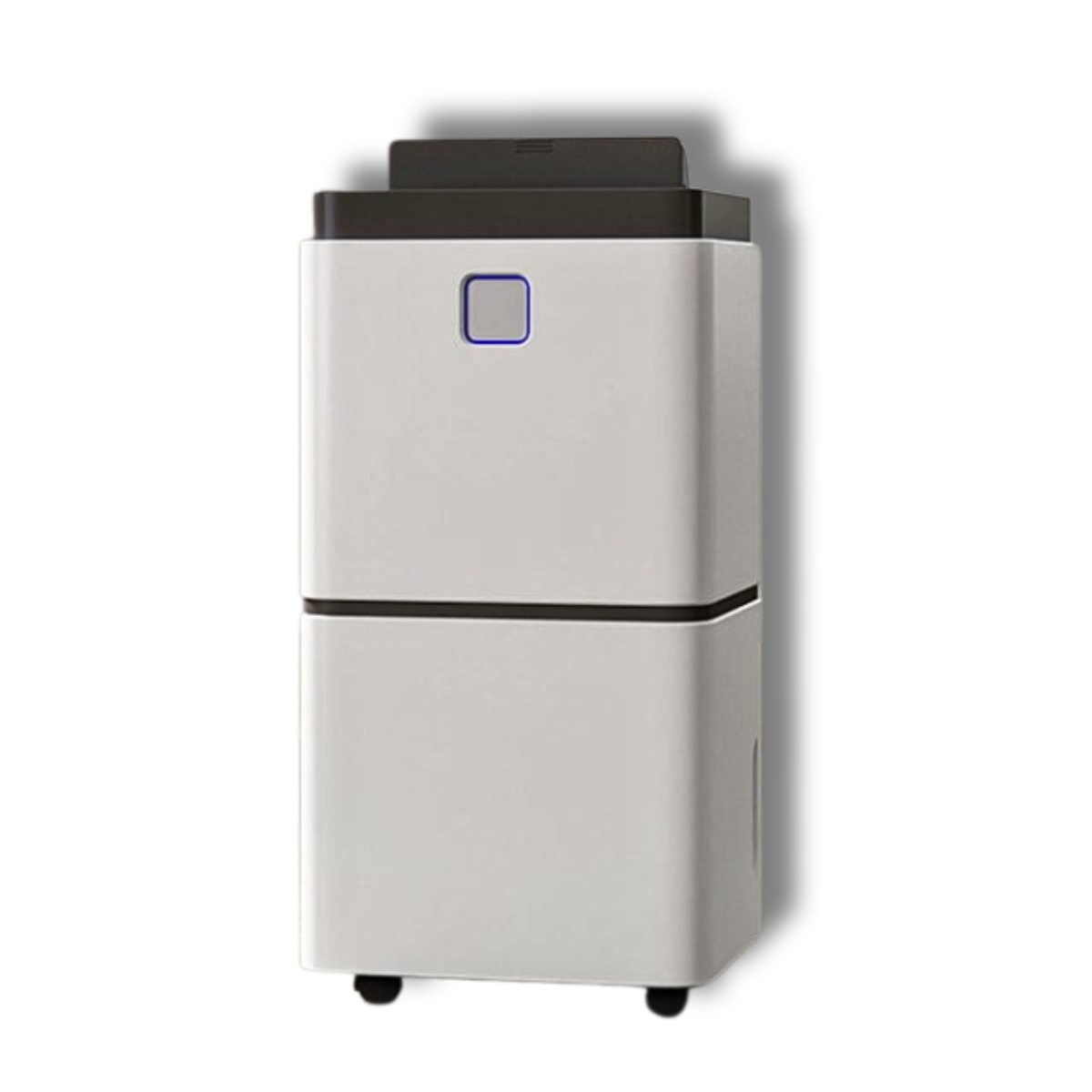
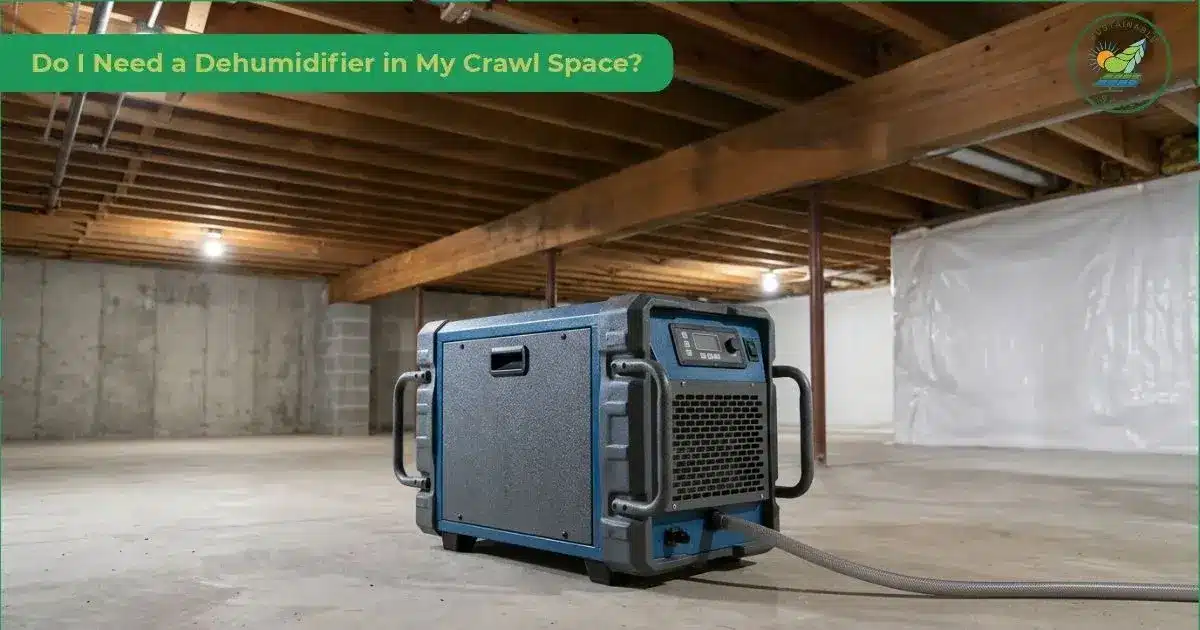

Yes, you need a dehumidifier in your crawl space because it helps control humidity and prevent long-term structural damage. A crawl space dehumidifier is essential when signs like musty odors, visible mold or mildew, surface condensation, wood rot, pest infestations, damp insulation, high humidity and cupping floors appear. It removes excess moisture, improves air quality and protects the structure from decay and unhealthy conditions.
A crawl space dehumidifier works by pulling in humid air, condensing moisture into water, draining it out and circulating dry air back into the space. It costs between $300 and $3,500, with installation costing $500 to $2,000 and moderate yearly operating expenses. A crawl space dehumidifier should be chosen based on crawl space size, humidity level, key features like automatic drainage and proper placement for effective performance.
A crawl space dehumidifier includes reliable options like BaseAire AirWerx 65X, AprilAire E070 and Waykar 155 Pint for different capacity needs. It requires proper installation with a clean, level area, drainage setup and safe electrical connection. It needs correct usage by setting the humidity around 50% to 55% and regular maintenance like cleaning filters and checking the drain system. A crawl space dehumidifier provides benefits such as structural protection, better air quality, energy efficiency, pest and mold control and long-term home value.
What signs indicate that I need a dehumidifier in my crawl space?
You need a dehumidifier in your crawl space when you see signs such as musty odors, visible mold or mildew, surface condensation, structural damage, pest infestations, damp insulation, high humidity or cupping floors. They indicate moisture problems so put a dehumidifier in the crawl space to manage humidity and protect the structure from long term damage.
The signs that indicate that you need a dehumidifier in your crawl space are given below.
- Musty odors: Detect musty odors in crawl space environments, which signal trapped moisture. A dehumidifier in a crawl space removes odor compounds, reduces damp air accumulation and stabilizes air quality.
- Visible mold or mildew: Notice mold or mildew on walls or insulation that shows humidity above 60%. It spreads quickly in damp conditions so a dehumidifier in the crawl space controls spores and protects indoor air quality.
- Surface condensation: Observe condensation on pipes, concrete or plastic sheeting, indicating saturated air. A dehumidifier in the crawl space prevents water buildup and protects surfaces from moisture damage.
- Structural damage or wood rot: Identify softened or rotting beams caused by chronic dampness. It weakens the foundation over time so a dehumidifier in the crawl space helps maintain structural strength.
- Pest infestations: Notice pest activity such as termites, silverfish or insects attracted to damp environments. They are attracted to damp environments so putting a dehumidifier in the crawl space makes the area dry and less suitable for infestations.
- Damp insulation: Check for sagging or wet insulation that loses effectiveness and encourages mold. It reduces energy so a dehumidifier in the crawl space keeps insulation dry and maintains proper temperature.
- High humidity levels: Measure humidity above 55 to 60% RH, which fosters mold, pests and structural issues. It creates an unhealthy environment so putting a dehumidifier in the crawl space maintains safe humidity and protects the home.
- Cupping floors: Observe floors warping unevenly due to vapor rising through subfloors so put a dehumidifier in the crawl space to reduce moisture and help keep floors stable over time.
What does a crawl space dehumidifier do?
A crawl space dehumidifier removes excess moisture from the air in the crawl space to control humidity and prevent mold, odors and structural damage. It pulls in humid air from the crawl space, turns moisture into water droplets, collects and drains the water away. The system reheats and circulates the dry air back into the crawl space to maintain ideal humidity levels of 45% to 55%. This protects structural wood, insulation materials and indoor air quality, which sustains a dry air environment and prevents mold growth and material decay.
How does a crawl space dehumidifier work?
A crawl space dehumidifier works through air intake, condensation process, water collection or drainage and reheating or exhaust. These processes keep the crawl space dry, protect the structure and maintain a healthy environment.
4 steps of how a crawl space dehumidifier works are given below.
- Air intake: A crawl space dehumidifier draws in humid air from the crawl space through an intake grille, which allows large volumes of air to continuously enter the unit for conditioning.
- Condensation process: A crawl space dehumidifier passes the moist air over cold coils inside the unit, which causes water vapor to condense into liquid droplets that are removed from the airstream.
- Water collection and drainage: A crawl space dehumidifier collects the condensed water in a reservoir or drain pan and then directs it to a drain line or pump so it safely exits the crawl space without pooling.
- Reheating and exhaust: A crawl space dehumidifier warms the dehumidified air as it passes over internal components and then exhausts it back into the crawl space as drier, less humid air to help control moisture levels.
How much does a crawl space dehumidifier cost?
A crawl space dehumidifier costs about $300 to over $3500 based on unit type, capacity and features. It costs about $300 to $600 for budget units, $900 to $1,500 for mid-range units and $1,500 to over $3,500 for commercial units. A crawl space dehumidifier usually adds $500 to $2,000 for installation that includes labour, drainage setup and electrical configuration. Its operating costs are about $50 to $150 per year, though heavier use can raise that to $300 to $500 annually.
How to choose the right dehumidifier for a crawl space?
Choose the right dehumidifier for a crawl space by calculating size and capacity, assessing environmental conditions, identifying features and determining placement or installation. These ensure proper humidity control, prevent mold growth and improve air quality in the crawl space.
4 steps to choose the right dehumidifier for a crawl space are given below.
- Calculate size and capacity: Measure the crawl space square footage and match the dehumidifier’s capacity to the moisture load so it can remove humidity efficiently.
- Assess environmental conditions: heck humidity levels, standing water, ventilation and insulation because harsher conditions usually require a more powerful, durable unit.
- Identify key features and requirements: Look for automatic drainage, humidistat control, energy efficiency and corrosion resistant parts, especially if the crawl space stays damp or hard to access.
- Determine placement and installation: Choose a location with good airflow, easy service access and proper drainage so the unit runs effectively and is easier to maintain.
What are the best dehumidifiers for a crawl space?
The best dehumidifiers for a crawl space are BaseAire AirWerx 65X, AprilAire E070 and Waykar 155 Pint. They are designed for durability and high moisture removal capacity and they perform well in low temperatures and tight crawl space conditions.
The best 3 dehumidifiers for a crawl space are given below.
- BaseAire AirWerx 65X: BaseAire AirWerx 65X provides durability and high moisture removal capacity in tight spaces. It is a budget friendly best dehumidifier for crawl spaces with performance in low temperature conditions.
- AprilAire E070: April Aire E070 represents the best dehumidifier for crawl space medium solution that confirms durability, high moisture removal capacity, ability to operate in low temperature and tight spaces environments.
- Waykar 155 Pint: Waykar 155 Pint functions as the best dehumidifier for a crawl space high capacity unit that maintains durability, high moisture removal capacity, ability to operate in low temperature and tight spaces conditions.
How to install a dehumidifier in a crawl space?
To install a dehumidifier in a crawl space, you have to prepare the crawl space installation area, set up the drainage and complete the electrical setup and activation.
The steps to install a dehumidifier in a crawl space are given below.
- Prepare the crawl space: Clear debris, remove standing water, fix obvious moisture issues and make sure the area is safe enough for installation and future service access.
- Prepare the installation area: Level the surface and place the dehumidifier in a central crawl space position to ensure balanced airflow and stable humidity control.
- Set up drainage: Connect a hose or pump system, drain the dehumidifier in the crawl space and direct collected water away from the crawl space to prevent moisture buildup and support continuous operation.
- Complete electrical setup and activation: Connect power safely, verify the outlet and wiring meet requirements, then turn on the unit and confirm it starts, drains and dehumidifies properly.
The image below shows where to place a dehumidifier in a crawl space.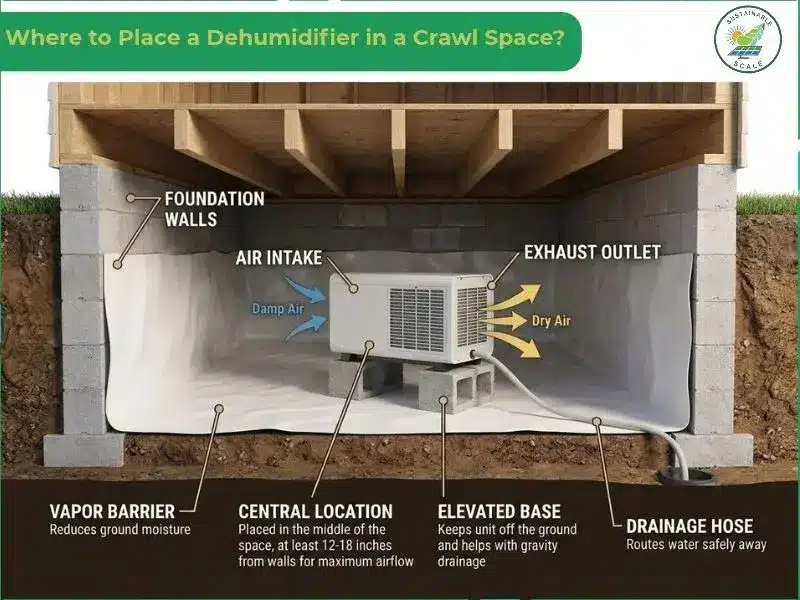
How to use a crawl space dehumidifier?
Use a crawl space dehumidifier by powering up the dehumidifier, setting up the dehumidifier settings, and maintaining it regularly to keep humidity under control. It works best when the target humidity level is adjusted correctly and the drain hose is kept clear for continuous moisture removal.
The steps to use a crawl space dehumidifier are given below.
- Power dehumidifier: Plug in the unit, confirm the drain hose is secure, and switch it on so it can begin removing moisture from the crawl space air.
- Configure dehumidifier settings: Adjust the target humidity level, usually around 50% to 55% and verify the controls are set for automatic operation if available.
- Maintain dehumidifier: Check the drain hose for clogs, clean the filter and inspect the unit often to keep it running efficiently and prevent moisture buildup.
What are the advantages of using a dehumidifier in a crawl space?
The advantages of using a dehumidifier in a crawl space are structural protection, improved air quality, energy efficiency and HVAC savings, pest and mold control and long term investment value. A dehumidifier in a crawl space maintains optimal moisture levels that stabilize structure, air composition and system performance.
The advantages of using a dehumidifier in a crawl space are given below.
- Structural protection: A dehumidifier in a crawl space reduces moisture level, prevents wood rot, protects beams and joists and stabilizes foundation materials if humidity exposure causes structural deterioration.
- Improved air quality: A dehumidifier in the crawl space lowers airborne allergens, reduces musty odors and limits microbial particles, which improves indoor air quality and healthier breathing conditions with dehumidified crawl space control.
- Energy efficiency and HVAC savings: A dehumidifier in a crawl space reduces latent load on HVAC systems, preconditions incoming air, lowers energy consumption and improves operational efficiency through dehumidifying crawl space moisture regulation.
- Pest and mold control: A dehumidifier in the crawl space eliminates excess moisture that supports mold spores and pest activity, which restricts breeding conditions and maintains controlled humidity levels.
- Long-term investment value: A dehumidifier in a crawl space preserves structural integrity, reduces maintenance costs, increases property durability and supports long term asset value through continuous crawl space moisture management.
Can a dehumidifier eliminate crawl space molds?
No, a dehumidifier cannot eliminate crawl space molds because it only works to dehumidify the crawl space and prevent future growth. It does not remove or kill existing mold in a crawl space and does not perform full mold remediation. It helps reduce excess moisture levels and create conditions that slow down mold development over time. It helps prevent mold from returning and keeps the crawl space environment dry.
Can I place a dehumidifier in a crawl space without encapsulation?
Yes, you can place a dehumidifier in a crawl space without encapsulation because it reduces humidity like a dehumidifier in a vented crawl space setup. It helps prevent mold and protect structural integrity in open conditions. It also supports better air quality and limits dampness over time. It works differently compared to a dehumidifier in an encapsulated crawl space, which operates in a sealed and controlled environment.
Is it worth placing a dehumidifier in a crawl space without encapsulation?
Yes, it is worth placing a dehumidifier in a crawl space without encapsulation because it controls moisture in a non-encapsulated crawl space where humidity enters through vents. It reduces dampness to prevent mold and wood damage while improving air quality and maintaining drier conditions over time. It differs from a dehumidifier in a crawl space with encapsulation, which operates in sealed environments.
Can I install a crawl space dehumidifier by myself?
Yes, you can install a crawl space dehumidifier by yourself because a diy crawl space dehumidifier setup is possible with basic tools and proper guidance. It is a challenging project that requires crawl space access, electrical setup and drainage planning for proper operation. It becomes easier when you follow the manufacturer’s instructions and safety steps carefully. This helps ensure correct placement and steady performance if you are comfortable working in tight spaces.
What is the ideal humidity for my crawl space?
The ideal humidity for my crawl space is 45% to 55% because it stays at the maximum threshold of 60% to prevent mold and moisture damage. It helps reduce the risk of wood rot, mold growth and structural problems over time. It is maintained by using a dehumidifier to dehumidify the crawl space air properly. It is controlled encapsulation to block outside moisture and keep the crawl space dry year round.
Can I use multiple dehumidifiers in a crawl space?
Yes, you can use multiple dehumidifiers in a crawl space because a single unit may not handle high moisture levels in large or complex areas. They are useful in separate sections with limited airflow where one machine cannot reach all spaces. They help balance humidity across the entire crawl space. This setup improves performance and stabilizes humidity across the crawl space.
Should I run a crawl space dehumidifier year round?
Yes, you should run a crawl space dehumidifier year-round because it helps maintain consistent humidity levels around 45 to 55% in all seasons. It helps prevent mold, wood rot and structural damage with continuous moisture control. It protects the home’s foundation and improves indoor air quality regardless of outside weather conditions. It confirms a stable, dry environment in the crawl space, which reduces long term repair risks and supports home durability.
How often should I change the filters of my crawl space dehumidifier?
You should change the filters of your crawl space dehumidifier every 6 to 12 months because it keeps airflow strong and ensures efficient operation. It helps maintain performance in encapsulated spaces where dust builds up faster. It requires annual replacement in high use conditions for better durability. It supports cleaning filters with water and replace dirty filters on time while reducing system strain and improving longterm moisture control.
Solar Panel
Air Purifier