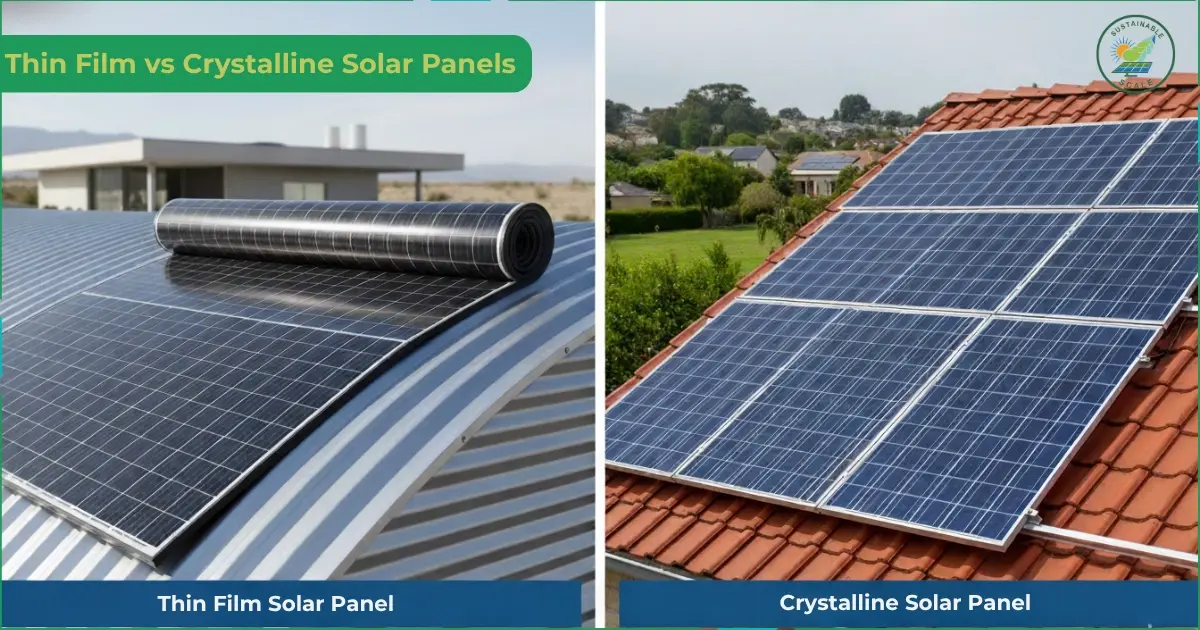

Thin-film solar panels and crystalline solar panels differ in efficiency, cost, installation and environmental impact. Thin-film panels use semiconductor layers like cadmium telluride or amorphous silicon deposited on glass or flexible substrates, while crystalline panels rely on silicon solar cells, either monocrystalline or polycrystalline.
Crystalline solar panels offer higher efficiency rates, exceeding 20%, compared to thin-film’s 10 to 13%, which means crystalline power delivers more electricity per square foot. Thin-film solar panels are more cost-effective upfront and provide greater flexibility for their lightweight and adaptable design.
Installation of thin-film panels is usually simpler and faster, but crystalline panels boast superior durability and a longer lifespan, and last 25 to 30 years with consistent performance. Crystalline panels avoid toxic materials like cadmium found in some thin-film technologies, though both types contribute positively by reducing carbon emissions compared to fossil fuels.
Crystalline panels offer better efficiency, durability and overall performance, but thin-film panels are flexible and have lower initial costs. Choosing between thin-film and silicon solar panels depends on factors such as available space, budget, desired lifespan and specific energy needs, which makes it essential to weigh the pros and cons of each technology to know the best fit for your situation.
Thin-film solar panels are a type of photovoltaic panels made of ultra-thin layers of photovoltaic material deposited onto a substrate. These panels convert sunlight into electricity by absorbing light in their thin semiconductor layers, which generate power through electron excitation.
Types of thin-film solar panels include amorphous crystalline, cadmium telluride, copper indium gallium selenide (CIGS) and organic photovoltaic (OPV).
Thin film solar panel characteristics are visualised in the image below.

Crystalline solar panels are solar modules made from crystalline semiconductor materials, predominantly silicon, designed to convert sunlight directly into electricity through the photovoltaic effect. These panels achieve efficiency between 15% and 22%, exhibit excellent durability and have a lifespan of 25 to 30 years.
Crystalline panels are made from purified crystalline silicon and generate electricity when sunlight excites electrons in silicon cells and creates crystalline power via the photovoltaic effect.
There are two main types of crystalline solar panels, monocrystalline silicon solar panels and polycrystalline silicon solar panels, which differ in crystal purity and efficiency. Crystalline solar panels provide 22% efficiency using monocrystalline silicon and remain low cost for both residential and commercial use. They resist severe weather and maintain performance over 30 years.
The comparison between Monocrystalline and Polycrystalline solar panels are shown in the image below.

The main differences between thin-film and crystalline silicon solar panels lie in efficiency, cost, installation and environmental impact. Monocrystalline solar panels have higher efficiency rates of 15% to 22%, while polycrystalline panels range from 13% to 17%. In comparison, thin-film solar panels have efficiencies of 10% to 13%, though some advanced types reach up to 15%.
Thin-film panels cost less to produce because they use fewer materials and have a simpler manufacturing process. This lowers the upfront cost of solar systems, especially in large-scale installations. Crystalline silicon solar modules cost between $0.60 and $0.90 per watt, while thin-film panels range from $0.50 to $1.00 per watt for materials, though total installed costs may vary depending on the project.
Thin-film solar panels are light and flexible, weighing between 5 to 10 kilograms per square meter. This makes them easier to install on curved or delicate surfaces. Crystalline panels are heavier, around 15 to 20 kilograms per square meter, and require stronger mounting systems.
Thin-film and silicon solar panels impact the environment in different ways. Some thin-film types, like cadmium telluride (CdTe), are harder to dispose of because they contain toxic materials. On the other hand, crystalline silicon panels require a significant amount of energy to produce, which contributes to their environmental footprint.
Thin film and crystalline solar comparison is shown in the image below.

Crystalline solar panels provide higher efficiency than thin-film solar panels, as monocrystalline types offer efficiency between 15% to 22%, and polycrystalline panels range from 13% to 17%, while thin-film solar panels are usually 10% to 13%.
Thin-film solar panels have better temperature coefficients than crystalline panels, with thin-film around –0.2% per °C and crystalline panels closer to –0.4% to –0.5% per °C. In hot climates or on surfaces with high heat exposure, thin-film panels maintain more stable output.
Thin-film solar panels also perform better in low-light conditions like cloudy days or early mornings, while crystalline panels perform best in direct sunlight and lose more efficiency in low light. Thin-film panels suit regions with frequent cloud cover or inconsistent sunlight, but require more surface area to match crystalline output.
This PV module efficiency comparison shows that crystalline panels are ideal for homes and small roofs, while thin-film panels provide value in large-scale, low-cost or specialty projects.
Thin-film solar modules cost $0.50 to $1.00 per watt, while crystalline panels range from $0.60 to $0.90 per watt, showing a notable cost difference. Thin-film modules reduce initial material costs by about 10% to 20% which contribute to their lower pricing.
Thin-film panels are lighter and more flexible, so they are easier and often cheaper to install. Their lower weight of 7 to 10 ounces per square foot (about 2 to 3 kg/m²) reduces the need for heavy mounting hardware and can speed up installation.
Thin-film panels have lower efficiency, usually 10% to 13%, and need more space and panels to match the output of crystalline panels. Crystalline panels are heavier and cost more to mount, but they generate more power per square meter, about 150 to 220 watts, and their higher efficiency reduces the number of panels needed.
Thin-film panels tend to degrade faster and need replacement sooner, but they remain a low-cost PV option with strategic value for budget projects or temporary setups. Crystalline panels, by contrast, offer better value through longer lifespans of 25 to 30 years with stable output.
Thin-film solar panels are easier to install than crystalline panels due to their lightweight design and greater flexibility. Thin-film panels weigh 5 to 10 kilograms per square meter, while crystalline panels are heavier at 15 to 20 kilograms per square meter.
Thin-film panels are lighter, weighing 12 to 15 kg per panel, which reduces labor costs and makes them easier to handle during installation. In contrast, crystalline panels weigh 18 to 22 kg per panel and require sturdier support structures.
The installation cost for thin-film solar panels ranges from $12,000 to $15,000 for a residential system, while crystalline solar panels cost between $12,500 and $17,000. Thin-film panels are more flexible and can be placed on curved or delicate surfaces, while crystalline panels are rigid and work best on flat, sturdy rooftops.
Crystalline solar panels have a lower environmental impact over their lifetime compared to some thin-film panels, due to their longer lifespan and stable performance. Some thin-film panels, such as those made from cadmium telluride (CdTe), contain hazardous elements that complicate waste disposal and recycling. Crystalline panels are made from silicon, a non-toxic material, which makes them easier and safer to recycle.
Thin-film panels have an advantage in requiring less energy to manufacture which leads to lower carbon emissions upfront, around 14 g CO2e per kWh. Both crystalline and thin-film panels use similar amounts of water in production, approximately 26 gallons per megawatt-hour (MWh).
The advantages of thin-film solar panels over crystalline solar panels include their lightweight design, flexibility, lower cost and better performance in low light conditions.
The benefits of thin-film solar panels when compared to crystalline are listed below.
The advantages of crystalline solar panels over thin-film solar panels include their higher efficiency, cost-effectiveness, durable nature and stable performance across various conditions.
The benefits of crystalline solar panels when compared to thin-film solar panels are outlined below.
To choose between thin-film and crystalline panels, assess your energy needs, budget and installation conditions. Thin-film panels suit lower budgets, flexible installations and low-light environments. Crystalline panels, on the other hand, are better for high efficiency, long-term durability and limited space where maximum output is required.
The factors to consider when choosing between thin-film and crystalline solar panels are listed below.
The right choice of solar panels depends on balancing your performance expectations, space availability and long-term investment. Thin-film panels offer flexibility and lower upfront costs, while crystalline panels deliver higher efficiency, durability and better returns in space-constrained setups.
Yes, thin-film solar panels are worth it for specific uses such as mobile homes, RVs, boats or large commercial projects where flexibility, lightweight design and lower upfront costs are priorities. They are less suitable for most residential rooftops, due to lower efficiency, shorter lifespan and higher space requirements compared to crystalline panels.
Yes, crystalline solar panels are worth it for most homeowners and businesses. They offer high efficiency, long lifespans of 25 years or more and reliable performance in various conditions.
The upfront cost of crystalline solar panels is higher, but their durability and strong energy output provide excellent long-term savings and return on investment.
The types of thin-film solar panels are outlined below.
There are 2 main types of crystalline solar panels which are listed below.
The materials that are used in thin-film solar panels are listed below.
The materials that are used in crystalline solar panels are listed below.
The disadvantages of thin-film solar panels are given below.
The disadvantages of crystalline solar panels are given below.