

Solar panel specifications include electrical characteristics, mechanical construction, documentation, warranties and performance factors. These specifications help installers, designers and buyers evaluate capacity, compatibility, durability and expected energy production. Solar panel electrical specifications include maximum power (Pmax), efficiency, voltage at maximum power (Vmp), current at maximum power (Imp) and open-circuit voltage (Voc). Solar panels use these values to describe rated power, conversion efficiency, operating voltage and current, temperature related performance and real world operating conditions. These specifications help designers size strings, select compatible inverters and charge controllers and estimate expected output.
Solar panel mechanical specifications include dimensions, weight, frame material, junction box and cables, cell type and degradation rate. They describe physical size, structural support, mounting requirements, connection components, photovoltaic technology and long term power retention. These specifications help installers plan roof layouts, assess loading, select compatible mounting hardware, manage handling requirements and evaluate durability.
Solar panels have specification sheets that provide information on PV panels such as electrical ratings, mechanical properties, temperature data, warranties, certifications and structural limits. They help users compare products and verify technical information. Solar panels also have manufacturer certificates that verify quality, safety, rated performance and compliance, while their warranties cover product defects and minimum power retention.
What are the electrical specifications of solar panels?
The electrical specifications of solar panels include maximum power (Pmax), solar panel efficiency, voltage at maximum power (Vmp), current at maximum power (Imp) and open-circuit voltage (OCV). These electrical specifications describe the module’s rated power, voltage, current, efficiency and temperature behavior. Solar panel electrical specifications help installers match modules with inverters, strings, wiring, mounting designs and expected operating conditions. Maximum power (Pmax) states the highest rated electrical power under standard test conditions, expressed in watts. Solar panel efficiency shows the percentage of incoming sunlight that the module converts into electrical energy. Voltage at maximum power (Vmp) identifies the voltage at which the module produces its maximum rated power.
The electrical specifications of solar panels are listed below.
- Maximum power (Pmax)
- Solar panel efficiency
- Voltage at maximum power (Vmp)
- Current at maximum power (Imp)
- Open circuit voltage (OCV)
- Short circuit current (Isc)
- Temperature coefficients
- Nominal operating cell temperature (NOCT)
Maximum Power (Pmax)
Maximum power (Pmax) is an electrical specification of solar panels that identifies a module’s greatest electrical output at its Maximum Power Point (MPP). It represents the point where current and voltage combine to produce the solar panel’s highest power output. A maximum power (Pmax) rating of 450 watts (W) indicates that a solar panel produces 450 W under standard test conditions (STC). These STC measurements use 1,000 W/m² irradiance, a 25°C cell temperature and an AM1.5 solar spectrum.
Maximum power (Pmax) helps system designers compare module capacity, calculate total solar array output, match panels with inverters and estimate expected electricity production. It represents a standardized nameplate rating rather than guaranteed field output.
Solar Panel Efficiency
Solar panel efficiency is an electrical specification of solar panels that measures the percentage of sunlight a photovoltaic module converts into usable electricity. Solar panel efficiency ratings express this value as a percentage of solar energy converted into electrical output. Solar panel efficiency is important because it shows how much power a module produces within a fixed roof or ground area. It helps homeowners and system designers compare panels, maximize limited installation space and select suitable modules.
Solar panel efficiency ranges from 18% to 23% for residential modules. It reaches 22% to 24% in high end panels, while premium modules approach 25% under laboratory conditions. Solar panel efficiency ratings are measured under Standard Test Conditions (STC), which include 1,000 W/m² irradiance, a 25°C cell temperature and an AM1.5 spectrum. It varies with cell technology, temperature, irradiance, shading, dust orientation, tilt and airflow beneath the module.
Voltage at Maximum Power (Vmp)
Voltage at maximum power (Vmp) is an electrical specification of solar panels that indicates the voltage at which a module produces its maximum power output. It represents the operating voltage at the Maximum Power Point (MPP), where voltage and current combine to produce the highest power. Vmp appears on a solar panel’s specification sheet or datasheet within the electrical characteristics table. It is labeled as “Vmp,” “Vmpp,” “Maximum Power Voltage,” or “Voltage at Maximum Power,” alongside the maximum power current value, Imp.
Vmp is specified under Standard Test Conditions (STC), which use 1,000 W/m² irradiance, a 25°C cell temperature and an AM1.5 solar spectrum. Voltage at maximum power (Vmp) is important because it guides series string sizing and confirms compatibility with an inverter or MPPT charge controller. It decreases as module temperature rises, so designers check hot-weather Vmp against the equipment’s minimum MPPT voltage range.
Current at Maximum Power (Imp)
Current at maximum power (Imp) is an electrical specification of solar panels that indicates the current a module generates when operating at its Maximum Power Point (MPP). It represents the panel’s operating current when producing its rated power under specified test conditions. Current at maximum power (Imp) indicates the amperage available when a solar panel delivers its rated power to an inverter, charge controller or electrical load. It also helps with cable, fuse, connector and parallel string sizing.
Current at maximum power (Imp) combines with Voltage at Maximum Power (Vmp) to calculate Pmax using the formula Pmax = Vmp × Imp. Vmp identifies the operating voltage, while Imp identifies the operating current. Current at maximum power (Imp) remains lower than Isc (Short Circuit Current) because Isc is measured when the panel operates at zero voltage with its terminals shorted. It differs from Voc (Open Circuit Voltage), which represents the panel’s voltage when no external load is connected.
Open-Circuit Voltage (OCV)
Open-circuit voltage (OCV) is an electrical specification of solar panels that indicates the maximum voltage a module produces when no electrical load is connected to its terminals. It occurs when the external circuit remains open, so no current flows to an inverter, charge controller, battery or other equipment. Open circuit voltage (OCV) is important because it helps system designers calculate the combined voltage of solar panels wired in series. It also helps installers verify that an array remains below the maximum DC voltage limits of the inverter, charge controller, connectors and other electrical components.
Open-circuit voltage (OCV) appears in the electrical specifications table of a solar panel datasheet under Standard Test Conditions (STC). STC uses 1,000 W/m² irradiance, a 25°C cell temperature and an AM1.5 solar spectrum. Open-circuit voltage (OCV) decreases as cell temperature rises and increases during cold weather. It represents the no-load maximum voltage, whereas Vmp represents the lower operating voltage at maximum power.
Short-Circuit Current (Isc)
Short-circuit current (Isc) is an electrical specification of solar panels that indicates the maximum current produced when the positive and negative terminals are directly connected. It occurs under zero voltage because the direct connection creates a short circuit. Short-circuit current (Isc) appears in the electrical characteristics table of a solar panel datasheet under Standard Test Conditions (STC). It is expressed in amperes (A) and represents the current at the zero voltage point of the module’s current-voltage curve.
Short-circuit current (Isc) is important because it helps designers size cables, fuses, connectors, charge controllers and overcurrent protection equipment safely. It indicates the module’s maximum available current, while Imp identifies the lower operating current at maximum power. Short-circuit current (Isc) occurs when voltage equals zero, whereas OCV occurs when current equals zero.
Temperature Coefficients
Temperature coefficients are electrical specifications of solar panels that show how power, voltage and current change as cell temperature varies from the 25°C STC baseline. They appear on a solar panel datasheet in the electrical characteristics or temperature coefficients section. Temperature coefficients commonly include Pmax, Voc and Isc values. A Pmax coefficient of −0.35%/°C means the panel loses 0.35% of its rated power for every degree Celsius increase above 25°C.
Temperature coefficients for Pmax and Voc are negative because solar panels produce less power and voltage as cell temperature rises, while Isc increases slightly with temperature. Temperature coefficients with smaller negative Pmax values indicate better hot weather performance. Solar panels with a Pmax coefficient of −0.25%/°C experience less power loss than panels rated at −0.40%/°C as cell temperature rises.
Nominal Operating Cell Temperature (NOCT)
Nominal operating cell temperature (NOCT) is a thermal specification of solar panels that indicates the expected cell temperature under standardized outdoor operating conditions. It helps estimate real world power output beyond laboratory Standard Test Conditions ratings. NOCT uses 800 W/m² irradiance, a 20°C ambient temperature, 1 m/s wind speed, open rack mounting and no electrical load. Solar panels have NOCT values ranging from 40°C to 45°C.
NOCT varies with sunlight intensity, ambient temperature, wind, mounting method, tilt, roof heat and rear ventilation. It increases when restricted airflow traps heat beneath the module. NOCT works with temperature coefficients to estimate power loss as cell temperature rises. Solar panels with lower operating temperatures experience less heat related output loss.
What are the mechanical specifications of solar panels?
The mechanical specifications of solar panels include dimensions, weight, frame material, junction box and cables, cell type and degradation rate. They describe the module’s physical size, construction, materials, connection components, cell configuration and expected durability. Solar panel mechanical specifications help installers plan handling, roof loading, mounting compatibility, wiring and long term performance.
Dimensions state the panel’s length, width and thickness. Weight states the total mass of the solar panel. Frame material identifies the panel’s structural edge support. Junction box and cables identify the module’s rear electrical enclosure, bypass diodes, protection rating, cable size, cable length and connector type. Cell type identifies the solar cell technology inside the panel such as monocrystalline PERC, TOPCon or other crystalline silicon designs. Degradation rate states the expected annual reduction in solar panel power output.
The mechanical specifications of solar panels are listed below.
- Dimensions
- Weight
- Frame material
- Junction box and cables
- Cell type
- Degradation rate
1. Dimensions
Dimensions are a mechanical specification of solar panels that define solar module size through external measurements of length, width and thickness in millimeters or inches. Solar panel measurements guide roof layout planning by determining module capacity around setbacks, vents, skylights, chimneys and other obstacles. Dimensions affect portrait or landscape orientation, row spacing, shading clearance and area per kilowatt.
Solar panels require installers to follow manufacturer manuals for approved clamp zones and rail spacing. Dimensions affect loading because larger surface areas face increased wind uplift and snow forces. Dimensions also make oversized panels difficult to carry and position across rooftops. Solar panel dimensions in modern high wattage commercial modules include thicker structural components, encapsulation layers and rear glass that improve rigidity but increase overall weight.
2. Weight
Weight is a mechanical specification of solar panels that states the mass of a complete solar module in kilograms or pounds. Solar panels include cells, glass, frames, junction boxes, cables and other materials that contribute to total weight. Weight affects total roof loading, including panels, rails, clamps, ballast, snow accumulation, wiring and maintenance access.
Solar panels with greater weight create lifting hazards in windy conditions or on elevated roofs, requiring two person handling and careful positioning. They require roof hooks, fasteners, rails and clamps rated for their mass and site specific loads. Weight per unit area provides a useful structural comparison. Solar panels also contribute to dead load in ground mount systems, while wind and snow forces often control the structural design.
3. Frame Material
Frame material is a mechanical specification of solar panels that forms the rigid perimeter, protects glass edges, increases stiffness, provides mounting points and resists environmental loads. Solar panels use anodized aluminum alloy, while frameless glass construction and specialty metals suit architectural modules and specialty designs. Frame material benefits from anodizing because the resulting protective oxide layer improves corrosion resistance and long term durability. Solar panels with deeper frame profiles provide greater stiffness under high wind or snow loads.
Frame material with black finishes visually integrates with dark roofs but absorbs more heat. It also influences water drainage and the accumulation of dust, leaves and snow around the perimeter metal. Solar panels require compatible clamps, rails and fasteners with suitable profile depth, placement, torque and rail span to prevent damage and warranty issues. They also require separation from dissimilar metals in moist conditions to reduce galvanic corrosion.
4. Junction Box and Cables
Junction box and cables are mechanical specifications of solar panels that describe the rear enclosure and attached leads for electrical connection, handling and cable routing. Solar panels have a junction box that serves as the main electrical connection point and contains bypass diodes, terminal connections and output leads. Junction box and cables have ingress protection ratings, potting materials and suitable operating temperature ranges that help protect against water ingress, moisture, dust, thermal cycling and vibration related damage.
Solar panels use bypass diodes to route current around shaded cell strings, reducing overheating and hot spots. Junction box and cables specify cable cross section, weather resistant insulation, connector type and maximum system voltage for safe array design. Solar panels have different positive and negative lead lengths that help installers connect adjacent modules in a series string without extension cables.
5. Cell Type
Cell type is a mechanical specification of solar panels that identifies the photovoltaic technology and semiconductor cells used in a module. Solar panels use different cell types that determine how they convert sunlight into direct current electricity and influence appearance, dimensions, heat behavior, efficiency, degradation and bifacial performance. Cell types include monocrystalline silicon, which provides high efficiency and a dark appearance for limited roof space and premium installations. Solar panels using PERC technology have rear side passivation that reduces recombination losses and improves light capture compared with conventional silicon cell designs.
Cell type also includes TOPCon technology, which uses passivated contacts to support strong bifacial performance and lower degradation potential. Solar panels also require heterojunction and thin film technologies, including cadmium telluride, which offer distinct heat performance characteristics and manufacturing advantages.
6. Degradation Rate
Degradation rate is a mechanical specification of solar panels that states the expected annual percentage decline in power output as a module ages. Solar panels have degradation rates of around 0.4% to 0.8% per year, although performance varies by technology, manufacturing quality and climate. Degradation rate follows a two part schedule that separates first year power reduction from subsequent annual linear loss. It specifies a 1% to 2% first year decline followed by about 0.4% to 0.55% annual loss.
Degradation rate differs from product warranties because they cover material or workmanship defects, while performance warranties guarantee minimum power output over 25 to 30 years. Solar panels experience faster degradation because of thermal cycling, moisture ingress, cell microcracks, potential induced degradation (PID), connection corrosion, laminate failures and solder joint fatigue. These issues reduce energy yield by damaging cells, encapsulation, electrical contacts or module interconnections.
What is a solar panel specification sheet?
A solar panel specification sheet is an official manufacturer document that details a photovoltaic module’s technical, electrical, physical and performance properties. It is also called a solar panel datasheet, which helps installers, designers and buyers compare panels and verify product legitimacy. A solar panel specification sheet lists power output in watts, efficiency percentage, voltage levels, current ratings and laboratory baselines such as Standard Test Conditions. It also includes temperature coefficients and operating temperature data that show how power output and efficiency change under different temperatures and real world conditions.
A solar panel specification sheet describes mechanical specifications such as module size, weight, frame material, glass type, cable lengths, wind resistance and snow load limits. It also states product warranties, long term performance guarantees and safety certifications. A solar panel datasheet can be read by comparing rated power, efficiency, Vmp, Imp, OVC/Voc, Isc, temperature coefficients and structural ratings. It helps installers design safe layouts and match compatible inverters, while buyers use it to compare quality and verify product legitimacy.
The image below shows an example of a solar panel data sheet.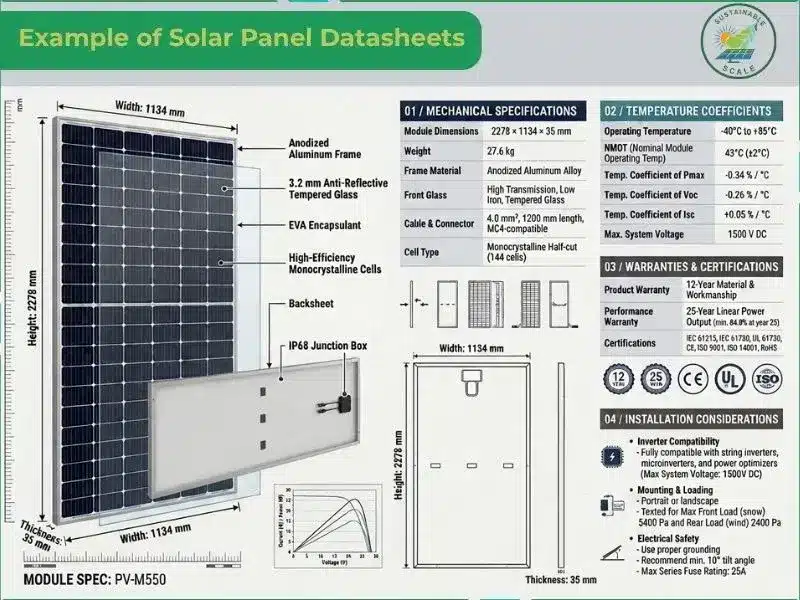
What is a manufacturer’s certificate for solar panels?
A manufacturer’s certificate for solar panels is official documentation that confirms photovoltaic modules meet specified quality, performance and safety standards. It includes a Certificate of Conformity from an accredited third party organization and verifies structural integrity, electrical safety, environmental stress resistance and wind load capacity. It also references standards such as UL 61730. A manufacturer’s certificate for solar panels includes factory flash test data for individual modules and validates their rated wattage. It also supports grid connection, regulatory approval, incentives and warranty claims.
What is a solar panel warranty?
A solar panel warranty is a manufacturer’s guarantee covering product quality and power production. It provides separate protections for physical defects and electrical output. It covers material failures, faulty wiring and premature equipment breakdown, while performance coverage guarantees minimum energy retention over the stated warranty period. A solar panel warranty also protects a specified percentage of rated capacity and limits annual degradation under its stated terms.
Does solar panel efficiency matter?
Yes, solar panel efficiency matters because solar panel efficiency ratings determine usable electricity from a limited installation area. Solar panel efficiency supports energy demand, reduces mounting hardware requirements, increases total power output and improves project economics.
What is a good temperature coefficient for solar panels?
A good temperature coefficient for solar panels is −0.25%/°C to −0.30%/°C for Pmax because a smaller negative value indicates less power loss as cell temperature rises. Solar panels with lower coefficients maintain better hot weather performance, although factory tested values should be compared under the same conditions.
Do solar panels degrade if not used?
Yes, solar panels degrade if not used because storage conditions expose them to moisture, heat, sunlight and other environmental factors. Solar panel degradation occurs through UV degradation and chemical degradation when modules are stored outdoors, while a dark warehouse limits those exposure related risks.
What is the best type of solar cell?
Perovskite silicon tandem cells are the best type of solar cell for maximum efficiency because they capture a broader range of sunlight across two material layers. Solar cell designs using Interdigitated Back Contact technology reduce front side shading, while Tunnel Oxide Passivated Contact technology balances efficiency, cost, availability and proven reliability.
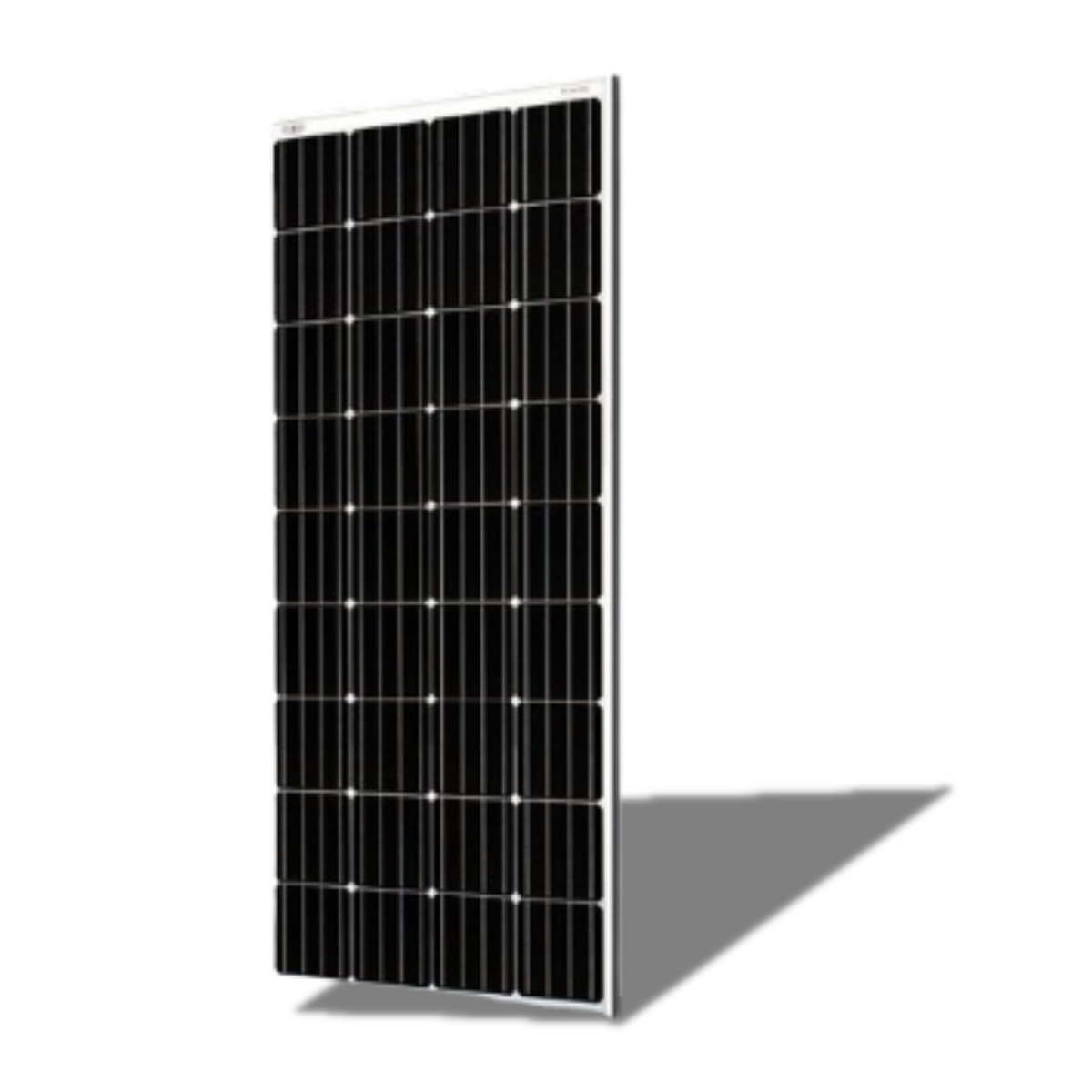
Solar Panel
Air Purifier