
Understanding the size, weight and wattage of solar panels is important for making the right investment if you are planning to install solar panels, especially when it comes to roof space, structural load and daily energy output. Residential panels measure around 65 x 39 inches and use 60 cells which makes them ideal for standard rooftops. In contrast, commercial panels are longer at roughly 77 x 39 inches, containing 72 to 96 cells to deliver higher wattage per panel for larger installations.
Panel’s length increases as the cell count increases, though the width remains consistent. 96-cell solar panels offer a compact high-output solution if you are tight on space but need more power. However, with more power comes more weight. Residential panels weigh 40 to 50 lbs on average, while commercial units exceed 50 lbs and require sturdier mounting.
Wattage is just as critical; most residential panels deliver 350 to 470W, while commercial panels range from 400 to 740W, depending on cell technology and design.
This article will walk you through the standard sizes, dimensions, weight ranges and wattage ratings of today’s most common solar panels, so you can plan your solar system with clarity and confidence.
The average size of solar panels for residential use is about 65 inches by 39 inches (5.4 feet by 3.25 feet), while commercial panels are larger, around 77 inches by 39 inches (6.42 feet by 3.25 feet). The number of cells in a panel is most commonly 60, 72 or 96, which directly impact its overall size.
The three common solar panel sizes that are widely used are listed below.
The number of cells determines the panel’s length, with more cells resulting in a longer panel. Width remains consistent across most solar models, but specialty panels like 96-cell designs are wider to accommodate additional cells.
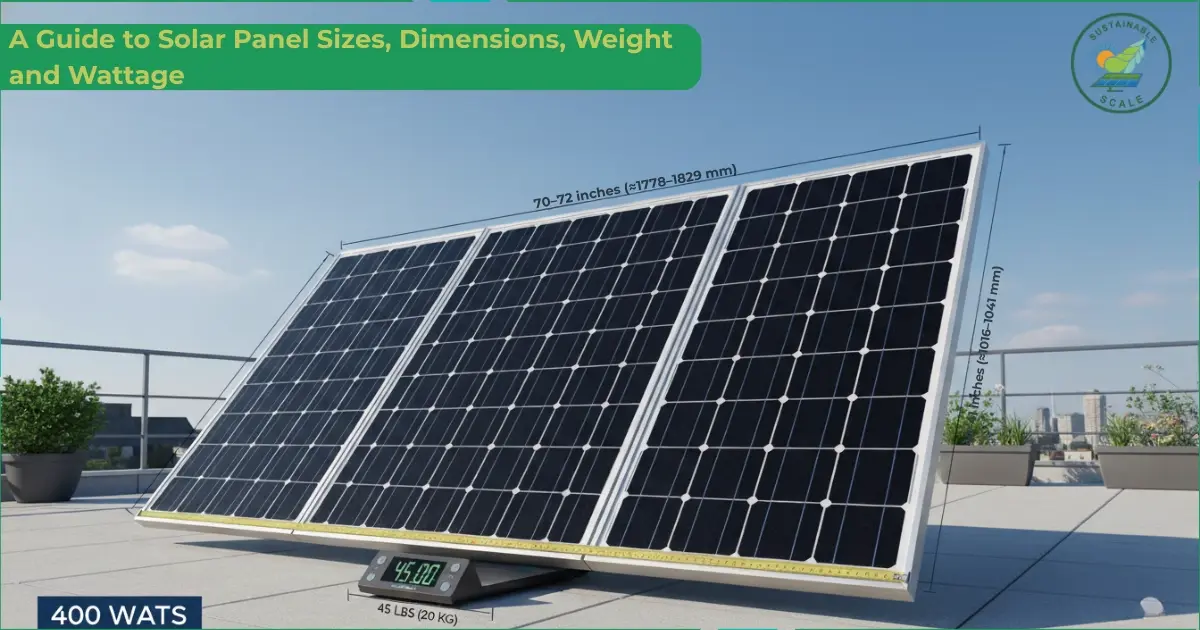
Solar panel measurements are shown in the image below.
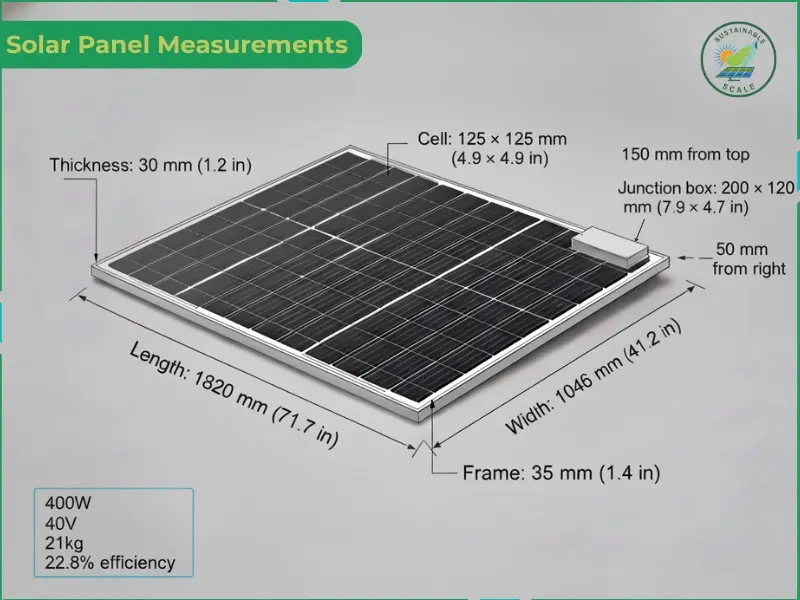
The size of residential solar panels is around 5.5 feet by 3 feet, while commercial panels are about a foot longer at approximately 6.5 feet by 3 feet, according to EnergySage.
The detailed comparison table of residential and commercial solar panels, focusing on the number of solar cells, average length, average width and average wattage is given below.
Residential solar panels | Commercial solar panels | |
Number of solar cells | 60 (sometimes 66 or 72) | 72 (sometimes up to 96) |
Average length | 65 to 66 inches (5.4 to 5.5 ft / 1.65 to 1.7 m) | 77 to 78 inches (6.4 to 6.5 ft / 1.95 to 2 m) |
Average width | 39 inches (3.25 ft / 1 m) | 39 inches (3.25 ft / 1 m) |
Average wattage | 300 to 400 W (350 to 400 W modern) | 400 to 550 W ( 415 to 500 W modern) |
Residential solar panels are 60-cell, but some newer models use 66 or 72 cells for higher output if roof space allows. Commercial panels, on the other hand, are larger, usually 72-cell, but can go up to 96 cells for utility-scale projects.
The sizes of monocrystalline and polycrystalline solar panels are almost the same, with heights ranging from about 64 to 77 inches (163 to 196 cm, 5.3 to 6.4 feet), widths from 39 to 51.5 inches (99 to 131 cm, 3.25 to 4.3 feet), and depths between 1.2 and 2 inches (3 to 5 cm). The main differences lie in their efficiency and appearance rather than their size or cell count.
To measure the size of a solar panel system correctly, follow the steps listed below.
A residential solar panel measures about 65 inches (5.4 feet) in length, 39 inches (3.25 feet) in width, and 1.5 to 2 inches in depth, while commercial panels are around 77 inches (6.4 feet) long, 39 inches (3.25 feet) wide, and 1.5 to 2 inches deep.
The standard size of solar panels depends on their application, brand and number of cells. Residential solar panels are about a foot shorter than commercial panels but share the same width and depth. Commercial panels’ increased length allows for more cells and higher wattage which makes them more suitable for large-scale installations.
Top 60-cell solar panel brands dimensions are listed below.
60-cell panel brand | Dimensions (inches) | Weight (lbs) |
LONGi | 66.25 x 39.21 x 1.37 | 41.6 |
QCells | 65.7 x 39.4 x 1.26 | 41.2 |
Trina | 65.04 x 39.13 x 1.38 | 41.9 |
Jinko Solar | 65.00 x 39.05 x 1.57 | 41.9 |
Top 72-cell solar panel brands dimensions are listed below.
72-cell panel brand | Dimensions (inches) | Weight (lbs) |
LONGi | 77 x 39 x 1.5 | 49.6 |
QCells | 78.50 x 39.40 x 1.38 | 52.9 |
Trina | 77.6 x 39.1 x 1.38 | 49.6 |
Jinko Solar | 77.91 x 39.45 x 1.57 | 50.7 |
These dimensions of solar panels vary slightly by model, but they represent the most common sizes for these leading solar brands.
Residential vs commercial solar panel dimensions are visualised in the image below.
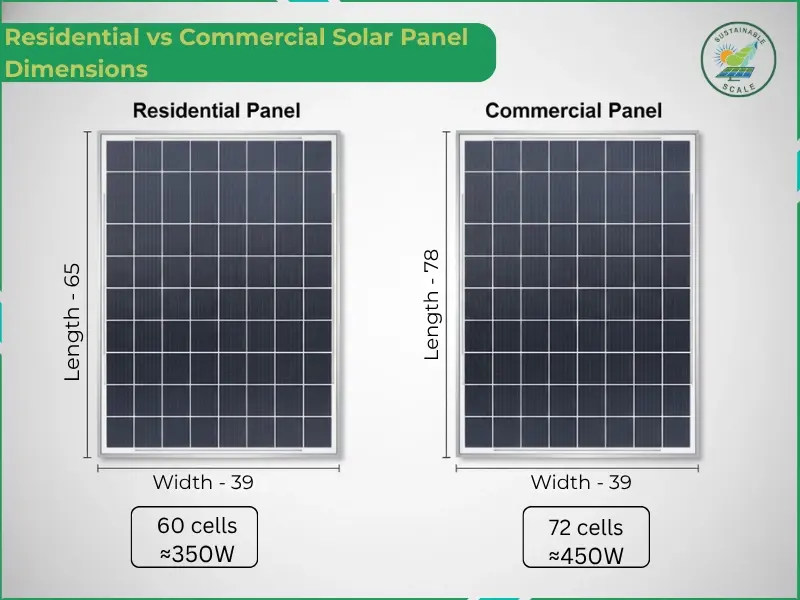
Solar panels weigh between 40 and 50 pounds for residential panels, with commercial panels weighing around 50 pounds or more, according to the data of SolarReviews. The weight of a solar panel depends on its size, cell count and construction materials.
Most residential solar panels, which have 60 cells, weigh about 40 pounds (18 kg), translating to approximately 2.3 to 2.8 pounds per square foot. These panels are designed to be sturdy, using tempered glass and aluminum framing to withstand outdoor conditions.
Commercial solar panels, which feature 72 cells, are larger and weigh around 50 pounds (23 kg), or about 2.5 to 5 pounds per square foot. Some high-capacity commercial panels and specialty models weigh up to 60 pounds or more.
The bulk of a panel’s weight comes from the glass and frame, rather than the solar cells themselves, which are relatively light. There are some lighter and heavier models available as well, but these averages represent the most common weights found in residential and commercial installations.
The weight of solar panels by brand is given in the table below.
Solar panel brand | Solar panel model | Solar panel weight (lbs / kg) |
Jinko Solar | Tiger Neo N-type 54HL4R-B 440 W | 48.5 lbs / 22 kg |
Jinko Solar | Eagle 72 JKM410M-72HL-V G2 410W | 49.6 lbs / 22.5 kg |
QCells | Q.TRON BLK M-G2+ 430 W | 47.2 lbs / 21.4 kg |
QCells | Q.PEAK-DUO-ML-G10+ 410 W | 48.5 lbs / 22 kg |
Trina Solar | TSM-425NE09RC.05 425 W | 47 lbs / 21.3 kg |
The factors that impact solar panel weight are given below.
The wattages of residential solar panels range from 350 to 470 watts, while commercial panels offer higher wattages, from 400 up to 740 watts, with some common commercial models producing between 500 and 600 watts, according to the data from Greenlancer. Commercial panels have higher wattage than residential panels due to their larger size and increased number of solar cells.
Cell technology impacts a solar panel’s wattage. Panels using advanced cell types, such as monocrystalline or PERC (Passivated Emitter and Rear Cell) technology, achieve higher efficiency and higher wattage for the same panel size compared to older polycrystalline designs. For example, monocrystalline panels offer higher power output and efficiency than polycrystalline panels of the same size.
Higher wattage does not always mean a panel is better for every installation. Higher wattage panels are physically larger and heavier, which complicate installation, increase costs and may not fit all roof spaces. The best choice balances panel wattage, efficiency, available installation space and budget to meet specific energy needs.
A good wattage for solar panels in residential installations is between 350 and 400 watts. This range offers the best balance of size, cost and efficiency for most home rooftops and is the most popular choice among homeowners. Panels in this wattage range are efficient, widely available and suitable for the majority of residential energy needs.
A 400W solar panel measures about 65 to 70 inches by 39 to 42 inches (approximately 5.4 to 5.8 feet by 3.25 to 3.5 feet), with some models reaching up to 75 to 79 inches by 39 to 45 inches (about 6.25 to 6.6 feet by 3.25 to 3.75 feet), depending on the manufacturer and design. The most common solar size is around 78 inches by 39 inches (6.5 feet by 3.25 feet).
The size of solar panels you need depends on your household electricity consumption, roof space and the wattage of the panels you choose. A normal U.S. home requires between 15 and 22 solar panels to fully offset its electricity use on average, which corresponds to a system size of about 7 to 8 kW, according to the latest statistics by EnergySage.
A 60-cell solar panel is a standard photovoltaic module used in residential solar installations and consists of 60 individual silicon cells arranged in a 6×10 grid. These panels measure about 1.65 meters by 1 meter (5.4 ft x 3.25 ft) and produce between 300 to 330 watts electricity with efficiency ratings of 18 to 20%, though high-performance models reach up to 370 watts and 22.8% efficiency. The 60-cell format of solar panels balances size, output and efficiency for rooftops with space constraints.
A 72-cell solar panel is a photovoltaic module made up of 72 individual solar cells, arranged in a 6×12 grid, which makes it larger and capable of higher power output (usually 415 to 460 watts, with 18 to 21% efficiency) than smaller panels. The extra cells in 72-cell panels increase both size and output and make them popular for commercial and utility-scale installations.
The comparison between Maxeon 3 and Maxeon 6 solar panel system sizes is given below.
Feature | Maxeon 3 | Maxeon 6 |
Panel size | 1812 x 1046 mm | 1872 x 1032 mm |
Power output | 415 to 430 W | 440 to 475 W |
System weight (10kW) | 981 lbs (21 panels) | 914 lbs (19 panels) |
Panels for 10kW | 21 to 24 panels | 19 to 22 panels |
Maxeon 6 panels use fewer units for equivalent power output due to higher wattage (440W vs 430W) and slightly larger dimensions which reduces total system weight despite individual panels being heavier (48.1 lbs vs 46.7 lbs). Both Maxeon 3 and Maxeon 6 solar panel series feature ~22.8% efficiency but differ in commercial scalability.
Comparison between Maxeon 3 and Maxeon 6 solar panel system weight is given below.
Feature | Maxeon 3 | Maxeon 6 |
Panel weight | 46.7 lbs | 48.1 lbs |
Weight of 10 kW system | 981 lbs (21 panels) | 914 lbs (19 panels) |
Power output (per panel) | 405 W | 440 W |
Panels for 10 kW system | 21 | 19 |
Maxeon 6 panels are heavier per panel but require fewer panels, resulting in a lighter total system weight for the same power output.
To charge a 12V battery, the size of the solar panel depends on the battery’s amp-hour (Ah) capacity and desired charging speed. For example, a 100Ah 12V battery (1200Wh) requires a 150 to 300 watt solar panel to charge within 5 to 8 hours under optimal sunlight. Smaller panels like 30W maintain or slowly charge smaller batteries, while larger panels like 300W charge faster and suit bigger batteries. A charge controller is important to regulate charging safely.
Solar panels cost between $4 and $10 per square foot, including equipment and installation. The exact price of solar panels depends on factors like the type of panel, brand, system size and your location. Premium brands or complex installations may push costs toward the higher end of this range.