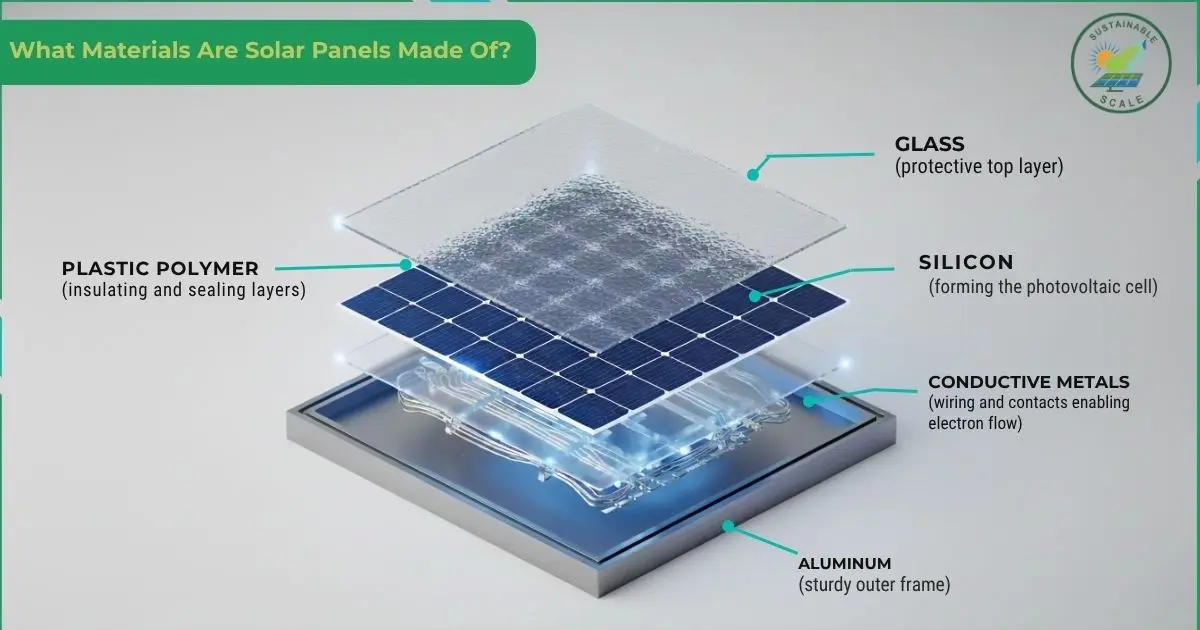

Solar panels are mainly made from silicon, glass, aluminum, copper, and plastic polymers. Silicon converts sunlight into electricity, while glass protects the cells and lets light in. Aluminum frames support the panel, copper wiring carries the electricity, and plastic polymers seal and protect the cells. Small amounts of silver are used for electrical contacts, and sealants keep out moisture.
Thin-film panels use different materials like cadmium telluride or copper indium gallium diselenide instead of silicon which makes them flexible and lightweight. Each material is chosen for its role in making panels efficient, durable and cost-effective.
Photovoltaic panels are composed of the materials listed below.
Silicon is the most critical material in most solar panels and serves as the foundation for the photovoltaic (PV) cells that convert sunlight into electricity. It is utilized in two primary forms, monocrystalline, which features a single crystal structure, and polycrystalline, composed of multiple crystals fused together. Both solar panel types are known for their high efficiency and long lifespans.
Silicon is combined with small amounts of elements such as boron, gallium, or phosphorus to enable the generation of electric current. This process creates the essential positive (p-type) and negative (n-type) layers within the solar cells, allowing them to efficiently capture and convert solar energy into usable electricity.
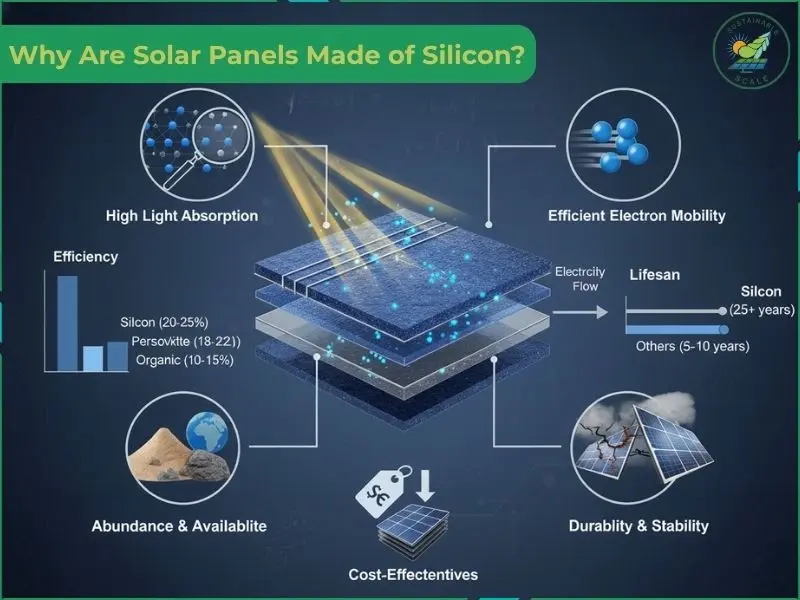
The reasons solar panels are made of silicon are visualised in the image below.
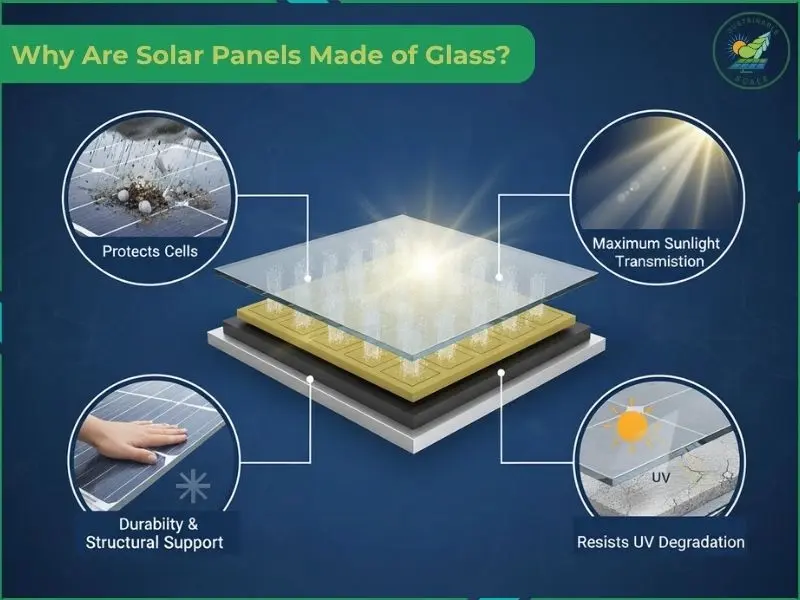
Glass makes up about 75 to 97% of a solar panel’s weight, depending on the design. The top layer of a solar panel consists of a sheet of glass that is 6 to 7 millimeters thick. This glass is important for protecting the silicon cells beneath from physical damage and environmental factors, while allowing sunlight to pass through efficiently and reach the photovoltaic components.
The reasons solar panels are made of glass are visualised in the image below.
Aluminum is used to construct the frame of a solar panel and play an important role in the overall structure. This material provides structural support to hold the panel together, so it remains durable and stable over time.
Aluminum offers excellent resistance to weather conditions such as rain, wind and extreme temperatures to protect the internal components of solar panels. The frame also facilitates mounting capability, making it easier to securely install the solar panel on rooftops or other surfaces.
A durable plastic backsheet is attached to the rear of the panel to provide insulation and additional protection from moisture and mechanical damage. The backsheet acts as a sealant between the various layers of the solar pane and is made from specialized polymers such as ethylene vinyl acetate (EVA). It improves the durability and environmental resistance of solar panels.
Copper is widely used in solar panel wiring, including both busbars and standard wires, due to its excellent electrical conductivity, which helps efficiently transfer the electricity produced by the cells. In addition to copper, some panels also incorporate small amounts of silver in their electrical contacts, which improves conductivity and optimizes performance.
Other materials used in solar panels include sealants and encapsulants such as EVA (ethylene-vinyl acetate) or similar compounds, which serve to bond the various layers together and protect the sensitive cells from moisture and dust.
A junction box, made of durable plastic, is also mounted at the back of the panel. This box houses the electrical connections for safe and secure wiring management.
The solar panel composition by weight is given in the table below.
Material | Approximate percentage (%) by weight |
Silicon | 5% |
Glass | 75 to 97% |
Aluminum | 8% |
Plastic polymer | 8 to 10% |
Copper | 1% |
The table shows that a monocrystalline solar panel is mostly composed of glass, about 80% by weight, with smaller amounts of plastic polymers, aluminum, copper and other materials making up the rest.
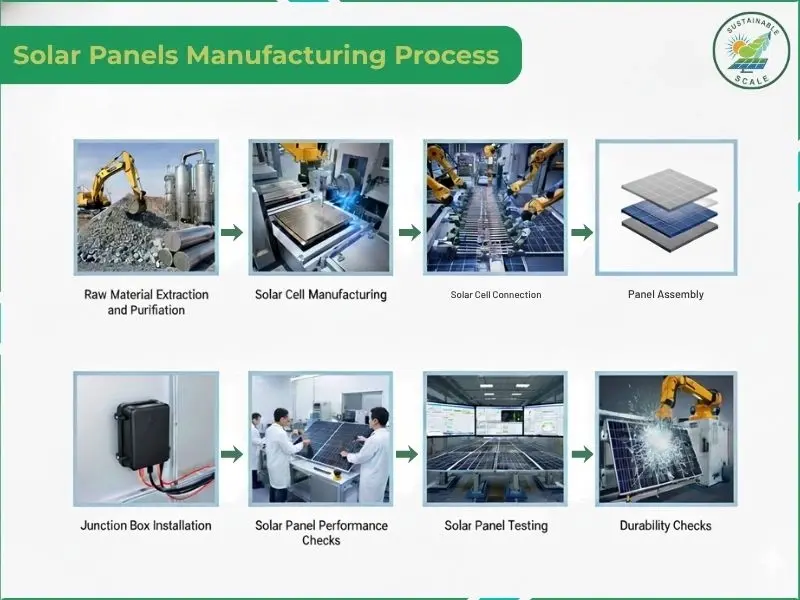
Solar panels are made by purifying silicon, forming wafers, creating solar cells, encapsulating the cells and framing the panels. The assembled panels then have a junction box installed for electrical connections and are thoroughly tested to gurantee quality and performance before being shipped for installation.
The manufacturing process of solar panels is outlined below.
The solar panel manufacturing process is shown in the image below.
Solar panels are made of silicon because it is highly efficient at converting sunlight into electricity and is readily available on Earth. Silicon is the second most abundant element on earth, approximately 27.7% to 28.2% of the Earth’s crust by mass, which keeps its production costs down and its durability provides a long lifespan for the panels.
Silicon is used in about 95% of solar modules sold today, according to the U.S. Department of Energy, which makes it the most common material for commercially available solar panels.
Silicon for solar panels comes from quartzite, sand and other silica containing rocks. Silicon dioxide is converted to metallurgical-grade silicon (MGS), a commodity abundant in nature, through a reduction process. MGS is then purified into highly pure polysilicon which is a valuable material for making solar cells.
Yes, solar panels can be made without silicon using alternative materials like perovskites, cadmium telluride (CdTe), and copper indium gallium diselenide (CIGS). Perovskites, a thin-film material, achieve over 27% efficiency and offer flexibility for diverse surfaces but face challenges in stability and toxicity.
CdTe photovoltaics are cost-effective thin-film solutions with a low carbon footprint, though limited by tellurium scarcity. CIGS cells, another thin-film technology, use adjustable band gaps for optimal efficiency but lag in commercial scalability. These silicon alternatives aim to reduce reliance on silicon while improving the affordability and versatility of solar panels.
Thin-film solar panels do not use silicon in their construction, but use semiconductors like cadmium telluride (CdTe) or copper indium gallium diselenide (CIGS), deposited in thin layers on substrates such as glass, plastic or metal.
These panels are less efficient but are cheaper to manufacture and are more flexible in application.
Monocrystalline solar panels are made from thin wafers sliced from a single silicon crystal ingot, produced using highly pure polysilicon. The panels also contain metal contacts (often silver), a glass cover, an ethylene vinyl acetate (EVA) encapsulant, a protective backsheet (like polyvinyl fluoride or PET) and a frame for durability and weather resistance.
Polycrystalline solar panels are made by melting multiple silicon crystal fragments together to form ingots, which are sliced into wafers. These wafers, along with glass for protection and aluminum framing for support, create the panel’s structure.
Thin film solar panels are made by depositing thin layers of photovoltaic material such as amorphous silicon (a-Si), cadmium telluride (CdTe), copper indium gallium selenide (CIGS) or organic materials onto substrates like glass, plastic or metal. These layers are only a few nanometers to microns thick, much thinner than standard silicon panels.
No, solar panels are not made of coal, but coal is used in their manufacturing process. Coal acts as a reducing agent to extract silicon from silica and it powers much of the energy intensive production of solar panels.
Solar panels are made in countries including China, Vietnam, India, Thailand, Malaysia, the United States, South Korea, Taiwan and Canada. China dominates the market in global production of solar panels, accounting for over 80% of output, as stated by The International Energy Agency (IEA). The largest solar panel manufacturer is Tongwei Solar, based in China.
Most raw materials of solar panels, like polysilicon, are also sourced and processed in China.
EVA stands for ethylene vinyl acetate and is a thermoplastic polymer film used as an encapsulant in solar panels. It is laminated between the solar cells and the protective glass to seal and protect the solar cells from moisture, dust and physical damage.
Ethylene vinyl acetate provides excellent transparency, electrical insulation and durability for long term performance and protection for solar modules.
The most expensive material in solar panels is high purity silicon, which is used to make photovoltaic (PV) cells. Monocrystalline silicon is costlier due to its complex manufacturing and higher efficiency.
Silicon cells account for the largest share of solar panel costs, with monocrystalline panels being 20 to 50% more expensive than polycrystalline panels, according to Energy Sage.
Yes, solar panel glass can be replaced, but it is rarely done because the glass is bonded to the solar cells and removing it risks damaging the panel. Laminating film or polyurethane can seal the surface for minor cracks, but for severe damage, it is more practical and cost-effective to replace the entire panel.
Yes, solar panels can be recycled because their materials such as glass, aluminum, copper and silicon can be recovered and reused. Solar panel recycling includes dismantling panels and recovering valuable components, but it is not always cost-effective.
Recycling solar panels is a sustainable approach because it reclaims resources for new panels and minimizes environmental harm.
The components of solar panels include solar or photovoltaic cells, a glass cover, a protective backsheet and a metal frame. Solar cells convert sunlight into electricity, the glass cover protects them, the backsheet insulates and shields from moisture and the frame provides structural support. Additional parts of solar panels include encapsulation films and a junction box for electrical connections.