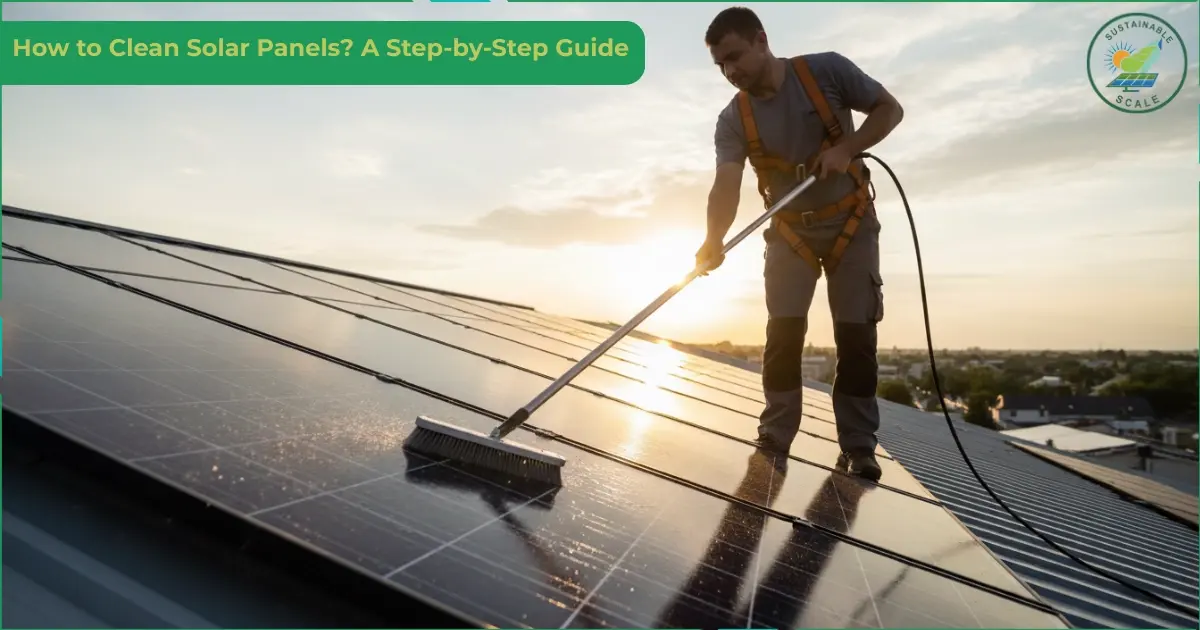
How to Clean Solar Panels? A Step-by-Step Guide

- Published Date - November 12, 2026
- Modified date - November 12, 2026
Table of Contents
Solar panels require cleaning to maintain efficiency and extend the lifespan of your system. The cleaning process includes checking the warranty, choosing the right time, shutting down the system, removing debris and applying the cleaning solution. Automatic solar panel cleaning systems like robotic cleaners, sprinkler systems and electrostatic technology are ideal for large or hard to reach setups. They reduce labor, improve safety and ensure consistent performance.
Solar panels’ cleaning tools include a ladder and safety harness, soft bristled brush, squeegee, telescopic pole and cleaning solution. Solar panels face damage from high pressure washers and harsh chemicals, so avoid using them to protect the surface. Solar panels require cleaning every 6 months. It is recommended to clean photovoltaic panels every 2 to 4 months in dusty or high pollution areas, if energy output drops or dirt buildup is visible.
Solar panel cleaning costs range from $10 to $25 per panel, with total service visits costing between $150 and $500. Solar panels benefit from regular cleaning through improved energy production, reduced maintenance, lower energy bills, extended panel life, better appearance and warranty protection. You need to use safety gear, avoid direct sunlight while cleaning and dry panels with a squeegee to prevent streaks and maintain maximum efficiency.
How to clean solar panels?
To clean solar panels, you need to check the system warranty, choose the right time, shut down the system, panel inspection, remove loose surface debris and apply a cleaning solution.
10 steps to clean solar panels are given below.
- Check your system warranty: Review the warranty and the installer’s guidelines before cleaning solar panels. Some solar panel cleaning methods like harsh chemicals or pressure washing, void warranties or damage sensitive surfaces.
- Choose the right time: Clean solar panels in the early morning, late evening or on cool, overcast days. This reduces the chance of thermal shock, which cracks hot glass and dry cleaning solutions quickly.
- Turn off the solar panel system: Turn off your solar panel system before cleaning to eliminate electrical hazards and avoid damaging sensitive equipment with water or cleaning solutions.
- Inspect the panels: Examine solar panels from a safe vantage point for visible debris, grime or bird droppings. Note areas needing more attention and check for potential surface or wiring damage.
- Gather your tools and supplies: You need a soft bristle brush, a dedicated solar panel cleaning solution, a garden hose, rubber soled shoes, gloves and a safe ladder for cleaning solar panels on a roof.
- Remove loose surface debris: Use a dry brush or handheld blower to remove dry dust, leaves and other debris. This prevents scratching the solar panel surface when water is applied.
- Apply the cleaning solution: Use a solar panel safe cleaning solution like diluted vinegar to break down mineral deposits and preserve panel efficiency.
- Gently scrubbing: Use a soft brush or cloth to clean in circular motions. Avoid applying heavy pressure, which causes micro cracks or reduces long term solar panel efficiency.
- Rinse thoroughly: Rinse the solar panels with a low pressure hose and remove all soap or vinegar residue to prevent streaks or buildup. Avoid power washers as they damage seals or force water into panel joints.
- Final inspection and system restart: Check for streaks, water spots or remaining dirt and dry gently with a squeegee or allow to air dry. Restart your solar system after drying and verify it is operating correctly.
How to clean solar panels automatically?
Cleaning solar panels automatically involves installing specialized systems designed to remove dust, dirt and debris without manual labor. These technologies help clean solar panels installed in hard to reach or hazardous locations such as rooftop arrays. Automated solutions for rooftop panels help maintain system efficiency and improve safety by reducing the need for direct human contact, according to leading solar provider Sunrun.
Automated systems for cleaning solar panels include sprinkler based systems, robotic cleaners, automated water jet systems and electrostatic repulsion systems. Sprinkler based systems that rinse panels using pipes and nozzles on a timer to wash away light dust and pollen. Robotic cleaners, either rail guided or remote controlled, scrub the panel surface using soft brushes and integrated water jets. These are well suited for both flat and sloped rooftops.
Automated water jet solar panel systems run along motorized tracks and target stubborn debris on large scale residential or commercial arrays. Electrostatic repulsion systems in dry climates use electric fields to repel dust, which offers a waterless solution. Solar panels maintain strong energy output, lower maintenance needs and stay consistently clean by using these automated approaches.
What tools do you need to clean solar panels?
The tools you need to clean solar panels include a ladder and safety harness, soft bristled brush, squeegee, non-abrasive cleaning solution, telescopic pole and microfiber cloths, as these make sure of safe and effective streak-free cleaning.
The tools you need to clean solar panels are outlined below.
- Ladder and safety harness: Use a sturdy ladder and safety harness to safely reach solar panels on rooftops or elevated areas.
- Soft bristled brush: Choose a soft bristled brush to gently loosen dirt and dust from solar panels without scratching the solar glass.
- Squeegee: Wipe water and cleaning solution off solar panels with a squeegee to prevent streaks and water spots.
- Water fed pole: Rinse solar panels with a hose or water fed pole for even cleaning and to remove leftover residue.
- Pure water: Wash solar panels with pure water or deionized water to avoid mineral deposits and keep surfaces spotless.
- Non-abrasive cleaning solution: Apply a non-abrasive cleaning solution or mild soap to clean solar panels for tough dirt and grime.
- Telescopic pole: Reach distant or large solar panels with a telescopic pole fitted with a brush or squeegee attachment.
- Microfiber cloths: Dry and polish solar panels with washable microfiber cloths to leave no scratches or lint behind.
How often should you clean solar panels?
Solar panels should be cleaned twice a year, every 6 months, to maintain optimal efficiency, though the exact frequency varies depending on your local conditions. Solar panels in areas exposed to dust, pollution or regular buildup of debris, such as deserts, near industrial zones or close to busy roads, are cleaned every 2 to 4 months. Solar panels located in cleaner or rainy environments go longer between cleanings. Solar panels require regular inspection and cleaning when you observe visible dust, debris, bird droppings, tree sap or notice a drop in electricity output. Solar panels’ cleaning frequency depends on factors such as the system’s location, local weather conditions, the angle of installation since flat panels gather more dirt than tilted ones and the panel type. You need to set a cleaning schedule that matches the optimal frequency with routine checkups and performance monitoring to make sure your panels operate properly and last longer.
How much does it cost to clean solar panels?
Solar panels cleaning costs range from $10 to $25 per panel, with the total cleaning cost for a standard residential array of 15 to 45 panels between $150 and $500 per visit. Professional cleaning companies charge a minimum service fee, between $100 and $150, regardless of system size. Commercial solar panel systems have high prices that start at $300 and rise based on the array size, accessibility and labor involvement.
Solar panels cleaning costs depend on factors such as location, accessibility and dirt accumulation. Location affects pricing because labor and travel fees are higher in urban areas or remote regions. Accessibility plays a major role in panels installed on steep, high or complex rooftops that require safety measures and equipment, which increases the overall cost. The number of panels directly influences the total expense, though some companies offer discounted per panel rates for larger systems. The degree of dirt or buildup, lastly, impacts cleaning time and method. Heavily soiled panels, for example, in dusty climates or when maintenance is delayed, require more effort and specialized tools, which results in higher service charges.
What are the benefits of cleaning solar panels?
The benefits of cleaning solar panels include increased energy production, extended panel lifespan, reduced maintenance costs, financial savings, aesthetics and warranty compliance.
6 benefits of cleaning solar panels are given below.
- Increased energy production: Clean solar panels absorb sunlight and boost energy generation by 5% to 30%. Regular cleaning helps maintain peak performance and maximizes your system’s output.
- Extended panel lifespan: Removing dust, dirt and buildup prevents corrosion and hot spots. This preserves solar panel surfaces and adds 5 to 10 years to their service life.
- Reduced maintenance costs: Clean solar panels remain free of debris that causes physical damage or complications, which lowers the need for more expensive repairs or replacements in the long term.
- Financial savings: Increased efficiency leads to higher electricity production, which translates to lower energy bills and improved return on your solar investment over time.
- Aesthetics: Regular cleaning keeps solar panels looking new by removing stains and bird droppings, which keeps your roof or property visually appealing.
- Warranty compliance: Some manufacturers require routine cleaning to keep solar panel warranties valid. Meeting these requirements protects your investment and helps secure future claims if needed.
What are the tips for cleaning solar panels?
The tips for cleaning solar panels include wearing safety gear, avoiding direct sunlight, avoiding harsh chemicals, using mild soap, using a soft cloth, rinsing the panels and drying the panels.
The tips for cleaning solar panels are outlined below.
- Wear appropriate safety gear: Use non-slip shoes, gloves and a harness (for rooftop panels) to protect yourself and prevent falls or injuries while cleaning solar panels.
- Avoid cleaning in direct sunlight: Clean solar panels early in the morning or late afternoon to prevent rapid evaporation of water, which causes streaks and to avoid hot surfaces that crack.
- Avoid harsh chemicals: Refrain from using abrasive or corrosive cleaning agents, as they damage the protective coating and reduce solar panel efficiency over time.
- Use mild soap: Add a small amount of gentle, non-abrasive soap to help remove dirt without harming the surface if water alone does not clean the solar panels.
- Use a soft brush or cloth: Select a soft brush or microfiber cloth to gently remove dust and debris, which prevents scratches on the solar panel’s glass surface.
- Rinse panels gently: Use a hose with low water pressure to rinse away soap and dirt and avoid high pressure washers that cause damage to solar panels.
- Dry the panels: Use a soft squeegee or cloth to dry the solar panels after rinsing and prevent streaks or water spots, which secures maximum sunlight absorption.
What are the safety considerations for cleaning solar panels?
The safety considerations for cleaning solar panels are given below.
- Maintain electrical safety: Always shut off solar panels before cleaning, check for damaged wiring and use insulated boots and gloves to prevent electrocution risks.
- Maintain height safety: Use harnesses, sturdy ladders and never work alone or in unsafe weather to avoid falls when cleaning rooftop solar panels.
- Wear protective equipment: Do not appropriate PPE such as non-slip shoes, hard hats, gloves and eye protection to guard against electric shock and physical injury from solar panels.
- Use non-abrasive tools: Choose soft brushes and purpose made equipment to prevent damaging the solar panel’s surface and to maintain user safety.
- Timing and weather: Clean early morning or late evening to avoid slippery surfaces, glare, heat exhaustion and the risk of cracking solar panels with cold water on hot surfaces.
- Professional assistance: Hire professionals for inaccessible or risky installations of solar panels, as they possess the right training, insurance and safety gear for the job.
What chemicals are safe to clean solar panels?
The safe chemicals to clean solar panels are outlined below.
- Mild soap and water: Biodegradable dish soap and water remove dirt from solar panels without causing damage or residues.
- Vinegar and water: A mix of diluted vinegar and water is eco-friendly, effective for removing grime and safe for solar panel glass and coatings.
- Deionized or distilled water: Use pure mineral free water to avoid streaks, prevent limescale deposits and guarantee no abrasive minerals scratch the solar panels.
- Specialized solar panel cleaners: Products like Polywater or dedicated solar panel cleaning solutions are formulated to lift tough contaminants without harming panel surfaces.
Should you consider professional solar panel cleaning?
Yes, you should consider professional solar panel cleaning when dust or bird droppings are hard to remove. Solar panel cleaning requires the right tools to handle the buildup safely, which reduces the chance of damage or injury. This protects your system’s warranty and helps keep solar panels efficient, so they maintain strong performance and long term value without putting you at risk.
Does cleaning solar panels increase efficiency?
Yes, cleaning solar panels increases efficiency by removing dust, dirt, bird droppings and debris that block sunlight from reaching the surface. Solar panels generate less electricity when obstructed. They require regular cleaning to guarantee sunlight is absorbed, which maintains solar panel efficiency and sustains energy output without performance loss caused by accumulated surface buildup.
Does rain clean solar panels?
No, rain cannot fully clean solar panels because it removes loose dust, but stubborn dirt and debris, with bird droppings, remain and block sunlight. Pollution residue does not wash away easily. Manual or professional cleaning is required for persistent debris to make sure solar panels stay efficient and free from buildup that reduces energy generation.
Does cleaning solar panels improve performance?
Yes, cleaning solar panels improves performance by removing dirt, dust and debris that block sunlight from reaching photovoltaic cells, which reduces energy production. Solar panels lose 15% to 25% efficiency in dusty areas. Regular PV panel maintenance helps maintain peak output, which guarantees consistent energy generation and supports long term system performance and return on investment.
Is solar panel cleaning worth it?
Yes, solar panel cleaning is worth it because it removes dirt, dust and bird droppings that block sunlight and reduce energy production. This builds lower electricity output by 20% to 25%. Solar panel cleaning keeps the system efficient, which helps reduce electricity costs, supports consistent performance and extends panel lifespan for better long term return on investment.
Products
Solar Panel
Air Purifier