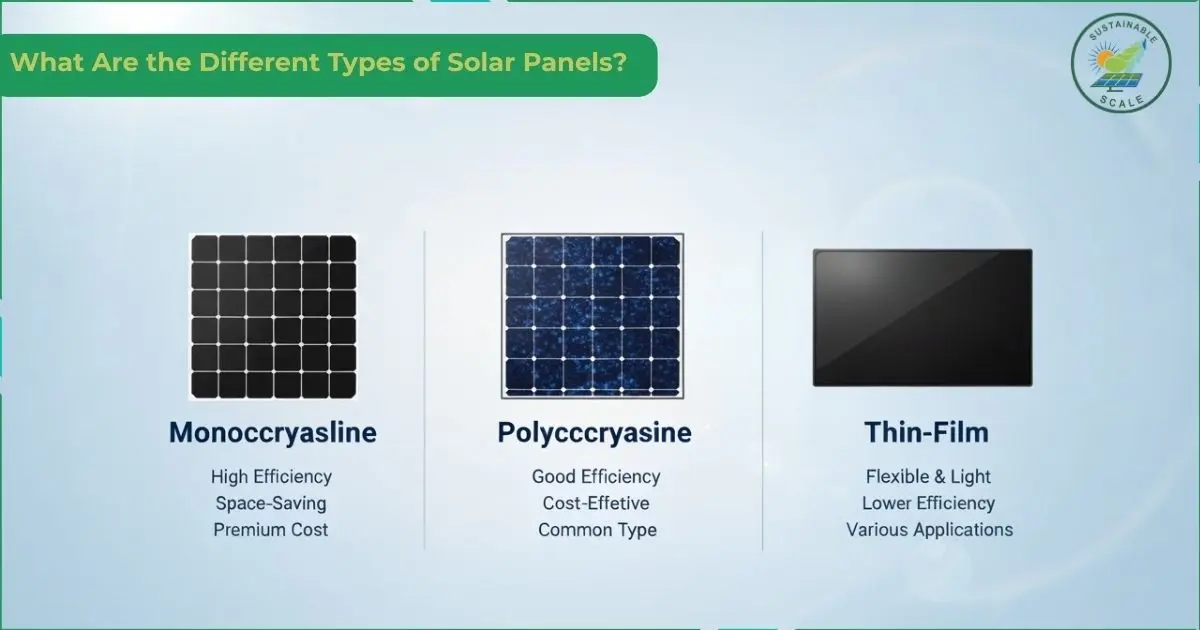

There are three main types of solar panels used today which include monocrystalline, polycrystalline and thin-film. Monocrystalline panels are highly efficient and durable, so they are ideal for limited spaces. Polycrystalline panels, while less efficient, are more affordable with good durability. Thin-film panels, on the other hand, are flexible and lightweight, provide easy installation, but their lower efficiency means they require more space to generate the same power.
Beyond the main solar types, new solar technologies like perovskite, transparent and solar roof tiles are emerging. These offer higher efficiency, flexibility and better integration into buildings to expand the possibilities for solar energy use in settings like automotives, greenhouses and aerospaces.
The three main types of photovoltaic panels are given below.
Some sources also mention PERC (Passivated Emitter and Rear Cell) as a subtype or enhancement of crystalline panels, but the main categories remain monocrystalline, polycrystalline and thin-film.
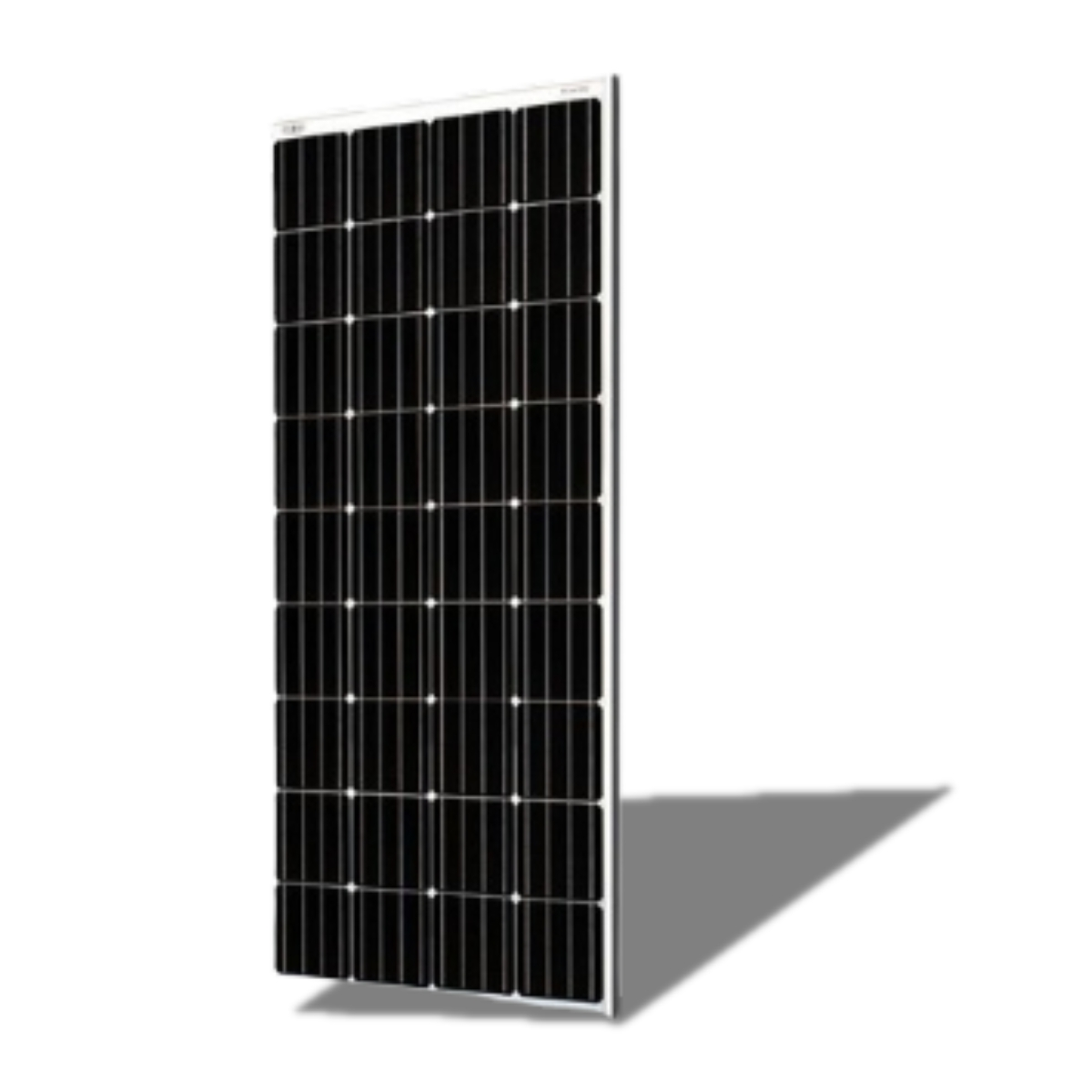
Monocrystalline solar panels are a type of photovoltaic panel made from high-purity, single crystal silicon ingots. They are produced by melting and slowly solidifying semiconductor grade silicon using processes such as the Czochralski method. This manufacturing process results in black panels with high efficiency that ranges from 17% to 22% under standard test conditions.
Monocrystalline solar panels are known for their durability and long lifespan, as these panels last 25 years or more with proper maintenance and are used in residential and commercial installations. Monocrystalline panels are more expensive than other types due to the complex manufacturing process and the high purity of silicon used. Their superior performance in low light conditions and high temperatures makes them popular for maximizing energy production.
Many modern monocrystalline panels now use Passivated Emitter and Rear Cell (PERC) technology, which adds a passivation layer to the rear of the cell to increase efficiency and energy yield, especially in low light conditions.
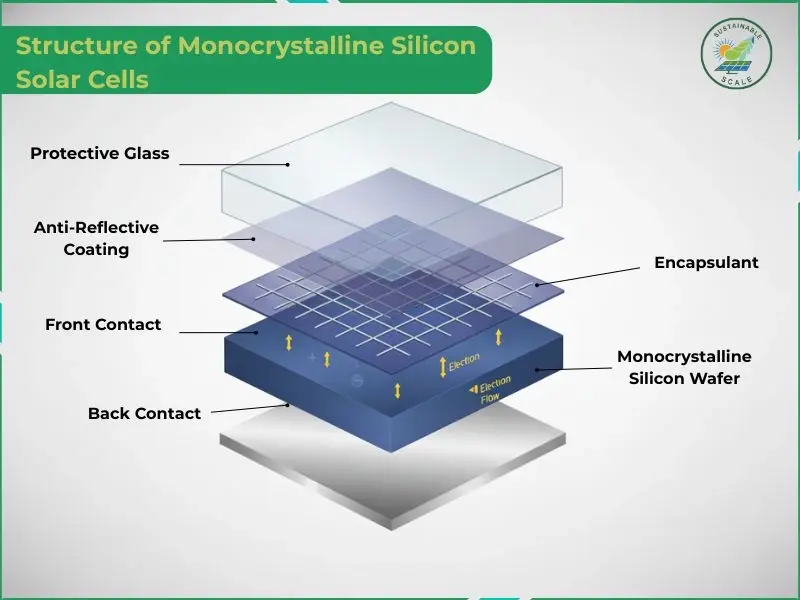
The diagram below illustrates the layered structure of a monocrystalline silicon solar cell, showing components from top to bottom: protective glass, anti-reflective coating, encapsulant, front contact grid, monocrystalline silicon wafer with electron flow, and back contact.
Polycrystalline solar panels are a type of photovoltaic panel made from silicon that has been melted and cast into square ingots composed of many small silicon crystals. This production method results in panels with a blue and speckled appearance.
The efficiency of polycrystalline solar panels range from 15% to 17%, which is lower than monocrystalline panels but still suitable for homeowners and businesses looking for cost-effective solar panels. These panels are more affordable due to a simpler manufacturing process and lower silicon purity requirements.
Polycrystalline solar panels require more space than monocrystalline panels for the same power output, but they offer a good balance of performance and price.
Some polycrystalline panels are also manufactured with PERC technology to improve their efficiency by reducing electron recombination and reflecting unabsorbed light back into the solar cell.
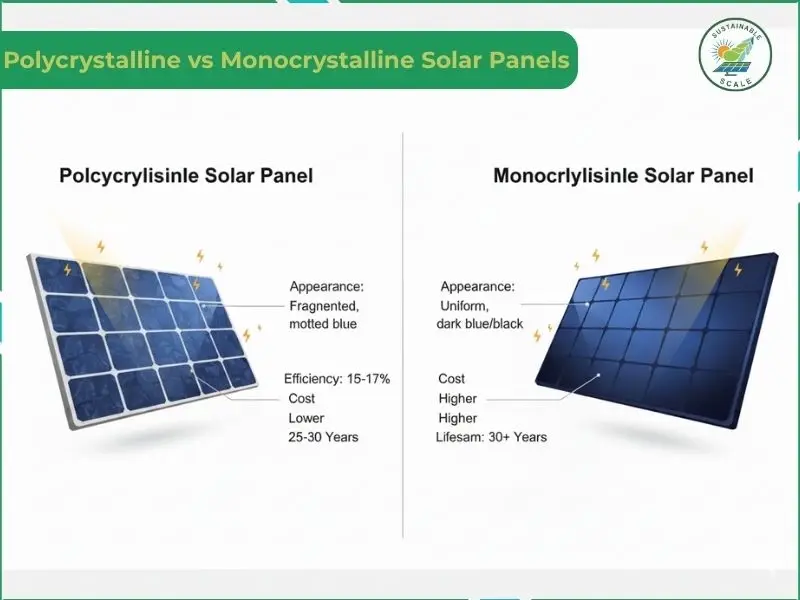
The infographic below compares polycrystalline and monocrystalline solar panels, highlighting that polycrystalline panels have a mottled blue appearance with lower efficiency and cost, while monocrystalline panels are uniform black with higher efficiency, cost, and lifespan.
Thin-film solar panels are a type of photovoltaic panel made by depositing one or more extremely thin layers of photovoltaic material, such as amorphous silicon (a-Si), cadmium telluride (CdTe) or copper indium gallium selenide (CIGS) onto a substrate like glass, plastic or metal. These panels are lightweight, flexible and have lower efficiency ranging from 10% to 13% under standard test conditions.
Thin-film panels are less expensive and can be applied to curved and flexible surfaces, despite their lower efficiency. They are used in DIY projects, large scale solar installations and portable solar applications where weight and flexibility are important. Their performance is less affected by high temperatures and shading compared to crystalline solar panels.
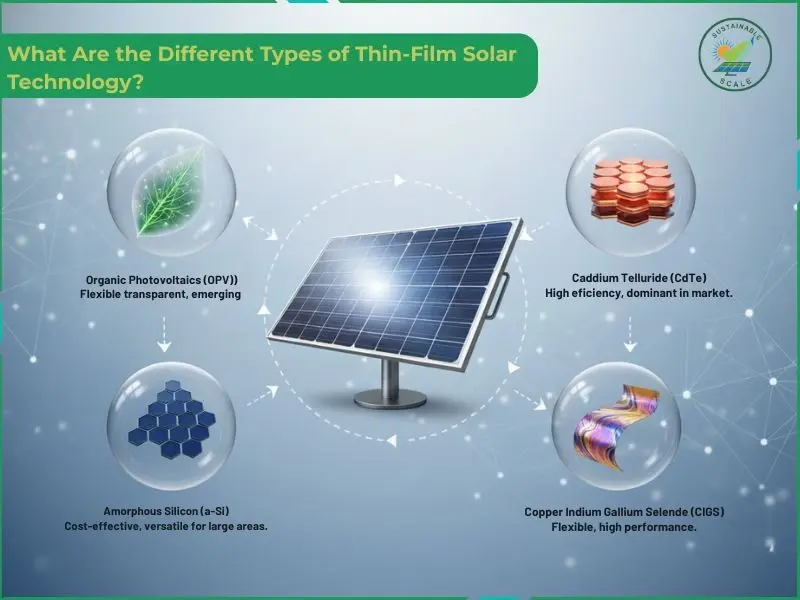
The infographic below highlights four types of thin-film solar technology such as Organic Photovoltaics (OPV), Cadmium Telluride (CdTe), Amorphous Silicon (a-Si), and Copper Indium Gallium Selenide (CIGS).
The other types of solar panels include transparent solar panels, perovskite solar panels and solar tiles. These special types of PV panels open up new ways to use solar energy, letting you put solar power into windows, flexible materials and even roof tiles for creative and practical energy applications.
3 other solar panel types are listed below.
Transparent solar panels are photovoltaic modules that allow light to pass through while generating electricity. They are used in windows, facades and skylights of buildings, and also have applications in greenhouses, automotives and consumer electronics.
The efficiency of transparent solar panels is currently low, according to a study in the International Journal of Scientific Research. GreenMatch’s 2025 stats show that the efficiency of fully transparent solar panels is about 1% with an estimated potential of 5%.
Perovskite solar panels are a type of solar panel that use perovskite-structured compounds as the light-absorbing layer, and have high efficiency and low production costs. These panels are thin, lightweight and flexible, which makes them suitable for applications like tandem cells with silicon for even greater efficiency, though long-term stability remains a research focus.
Solar tiles, or solar roof tiles, are integrated roofing materials that contain embedded photovoltaic cells. They blend with traditional roofing to provide renewable energy without compromising aesthetics. Solar tiles are durable, weather resistant and ideal for new construction or roof replacements where visual integration and sustainability are priorities.
The factors to consider when selecting a solar panel type include the efficiency of the solar panel, durability, warranty coverage and cost, as well as the available installation space, local climate conditions and the specific energy needs of your home or business.
9 factors to consider before going solar are outlined below.
You can assess your energy needs, budget and site conditions by carefully weighing these factors to get the best solar systems for homes.
The best solar panel type for most households is monocrystalline, as they have an efficiency of 23% or higher, last for 25 to 40 years, and offer excellent cost-effectiveness over time. Solar tiles, on the other hand, are preferable in conservation areas due to their aesthetic integration, but are more expensive than on-roof panels. You need to consider your budget, available space, and energy needs when choosing a solar panel.
The best solar panel type by performance in 2025 is the high-efficiency monocrystalline panel, especially those using advanced N-type technologies like TOPCon, HJT or back-contact cells.
Leading solar models from Aiko, Maxeon and Jinko Solar achieve efficiencies above 23%, with Aiko’s Neostar 2P reaching up to 24.3% efficiency. These panels offer superior output and durability.
The best solar panel type by cost is thin-film which is the cheapest per watt, but is less efficient and more suited for large commercial installations. Polycrystalline panels are the most affordable among crystalline panels for residential use, while monocrystalline panels offer higher efficiency at a higher price. Balancing cost and quality is important for long-term value of your solar system.
To choose between monocrystalline and polycrystalline solar panels, you need to consider the efficiency, cost and available space for both panels. Monocrystalline panels are more efficient, ranging from 17 to 22%, and have a sleek black appearance, but cost more. Polycrystalline panels are less efficient, ranging from 15 to 17%, and blue-hued, but more affordable and suitable if you have ample roof space.
You can choose monocrystalline solar panels when you are willing to make a larger investment for better performance and polycrystalline panels when you want to reduce upfront costs and space is not a limitation.
To choose between crystalline and thin-film solar panels, consider efficiency, durability and cost of both solar panel types. Crystalline panels are more efficient (over 20%) and durable which makes them ideal for homes and long-term use. Thin-film panels are lighter, more flexible and cheaper, but less efficient (10 to 12%) and durable, so they are better suited for large and low-cost installations or unique surfaces.