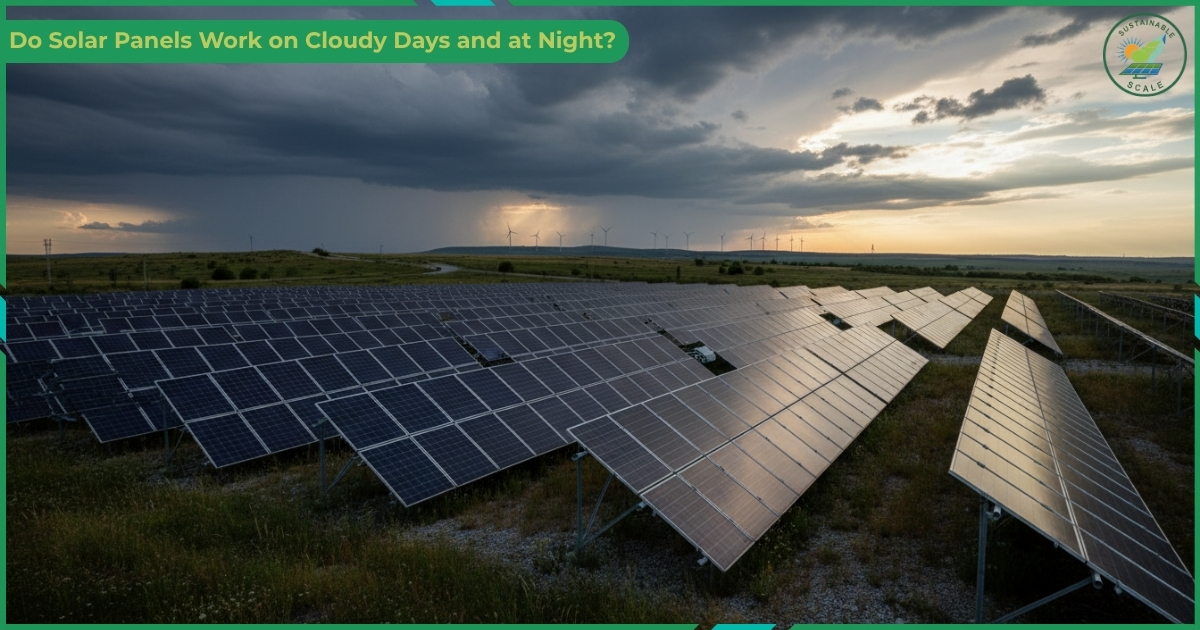
Do Solar Panels Work on Cloudy Days and at Night?

- Published Date - November 11, 2026
- Modified date - November 11, 2026
Table of Contents
Solar panels work on cloudy days but do not work at night. Solar panels generate electricity by capturing both direct and diffuse light through the photovoltaic effect, while cloudy weather reduces sunlight. The absence of sunlight stops the photovoltaic cells from producing electricity at night. Solar systems rely on battery storage and net metering to supply power after sunset. Battery storage systems collect excess electricity generated during the day and use it at night. Grid-tied systems send surplus energy to the grid and earn credits, which are used later to draw power when the panels are inactive.
Solar panels function in cloudy weather, though output drops based on cloud density. Solar panels produce 10% to 25% of their usual electricity, which depends on how much sunlight penetrates the clouds. Rain improves performance by cleaning off dust and debris. Modern systems include microinverters that operate at the panel level, which allows each panel to work independently and improve solar panel efficiency when some panels are shaded or affected by low light.
Solar panels work by absorbing sunlight through photovoltaic cells. These cells use the photovoltaic effect to excite electrons, which produces direct current (DC) electricity. An inverter then converts this DC into alternating current (AC) for household use. Any extra energy is stored in batteries or sent back to the grid, which secures optimal use of solar power throughout the day.
How do solar panels work in cloudy weather?
Solar panels continue to generate electricity in cloudy weather, but at a reduced output compared to sunny conditions. Photovoltaic cells in each panel capture both direct sunlight and diffused light that penetrates cloud cover. The panels convert it into electricity via the photovoltaic effect as long as daylight is sufficient to cast a shadow, which produces 10% to 25% of their usual output, depending on cloud density. Rain also improves performance by naturally cleaning dust and debris from the panels.
Modern systems use microinverters to optimize energy production in variable light conditions. Microinverters operate at the individual panel level, unlike centralized inverters, adjusting independently to maximize each panel’s output. This design prevents shaded or underperforming panels from reducing the overall efficiency of the array. Solar systems, as a result, equipped with microinverters maintain better performance and reliability in cloudy, rainy or overcast conditions, which makes solar power viable in less than ideal weather.
How do solar panels work at night?
Solar panels do not work directly at night, they work through battery storage and net metering. Photovoltaic cells of solar panels require sunlight to generate electricity through the photovoltaic effect. Solar panels generate more electricity than a home needs during the day. A solar battery storage system saves this excess electricity. The stored energy powers household devices, which allows continued use of solar energy after sunset. The battery’s capacity determines how much power is available and for how long.
Grid-tied systems use net metering to manage energy flow. Excess electricity from the solar panels is sent to the grid during the day, which earns credits from the utility provider. The home draws electricity from the grid and the credits offset the cost at night, when the panels stop generating power. Net metering balances daytime overproduction with nighttime use and helps reduce energy bills.
How do solar panels work?
Solar panels work by converting sunlight into electricity using the photovoltaic effect. It excites electrons, generating direct current (DC) electricity, when sunlight hits the photovoltaic (PV) cells.
The 5 steps of solar panels work include absorbing sunlight, producing electricity, converting DC to AC power, household uses and storing excess energy.
5 steps of how solar panels work are given below.
- Absorb sunlight: Photovoltaic (PV) cells in the solar panel absorb sunlight, which causes the energy from photons to excite electrons in the cell’s material, initiating the photovoltaic effect.
- Produce electricity: The excited electrons in the PV cells create a direct current (DC) electric flow. This process is fundamental to generating electricity from sunlight using the photovoltaic system in solar panels.
- Convert DC to AC power: An inverter in the solar panel system converts the generated direct current (DC) electricity to alternating current (AC), which is compatible with the grid connection and household appliances.
- Household uses: The alternating current (AC) electricity used to power household devices, lighting and other electrical systems reduces reliance on grid power from solar panels and lowers the utility costs.
- Store excess energy: Surplus energy is stored in batteries for later use or sent back into the grid, which optimizes solar panel energy efficiency and provides backup during low sunlight.
Do solar panels work in the rain?
Yes, solar panels do work in the rain because their photovoltaic cells can capture indirect sunlight and convert it into electricity. Rainy conditions reduce efficiency since there is less direct sunlight available. Rain helps clean the panels despite the lower output, which improves their performance once the weather clears and direct sunlight returns.
Can solar panels work with moonlight?
No, solar panels do not work with moonlight in any practical sense because the intensity of moonlight is extremely low. It is about 0.2% to 0.3% of sunlight, which makes their energy output negligible and insufficient to power household devices. Most photovoltaic systems go into “sleep mode” at night since moonlight cannot generate enough electricity to activate or power the inverter or meet the startup voltage for operation.
Do solar panels work when covered in snow?
No, solar panels do not work when covered in snow because the snow blocks sunlight from reaching the photovoltaic cells, which stops electricity production completely. Even a thin layer of snow impacts performance and reduces electricity output until it melts or slides off. Snow guards help manage accumulation, but panels require unobstructed sunlight for effective operation.
Do solar panels need direct sunlight to work?
No, solar panels do not need direct sunlight to work because they generate electricity from both direct and indirect sunlight as photovoltaic cells absorb photons from any visible light. Their efficiency is higher in direct sunlight of solar panel and output is reduced when relying only on indirect sunlight, panel location or shading conditions.
Do solar panels work during a power outage?
No, standard solar panels do not work during a power outage if they are connected to a grid-tied system. This is a safety requirement to protect electricians from accidental shocks while repairing power lines. It continues supplying electricity to your home during an outage if your solar setup includes a battery backup and an automatic disconnect from the grid.
Products
Solar Panel
Air Purifier