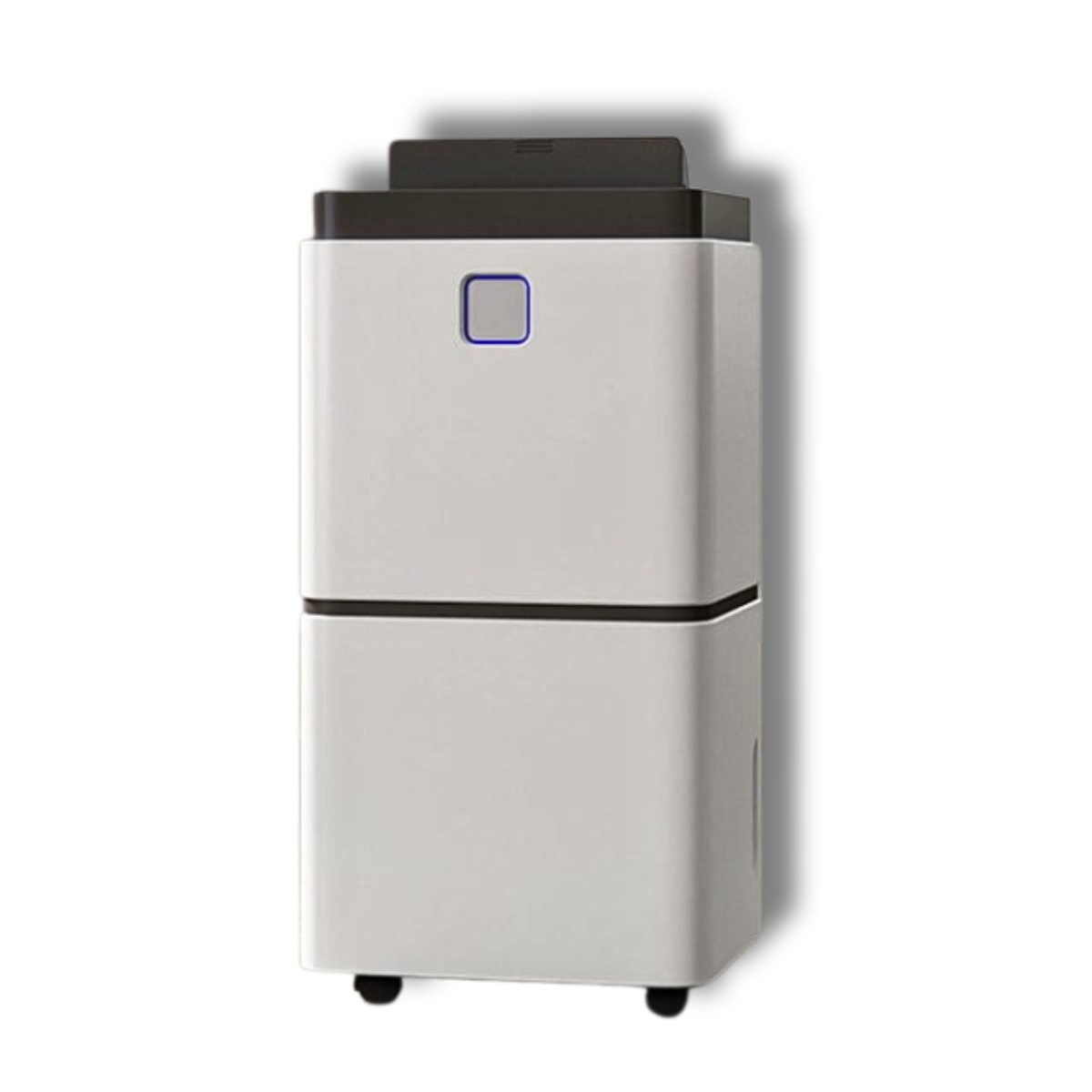


A dehumidifier needs recharging when its sealed refrigeration circuit loses refrigerant and stops condensing moisture from humid air. It shows poor dehumidification, frosted evaporator coils, and little or no collected water after normal operation. A dehumidifier shows signs of low refrigerant when the evaporator remains warm or moisture removal declines. It requires a certified technician because its sealed circuit lacks a consumer service port.
A dehumidifier follows eight sequential recharge steps, beginning with diagnosis and ending with moisture removal verification. It requires leak location, refrigerant recovery, joint repair, filter-drier replacement, evacuation, charging, operational testing and condensate measurement. A dehumidifier transfers its remaining refrigerant into certified recovery equipment before a technician opens the refrigeration circuit for leak repair. It undergoes evacuation to 500 microns after repair removes moisture and confirms sealed system integrity. It receives its exact nameplate charge by weight after the technician confirms the refrigerant type.
A dehumidifier costs 50 USD to 200 USD to recharge when a small residential unit requires basic service. It incurs HVAC labor charges of 75 USD to 150 USD per hour during diagnosis, leak repair, evacuation and charging. A dehumidifier costs more when inaccessible leaks, difficult repairs or legacy refrigerants increase service time and material expense. It becomes less economical to repair when the estimate exceeds 50% of a comparable new unit’s price.
How to know if a dehumidifier needs a recharge?
A dehumidifier needs recharging when it shows no water collection, ice buildup on coils, poor dehumidification, warm evaporator coils or longer operating time. These signs indicate that refrigerant loss has reduced moisture condensation within the sealed circuit.
The situations when a dehumidifier needs recharging are outlined below.
- No water collection: A dehumidifier runs for hours in humid conditions and collects no water after four hours in a damp basement, which indicates substantial refrigerant loss inside its circuit.
- Ice buildup on coils: A dehumidifier develops persistent ice buildup on coils because reduced refrigerant drops the evaporator temperature below 32°F during normal room operation and restricts moisture removal.
- Poor dehumidification: A dehumidifier removes fewer than its rated 30 to 70 pints per day after refrigerant loss, while relative humidity remains high throughout the room.
- Warm evaporator coils: A dehumidifier with low refrigerant keeps evaporator coils near room temperature instead of 40°F, which prevents moisture condensation and reduces water collection from humid indoor air.
- Longer operating time: A dehumidifier keeps the compressor running continuously for 24 hours without reaching the humidity setpoint, which provides a measurable sign of low refrigerant within its sealed circuit.
- Visible oil residue: A dehumidifier leaking refrigerant leaves visible oily residue at brazed joints because compressor lubricant escapes through the same opening during refrigerant leakage from the sealed circuit.
The infographic shows the signs your desiccant dehumidifier needs recharging.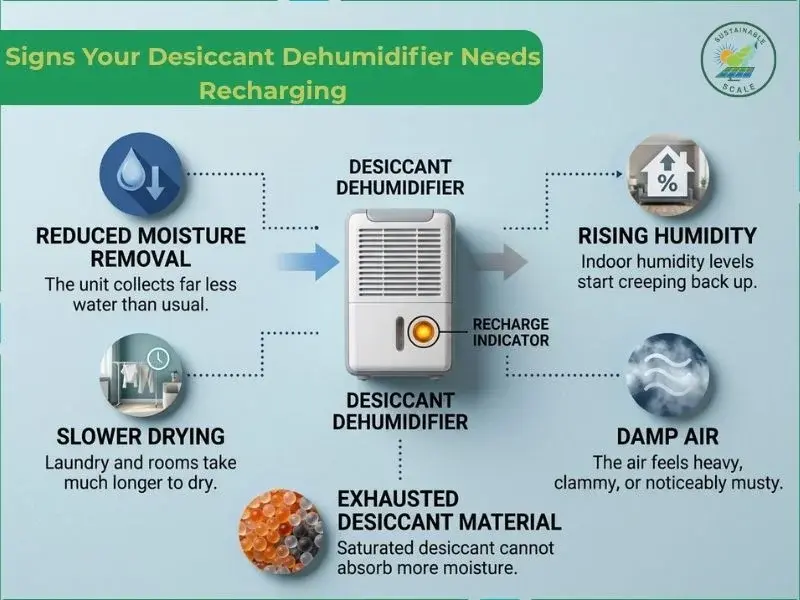
What are the steps to recharge a dehumidifier?
The steps to recharge a dehumidifier are to diagnose the problem, locate the refrigerant leak, recover the existing refrigerant and repair the refrigerant leak. These steps correct the source of refrigerant loss before refrigerant enters the refrigeration circuit. A dehumidifier loses moisture removal capacity when low refrigerant causes poor dehumidification.
A dehumidifier requires diagnosis to exclude dirty filters and blocked coils before sealed system service. It requires leak repair, a filter drier replacement and evacuation to 500 microns for 10 minutes. A dehumidifier receives the exact factory charge, 3 to 10 ounces, by weight. It undergoes 15 minute pressure, superheat, air temperature split and 24 hour condensate tests.
The steps to recharge a dehumidifier are given below.
- Diagnose the problem
- Locate the refrigerant leak
- Recover the existing refrigerant
- Repair refrigerant leak
- Evacuate the sealed system
- Add the correct refrigerant
- Test dehumidifier operation
- Verify moisture removal
Diagnose the problem
Diagnose the problem by confirming that the dehumidifier collects little or no water and by ensuring that the room temperature exceeds 65°F. Rule out a dirty air filter or coils, a blocked drain hose and a failed humidity sensor. Inspect evaporator coils while the compressor runs and warm coils after 15 minutes indicate low refrigerant. Listen for hissing or bubbling near the coils and inspect joints for active leaks in the refrigeration circuit.
Locate the refrigerant leak
Locate the refrigerant leak through a targeted visual inspection and look for oil or grease marks at brazed joints and tubing bends. Inspect the evaporator coil for corrosion, especially on units older than 5 years. Sweep tubing with an electronic leak detector at 1 inch per second, where rising counts indicate escaping refrigerant. Confirm and mark detector hits with a soap-bubble test on accessible joints. Pressurize the circuit with dry nitrogen at 150 psi and perform a 30 minute standing pressure test. A gauge drop confirms the leak.
Recover the existing refrigerant
Recover the existing refrigerant before repairing the refrigerant leak and confirm EPA Section 608 certification requirements. Gather certified recovery equipment, a vacuum rated hose set and a cylinder rated for the refrigerant on the nameplate. Weigh the empty cylinder, limit filling to 80% capacity and clear ignition sources from the workspace. Access the sealed system through a piercing valve or brazed process tube. Connect the recovery machine to the low pressure side and recover at least 90% of the nameplate charge. Verify recovery completion at 0 psig on the gauge.
Repair refrigerant leak
Repair refrigerant leak damage on accessible tubing, but replace a dehumidifier with a corroded evaporator coil. Prepare the copper joint for brazing copper with an oxy-acetylene or air acetylene torch at roughly 1,300°F. Flow dry nitrogen through the tubing at 2 to 3 cubic feet per hour to prevent internal oxide scale. Fill the joint with a 15% silver phos copper brazing rod without flux on copper-to-copper connections. Re-pressurize the sealed system to 150 psi with nitrogen and hold the reading for 30 minutes to confirm leak free repair.
Evacuate the sealed system
Evacuate the sealed system by brazing a new filter-drier into the liquid line, which traps residual moisture and acid. Connect the vacuum pump via a large diameter hose and mount an electronic micron gauge at the far system end. Start the pump and pull the circuit to 500 microns or lower to remove trapped water. Isolate the pump and let the reading stabilize for 30–60 seconds. Hold the system below 500 microns for 10 minutes during the decay test. Break the vacuum with oxygen free nitrogen for two cycles before final evacuation.
Add the correct refrigerant
Add the correct refrigerant by identifying the exact refrigerant type and factory charge weight on the dehumidifier nameplate. Place the cylinder on a digital scale accurate to 0.1 ounce and purge air from the charging hose. Use liquid charging for blended refrigerants such as R-410A to maintain proper composition within the sealed system. Weigh in the complete nameplate charge instead of adding refrigerant until pressures appear correct. Measure suction and liquid pressures during charging to confirm operation within the manufacturer’s specified range.
Test dehumidifier operation
Test dehumidifier operation by running the dehumidifier on continuous mode for 15 minutes to stabilize pressures and temperatures. Verify suction pressure against the saturation chart and confirm a 15 to 20°F coil temperature split. Measure line temperatures at the evaporator outlet and liquid line to confirm superheat near 10°F and subcooling near 8°F. Inspect the coil at the lowest humidity target for rapid frost buildup or hot spots. Confirm fan, compressor and humidistat operation reaches the manufacturer’s rated capacity without tripping the overload.
Verify moisture removal
Verify moisture removal by connecting a gravity drain to an empty container and removing bucket-full shutoffs from the test. Run the unit in continuous mode at the lowest humidity setting for 24 hours inside a closed room. Weigh the collected water, using 16 ounces of condensate for each pint removed. Confirm humidity drops from 70% toward the 45 to 50% range with a hygrometer. Compare collected water against rated pints per day and confirm 90% capacity for correct charge and full efficiency.
How much does it cost to recharge a dehumidifier?
A dehumidifier costs 50 USD to 200 USD to recharge, which includes HVAC labor billed at 75 USD to 150 USD per hour. A small residential dehumidifier incurs a smaller material expense because refrigerant recharge alone costs under 20 USD at contractor rates. A dehumidifier requires labor and equipment for leak detection, brazing, evacuation and filter-drier replacement.
A dehumidifier’s repair type drives the total price because each repair task adds technician time and service charges. Its leak location affects labor because accessible tubing repairs take 30 minutes, while buried evaporator leaks take hours. Its refrigerant type changes material pricing, with installed R-410A costing 40 USD to 90 USD per pound and legacy R-22 carrying higher prices.
The infographic shows the cost of recharging portable vs whole house vs mini desiccant dehumidifiers.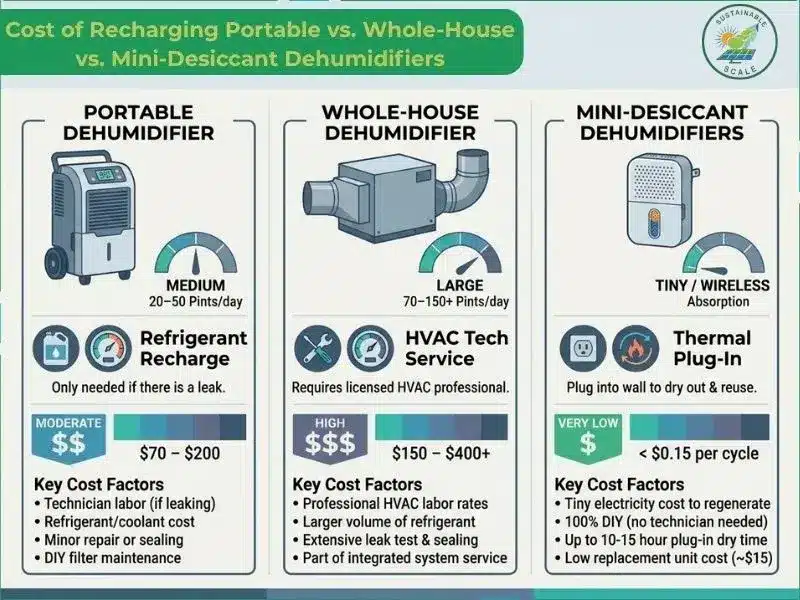
Is recharging a dehumidifier cheaper than replacing it?
Yes, recharging a dehumidifier is not cheaper than replacing it because refrigerant service costs less only when there is no refrigerant leak or sealed system damage. It often becomes uneconomical for older units and replacement is usually the more cost effective long term solution as the dehumidifier’s age increases.
Is there freon in dehumidifiers?
Yes, there is freon in dehumidifiers built before 2010 because many older units use R-22 as their standard refrigerant charge. Dehumidifiers in newer models use other refrigerants such as R-32 or R-410A, depending on the model and manufacturing date. They list the exact gas and charge weight on the rear nameplate.
How much refrigerant does a dehumidifier need?
A dehumidifier needs 3 to 10 ounces or about 85 to 280 grams of refrigerant. The exact charge varies by model size, compressor design and refrigerant type. Always check the unit’s nameplate and manufacturer specifications before adding refrigerant, as overcharging or undercharging can affect performance.
Can low refrigerant cause a dehumidifier to stop working?
Yes, low refrigerant can cause a dehumidifier to stop working by reducing the evaporator coil’s ability to condense moisture. A dehumidifier keeps drawing power and turning its fan, yet its tank stays empty after 8 hours. It causes the compressor to run continuously and triggers a thermal overload shutdown.
Can you recharge a dehumidifier yourself?
No, you cannot recharge a dehumidifier yourself because its sealed system requires specialized equipment and refrigerant-handling procedures. A dehumidifier requires recovery machines, micron gauges, brazing torches and calibrated scales for sealed system service. It also requires a Section 608 certified technician because federal law restricts refrigerant purchases.
Is refrigerant recharge safe?
Yes, refrigerant recharge is safe if a qualified technician performs the work using appropriate recovery and charging equipment. Refrigerant recharge follows manufacturer’s specifications for charge weight and applicable regulations for recovery and disposal. It prevents uncontrolled releases above 200 psi that cause frostbite and violate federal law.
Is it worth recharging a dehumidifier?
Yes, it is worth recharging a dehumidifier because fixing a refrigerant leak and restoring the charge can cost less than replacing a new one. A dehumidifier regains effective moisture removal after the leak is repaired and the refrigerant is properly recharged. It can also extend the unit’s useful service life.
When should you replace a dehumidifier?
You should replace a dehumidifier when the repair cost is high relative to the unit’s replacement cost. A dehumidifier with a failed compressor or major sealed system damage rarely justifies repair on portable models. It loses efficiency after 7 years compared with current Energy Star rated units.
Solar Panel
Air Purifier